
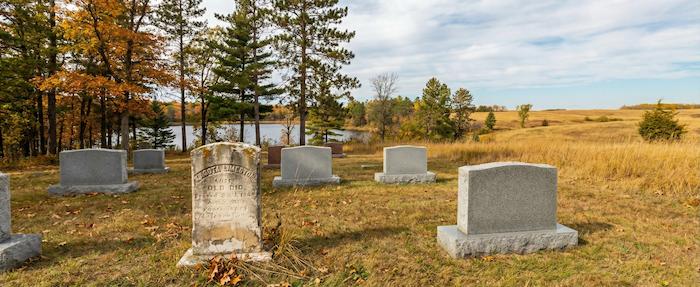
Grave Care on the River Bluffs
Saint Paul is built on limestone bluffs overlooking the Mississippi. The terrain is steep. In cemeteries like Oakland and Calvary, we fight gravity as much as the weather.
We deal with heavy monuments sliding down hillsides, local limestone markers crumbling from acid rain, and the thick black algae that grows under the canopy of ancient oak trees. Families searching for headstone cleaning services near me call us to stabilize these shifting stones and preserve the soft, historic rock before the inscriptions wear away completely.
Hillside Slope Creep
Many of Saint Paul’s oldest graves are on the steep banks of the river valley. Gravity pulls on them. Frost pushes them.
The wet ground swells in winter and shoves the stone downhill. Over time, the monument tips forward. We can't just push it back up. We have to dig a flat bench into the hillside. We install a retaining foundation of crushed rock. This locks the stone in place so gravity can't drag it down anymore.
Limestone Erosion
Early Saint Paul residents used local limestone for markers. It is soft. A century of rain and exhaust has dissolved the binder in the stone.
The surface turns to powder. The lettering fades. If you pressure wash this, you will erase the name. We use a gentle biological cleaner to remove the moss. Then, we apply a stone consolidant. This liquid soaks in and bonds the interior of the stone to keep it from dusting away.
Black Algae under the Oaks
Old cemeteries like Oakland have huge oak trees. They block the sun. That constant shade breeds a hard black algae.
It covers the stone like a layer of tar. It digs roots into the granite. We treat it with a heavy-duty biocide. It soaks in and kills the growth dead. The black crust turns grey, dries up, and the rain scrubs it off.
Sandstone Base Failure
In the late 1800s, masons often put a granite top on a sandstone base. It was cheaper. But sandstone is porous.
It absorbs ground moisture. When winter hits, that water freezes inside the block and shatters it. The granite top stays fine, but the foundation rots out from under it. We can't fix rotten stone. We jack up the monument, remove the failed base, and swap it for a granite one that will last.
Deep Frost Heave
The frost goes down 42 inches here. The bluff soil is full of clay pockets and rock ledges that freeze unevenly.
This pressure rotates monuments on their bases. We see obelisks spun around. We take the stack apart. We remove the clay and replace it with clean, crushed stone. The stone allows water to drain away. Dry ground doesn't heave, so the monument stays put.
Bronze Disease in Roselawn
Roselawn Cemetery is filled with flat bronze markers. Snow sits on them all winter.
The wet snow and road salt eat through the factory lacquer. The bronze turns green and starts to pit. We strip the old coating. We blast the metal with glass beads to remove the corrosion. Then we spray a new marine-grade clear coat to seal the metal up tight.
Service Costs in Saint Paul
Working on steep slopes requires extra crew members for safety. Restoring crumbling limestone is slow, careful work. We inspect the site conditions and the stone type before we give you a price.
- Slope Stabilization: Resetting monuments on steep hills.
- Limestone Consolidation: Hardening soft, eroding markers.
- Biocide Treatment: Removing heavy black algae from shaded stones.
- Bronze Refinishing: Restoring corroded flat markers.


