

The "Chinook" Stone Breaker
Montana weather kills masonry. It isn't just the deep cold; it is the shock. We get the Chinook winds in winter. You can go to bed at twenty below and wake up to forty degrees above zero.
That rapid heating snaps granite. The outside warms up fast while the middle stays frozen. We see headstones sheared clean in half. Repairing this takes structural work. For tombstone repair and restoration, we drill into the broken slabs and insert steel pins. We bond it with an epoxy made to handle those wild temperature swings. It keeps the stone together when the next Chinook rolls in.
Mining Soot and Smelter Fallout
In Butte and Anaconda, the copper mines left a permanent mark. The smelters ran day and night for a century. All that heavy smoke settled right into the cemeteries.
It formed a hard, metallic shell on the granite. It is full of arsenic and lead, and it is burned onto the rock face. Rain doesn't touch it. We use industrial degreasers for our headstone cleaning services. We let the cleaner soak. It breaks down that century-old carbon shell. We wash it off, and you finally see the granite that has been hidden since the mines closed.
Frost Heave in Clay Soil
The frost goes down deep here—four or five feet. When wet clay freezes, it swells up. It lifts everything in the ground. In spring, the mud thaws, and the ground drops out.
Monuments don't settle evenly. They lean hard or tip over. You can't just push them straight. We have to dig the foundation out completely. We replace that heaving clay with a deep bed of packed gravel. This drains the water away. If the ground under the footer stays dry, the frost can't throw the stone around.
High Altitude Lichen
Our air is dry and clean. Lichen loves it. Those orange and green crusts grow thick on the granite, especially up in the mountains. They dig right into the minerals.
If you scrape dry lichen, you take the polish with it. We spray it with a biological solution first. It kills the roots and softens the crust. It turns brittle and lets go of the rock. Then we scrub it off gently. This stops the acid from eating deeper into the marker.
Wildlife Damage
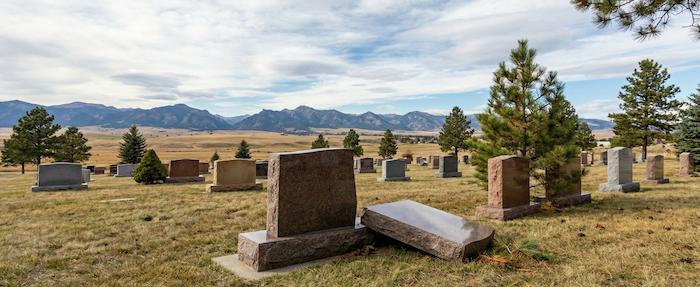
Our cemeteries are full of deer and elk. Bucks rub their antlers on the upright monuments to clean off the velvet. A big bull elk puts a lot of weight behind that rub. He can knock a 500-pound stone flat on its face.
We often find fresh chips on the corners where the antlers hit the rock. As part of our grave site cleaning services, we check every stone for wobble. If it is loose, we reset it with fresh compound. We cement that base in tight. A bull elk can lean on it all he wants; that stone isn't going anywhere.
Wind Erosion on Sandstone
Out on the eastern plains, the wind just doesn't quit. It scours the cemeteries with dirt and grit constantly. Over fifty years, that wears the stone down.
We see pioneer sandstone markers worn smooth. The lettering is barely visible. Pressure washing these is a disaster. It blows away what is left of the stone. We use soft brushes and consolidants. We clean the dirt out of the faint letters to make them stand out. We treat the stone to harden the surface and slow down the wear.
Irrigation Scale
Summers are dry, so cemeteries water constantly. Our well water is hard. It leaves heavy white calcium deposits on the dark granite.
The sun bakes it on until it looks like white paint. Chipping it off scratches the stone. We use a professional descaler for cleaning stone gravestones. It melts the calcium chemically. We wash it off, and the polish looks dark and clear again.
Pine Needles and Sap
In the western mountains, we deal with pines. They drop needles and sap. The sap turns into hard amber beads that won't wipe off.
The needles pile up around the base. They hold snow melt against the stone for months. That constant wet spot rots the bottom of the monument. We clear that debris out to let the stone breathe. For the sap, we use a solvent poultice. It softens the resin so we can wipe it away without dulling the granite finish.