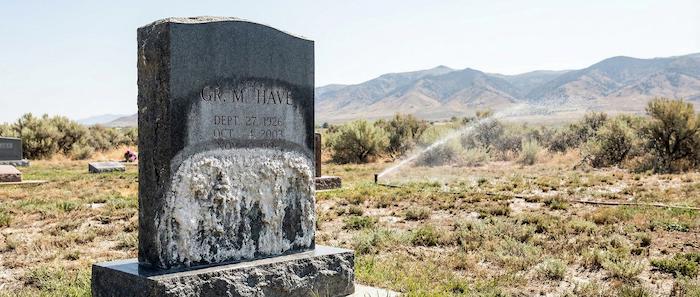
A headstone in a Magic Valley cemetery near Twin Falls can vanish under a crust of hard well-water scale within a decade; a bronze plaque in a mountain cemetery near Sun Valley corrodes from thin, intense high-altitude sun, with no irrigation involved. Tending backs every headstone cleaning appointment across Idaho's 673 cemeteries with a $2,000,000 liability policy and ICCFA membership. Which fix actually helps an Idaho headstone depends on exactly what's behind the damage.
How Idaho's High Desert and Mountain Climate Wear Down a Headstone
Southern Idaho's high desert stays dry enough that cemeteries run sprinklers through most of the growing season, and hard well water pumped through those sprinklers leaves its own mark on stone. Winter ground movement reaches every part of the state, from the Snake River Plain up into the northern panhandle, and mountain cemeteries at elevation face intense UV that the valley floor below rarely gets.
Magic Valley Irrigation Scale and Headstone Lettering Repair
Southern Idaho's Magic Valley and the rest of the Snake River Plain sit in high desert country, and cemeteries there rely on sprinklers running through most of the growing season just to keep grass alive. The groundwater feeding those sprinklers carries a heavy load of dissolved calcium, and the water flashes off a sun-heated headstone almost the moment it lands, leaving the mineral behind on the surface. Cemetery sections irrigated by overhead spray build the thickest scale, since spray water lands directly on the stone face with every cycle. A thin residue after one summer barely shows. Years of buildup turn it into a hard, pale crust thick enough to bury an inscription. A wire brush cuts through the crust easily enough. It also scratches straight through the granite's polish at the same time, leaving permanent marks that a later treatment can rarely fix. An acidic cleaner made for calcium deposits dissolves the crust chemically, without the scratching a wire brush would cause, and headstone lettering repair repaints whatever letter the scale had been hiding once the stone underneath is clean and legible again. Markers on the sunniest side of a family plot usually need this treatment again within five or six years, since faster evaporation there means faster mineral buildup too.
Idaho Deep Frost Heave and Headstone Repair
Idaho's ground freezes deep most winters, and the water trapped in wet soil expands as it turns to ice, pushing upward against anything sitting on top of it. A heavy monument gets shoved up along with the frozen ground beneath it, and when the spring thaw finally arrives, the stone drops back down but rarely lands exactly where it started. Flat markers set close to ground level heave up out of their sockets, catching the blades of cemetery mowers until someone notices and calls it in. Upright stones tip more gradually, leaning a little further with each winter's freeze-thaw cycle until the tilt becomes obvious even from a distance. Cemeteries on clay-heavy ground see the worst of it, since clay soaks up and holds a large volume of water each time it rains, all of which expands the moment it freezes. Gravel drains fast enough that it never holds the water a frozen ground needs to heave in the first place, so headstone repair rebuilds a monument's foundation on a deep bed of it — excavating past the unstable native soil, packing in crushed gravel, and resetting the stone level on a base that won't trap water through the next winter.
Sawtooth Elevation UV and Bronze Marker Restoration
Mountain cemeteries around Sun Valley and the Sawtooth range sit thousands of feet above Idaho's valley floor, where thin air lets through an unusually large share of the sun's ultraviolet radiation. Ultraviolet exposure at this elevation breaks down the clear-coat sealant on a bronze plaque within just a few years. Once the seal fails, the bare patina underneath starts picking up windblown dust and mountain moisture with no protective layer left to stop either one. Corrosion spots show up first on the shadiest side of a plaque, since that side stays damp longest after each snowmelt. Plaques mounted flat into a granite base see this worst of all, since meltwater has nowhere to run off and simply sits on the metal until it evaporates. The crew strips the failed coating down to bare metal, and bronze marker restoration finishes with a UV-rated finish suited to Sawtooth-country sun, due for another check within a few years.