A headstone in a Willamette Valley cemetery can tip sideways as Himalayan blackberry roots grow directly under its base; a bronze veteran's plaque on the Oregon coast corrodes green from salt-laden fog instead, with no blackberry anywhere nearby. From the Willamette Valley to the high desert, a Tending headstone cleaning visit to any of Oregon's 1,063 cemeteries comes with the same $2,000,000 liability policy and ICCFA membership. Which fix actually helps an Oregon headstone depends on what's really behind the damage.
How Oregon's Wet Valleys and Dry Plateaus Shape Headstone Care
Himalayan blackberry roots work underneath monuments across the wet Willamette Valley, prying bases out of level as the canes spread. Eastern Oregon's high desert leaves its own mineral scale over engraved letters, and salt fog along the coast reaches bronze markers on its own.
Willamette Valley Blackberry Roots and Headstone Repair
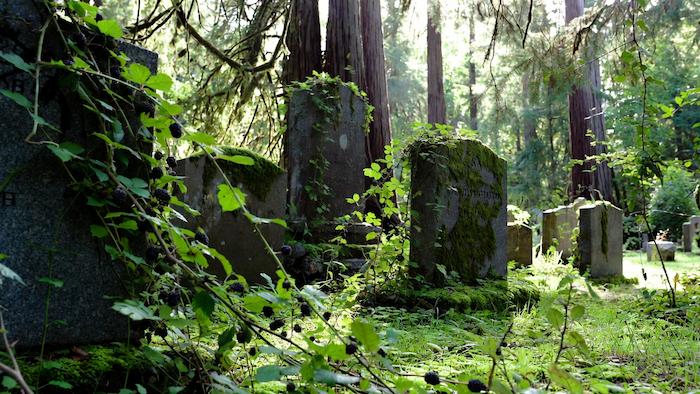
Himalayan blackberry is the single most widespread noxious weed in western Oregon, and the Willamette Valley's mild, wet climate gives it exactly the conditions it needs to spread unchecked through an untended cemetery section. A cane that touches the ground roots on contact, and a single plant can send new canes out in every direction until an entire family plot disappears under a thicket. Roots seeking out any gap around a monument's base work their way directly underneath it, and a root thick enough eventually pries the base up and out of level as it keeps growing. Cutting the visible canes back only helps for a season, since the root system underneath keeps sending up new growth from the same crown. A single Himalayan blackberry crown can send canes out ten feet or more in a single growing season, so a plant that starts a row away can reach a monument within just a couple of summers. Winter in the valley also turns the ground itself soft and unstable, since heavy Willamette Valley soil holds standing water for weeks after the rain finally lets up, and a monument can sink straight down into ground that's lost this much structure. Tending digs out the entire root ball around a monument's base and resets it on a compacted gravel pad that gives the roots nowhere new to grip. Headstone repair on saturated valley ground follows the same excavate-and-rebuild approach, since a heavy monument needs a stable footing no matter which problem put it out of level in the first place.
Eastern Oregon High Desert Hard Water and Headstone Lettering Repair
Eastern Oregon's high desert stays dry most of the year, and cemeteries out there run sprinklers through most of the growing season just to keep any grass alive at all. The groundwater feeding those sprinklers carries a heavy mineral load, and the water flashes off a sun-warmed headstone almost as soon as it lands, leaving calcium behind on the surface. Years of this buildup turn into a hard, pale scale thick enough to bridge across an engraved letter and hide it from view. Markers on the sunniest side of a family plot usually build scale fastest, since faster evaporation there leaves mineral behind more often over the course of a season. Chipping at the scale with a blade or wire brush cuts into the granite's polish just as easily as it cuts into the mineral crust. A buffered acid solution dissolves the calcium bond chemically without any abrasive contact, and headstone lettering repair repaints whatever letter the scale had been hiding once the surface underneath is fully clean.
Oregon Coast Salt Fog and Bronze Marker Restoration
Oregon's coast stays wrapped in salt-laden marine fog for much of the year, keeping bronze and granite markers damp almost constantly. Salt in the fog settles onto every exposed surface, and the constant dampness keeps the salt actively working on a bronze plaque's clear coat around the clock. Chlorides react directly with the copper in the alloy, and a coastal plaque can develop a chalky green cast within just a few foggy seasons. Towns like Astoria and Newport see fog roll in off the Pacific on most mornings even in summer, so a plaque there rarely gets a real dry stretch to slow the reaction down. Salt also works into the joint between a plaque and its granite backing, breaking down the mortar holding it in place over time. A chloride-neutralizing rinse stops the corrosion before it eats any deeper into the metal, and bronze marker restoration reseals the surface afterward with a marine-grade finish made to hold up against sustained coastal fog.