
Lehigh Valley Kiln Dust on Headstones
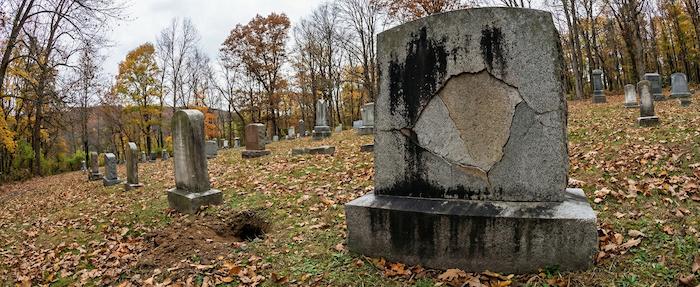
Allentown's cement plants ran for the better part of a century, and the kiln dust they threw into the air still hasn't fully settled. It drifted across cemeteries throughout the Lehigh Valley -- Fairview and Greenwood took a heavy share of it -- and every rainstorm turned that fine gray powder into a thin skin of hardened lime on the stone below. On older granite and marble markers, that skin doesn't rinse off with a hose; it bonds to the surface like a scab that keeps thickening with each wet season.
Families searching for headstone cleaning services near me in Allentown are usually looking at a marker that has gone flat and gray, with dates and names buried under that crust and not simply covered in surface dirt. Our technicians use a chelating-agent solution built to dissolve cured lime and cement binder, working slowly enough that the polish underneath stays intact while the lettering gradually re-emerges. Tending carries a $2,000,000 liability policy and holds membership with ICCFA, the trade association that sets the standard for cemetery and funeral service work.
Karst Bedrock Sinkholes Swallowing Grave Markers
Much of the ground under Allentown is karst limestone, a bedrock riddled with underground voids that can open into sinkholes with almost no warning. Cemetery soil settles unevenly over these hollows, and a marker that stood level for decades can drop six inches in a single wet spring. We've reset bases tilted so steep that the inscription faced straight down into the dirt.
A sinking stone is a foundation problem, not a cleaning one, and no amount of surface work corrects it. Tending's headstone repair and restoration crews excavate the unstable soil and pack a compacted gravel base below frost depth. Then they reset the marker so it stops chasing the sinkhole downward. On older double bases we also check whether the two halves have sheared apart from the uneven drop, since that kind of gravestone restoration work needs the full assembly releveled together, not just the top stone reset on its own.
South Mountain Slate Delaminating on Monuments
Slate markers turn up across older Lehigh Valley cemeteries, cut thin and layered the way roofing slate is, and quarried in part from the ridges around South Mountain. Water works into those layers, and a Pennsylvania winter freezes and thaws it a dozen times or more in a single season. Each cycle wedges the layers a little further apart until the face of the stone starts to separate the way pages of a soaked book do.

Once a slate marker starts delaminating, the carved lettering usually goes with the outer layer, so names and dates fade or disappear along with the flaking stone. Tending's headstone lettering repair work re-establishes readable dates and names where the shallow slate carving is still legible beneath the loose layer, paired with a breathable cap set along the top edge to keep new rainwater from working further between the sheets. It won't reverse years of splitting, but it slows the process enough that a gravestone cleaning services near me search doesn't turn into a full replacement quote a few years later.
Little Lehigh Humidity Lichen on Markers
The Little Lehigh and Jordan Creek keep the air across several Allentown cemeteries damp for a good part of the year, and that moisture is exactly what red lichen and black algae need to take hold. Sandstone and limestone markers at Union & West End, and shaded rows at Highland, pick up a stubborn reddish-orange crust that spreads over months. Left alone, the lichen's root structure works into the stone's pores and pits the surface as it grows.
"I had three cemeteries reviewed and memorials restored and/or cleaned. Service was fast and efficient. Memorials quickly located. I look forward to a visit shortly and quarterly update. Thanks, this has been on my mind for some time."
— Edward Drosdick, Pennsylvania
The same damp air that feeds lichen on stone also corrodes nearby bronze plaques and nameplates, leaving a dull green patina and, over time, pitted lettering. Tending treats the biological growth with a quaternary ammonium biocide that kills the lichen's root system, not just the surface color, so it doesn't return within a season, and offers bronze marker restoration for plaques affected by that same humidity. Most families schedule both in one visit, since the underlying cause -- air that never fully dries out between the creek and the tree cover -- is identical.
Service Costs in Allentown
Every price comes from our online calculator before any work begins: you choose the memorial type and the care plan, and that combination sets a fixed price at checkout. That covers routine cleaning as well as the heavier monument restoration services described above, including cement crust removal and foundation leveling for sunken markers. Visit our online pricing calculator to see exact costs for the services below.

- Cement Crust Removal: Dissolving cured kiln-dust binder from granite and marble without abrasion.
- Foundation Leveling: Excavating unstable karst soil and resetting sunken markers on a compacted base.
- Slate Stabilization: Cleaning and capping delaminating slate markers to slow further splitting.
- Lichen/Algae Removal: Quaternary ammonium biocide treatment that kills growth down to its root system and lifts the stain.