
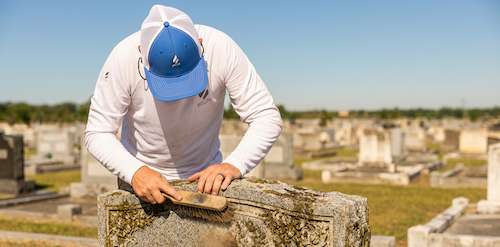
Cemetery ground in Alaska moves more than in most states. That movement drives most of the headstone repair calls Tending gets here. Fine glacial silt in valleys like the Matanuska-Susitna and the Tanana holds water differently than sand or clay. Repeated seasonal freezing works on that difference year after year. Our breakdown of how professional headstone restoration works covers the assessment-to-sealing process in full. Tending's crews carry $2,000,000 in liability coverage on every visit and belong to the ICCFA.
Frost Heave in Glacial Silt
Fine-grained, frost-susceptible soil is common under Alaska cemeteries. That kind of soil forms ice lenses as it freezes, not a uniform hard crust. Those ice lenses lift a footing unevenly through the winter. The footing settles back down once the ground thaws in spring. A monument that goes through this cycle for several winters typically ends up leaning rather than sinking straight down. This isn't the same process as permafrost thaw, which involves deeper, older ice. It's ordinary seasonal freeze-thaw settlement, acting on soil that's unusually prone to it. Tending excavates below the active freeze layer and rebuilds the footing on more stable ground.
Monument Joint Seal Failure
Two-piece monuments in Alaska are set the same way they are everywhere else. The die rests on the base by its own weight. A flexible sealant packed into the joint keeps moisture out; it isn't structural. Alaska's wide swing between summer heat and deep winter cold works that sealant harder than a milder climate would. Eventually the bead cracks or pulls away from one side. Once the seal fails, moisture gets into the joint. The freeze-thaw cycle that follows can rock the top piece loose from the base underneath it. A loose die on a monument that size puts anyone nearby at real risk, not just a cosmetic problem. Tending cuts out the failed sealant, cleans both mating surfaces, and repacks the joint with a sealant built for that temperature range.
Backfill Settling Under Flat Markers
Flat bronze and granite markers sink for a more ordinary reason than winter weather. The soil used to backfill a grave shaft keeps compacting for years after burial. Turf also grows up around the edges faster than most families expect. Add Alaska's own freeze-thaw cycle on top of that settling. A flat marker can end up an inch or more below grade within a decade. Cemetery mower blades catch the buried edge and chip the polished granite or bend the bronze frame. Statewide, this is the single most common repair request Tending's crews get for flat-marker sections. Tending lifts the marker, rebuilds the bed underneath with compacted base material, and resets it flush with the surrounding grade.
Black Spruce and Birch Root Intrusion
Black spruce and paper birch are the two trees most likely to border an older Alaska cemetery section. Both root shallow and wide rather than deep, an adaptation to soil that stays cold and wet most of the year. A root running under a stacked monument grows thicker every summer. That steady growth eventually wedges apart the joint between base and die. Sections shaded by mature spruce or birch see this kind of separation far more often than open, unshaded rows. Before any structural repair begins, Tending's technicians confirm the cemetery's own approval for the work. Most Alaska cemeteries require sign-off on anything beyond routine cleaning. Tending removes the intruding root, rebuilds the joint, and resets the stone once the ground underneath is stable.
Headstone Repair Costs in Alaska
A fixed price for headstone repair in Alaska comes from the online pricing tool. It's based on the type of damage and how far it's spread, not on which region of the state the cemetery sits in. That price is set before the crew is ever scheduled. A technician still visits the site to do the actual work. If the ground movement or root damage runs deeper than the photos showed, that extra scope gets quoted separately and confirmed with the family first. It's never billed as a surprise afterward. Once the repair is finished, photos of the reset monument go up on the Tending app. From there, the family can see the result without a trip to the cemetery.
- Frost heave footing rebuild: footing excavated below the active freeze layer and reset.
- Joint seal repair: failed sealant removed and the joint repacked.
- Flat marker resetting: bed rebuilt and the marker reset flush with grade.
- Root intrusion repair: intruding root removed and the joint rebuilt.
How Our Headstone Repair Process Works
- Technical Assessment A technician checks the monument's geometry, the stability of its footing, and the condition of the soil underneath before deciding on a repair plan. A lean of only a couple degrees can already mean hidden stress cracks that haven't reached the surface yet.
- Foundation and Base Repair Any cracked, waterlogged, or heaved section of the footing is exposed and cleared out, and cemetery approval for the structural work is confirmed before excavation starts.
- Raising and Bracing the Monument Rigging matched to the monument's weight lifts it clear of the damaged base, and each piece is marked and set aside safely if full disassembly turns out to be necessary.
- Rebuilding Cracked or Chipped Stone Structural cracks and chips get stabilized with a color-matched compound, which stops further deterioration rather than just covering the damage cosmetically.
- Sealing the Repair and Uploading Photos A breathable sealant protects the finished repair, and photos go up on the Tending app once the monument is reset and level.
