
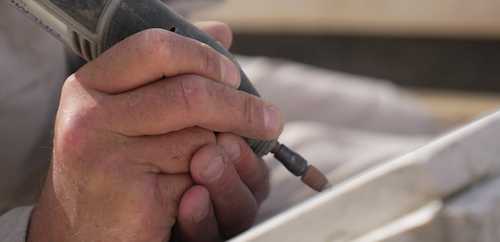
Carved headstone lettering in Alaska takes damage from opposite ends of the calendar. Deep winter freeze-thaw cycling does most of the work in the Interior. The state's unusually long summer daylight hours add a slower kind of wear that most other states never see at the same scale. Our guide to how headstone lettering repair actually works walks through the process Tending's crews follow statewide. It's the same process used for headstone lettering restoration in any region of the state. Every lettering repair job here is backed by Tending's $2,000,000 liability policy and its membership in the ICCFA.
Freeze-Thaw Paint Ejection
Meltwater collects inside a carved letter groove during the day. It freezes solid once temperatures drop, a routine event across most of Alaska for half the year. Ice takes up more volume than the water that formed it. That expansion physically pushes rigid enamel paint out of the groove from underneath. A single freeze rarely does visible damage on its own. It's the accumulation of one freeze after another, repeated across an entire winter and then another, that eventually shows up as flaking and bare stone. Grooves that face north and stay shaded longer tend to hold moisture the longest between thaws. Tending clears any loosened paint and confirms the groove is fully dry before repainting.
Extended Summer UV and Enamel Embrittlement
Alaska's summer days run far longer than almost anywhere else in the country. That extra daily sun exposure adds up over a season even at this high latitude. Prolonged UV exposure oxidizes the binder inside painted lettering. The enamel gradually turns brittle and starts to crack along the edges of each letter, rather than failing all at once. Lettering repair in sections with little tree cover tends to be needed sooner than in shaded plots nearby. Tending strips the embrittled paint completely before applying a fresh, UV-resistant coat.
Windblown Glacial Silt in Carved Grooves
Fine windblown silt from Alaska's glacial river valleys settles into carved letter grooves, the same way it settles onto exposed bronze. It packs in tighter with every wetting and drying cycle. That packed grit holds moisture against fresh paint. It can lift a new coat away from the stone underneath before the coat has had a chance to fully cure. Grooves in valley cemeteries well away from any glacial river rarely build up this kind of residue. Tending digs the packed silt out completely before any new enamel goes in.
Lichen and Moss Growth in Letter Grooves
Alaska's cool, damp climate supports heavy lichen and moss growth on stone. A carved letter groove holds moisture longer than the smooth face of the monument around it. That makes it a favored spot for growth to take hold. Lichen in particular can etch the stone surface slightly as it grows. On top of that, it simply covers the lettering and holds dampness underneath any existing paint. Older, weathered stone tends to see this more often than recently repainted lettering. Tending clears the growth and treats the surface before repainting.
Headstone Lettering Repair Costs in Alaska
Pricing for headstone lettering repair in Alaska is based on character count and carving depth. That figure comes from photos submitted through the online pricing tool, not from the size of the monument itself. The price is fixed before a crew is ever scheduled. A technician still confirms the groove condition on-site as part of the visit. If the damage turns out more extensive than the photos suggested, that additional work is quoted separately and approved by the family first. Photos of the finished repaint go up on the Tending app once the crew wraps up, so the family can see the result.
- Freeze-thaw repaint: loosened paint cleared, groove dried, and repainted.
- UV embrittlement treatment: brittle paint stripped and recoated.
- Silt removal treatment: packed grit cleared before repainting.
- Lichen and moss treatment: growth cleared and the surface treated before repainting.
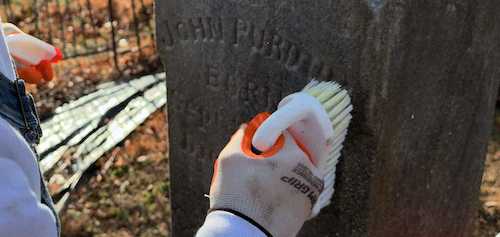
How Our Headstone Lettering Repair Process Works
- Groove Clearance Old paint, packed silt, or lichen growth, whatever is currently in the groove, gets worked out by hand down to bare, clean stone.
- Rinsing the Groove Clean A solvent wash removes any remaining residue or oils from the groove so the new enamel can bond directly to the stone.
- Confirming Full Dryness The groove is force-dried rather than left to air out on its own, since trapped moisture under fresh paint is one of the most common reasons a repaint fails early.
- Packing In the Enamel Weather-rated enamel is packed into the dry groove, shaped to match the depth and profile of the original carving.
- Polishing and Photo Report The surrounding stone is polished clean of excess paint, and finished photos are uploaded to the Tending app for the family's records.
