
Salt Marsh Groundwater and Headstone Lettering
East Haven's shoreline runs along tidal salt marshes fed by the Quinnipiac and Farm Rivers, and the water table under low-lying cemetery ground here sits closer to salty tidal water than it does in towns set back from the marsh. That saline groundwater wicks upward into a monument's base all year long, storm or no storm, and it leaves behind a crusty white efflorescence as it evaporates from the stone's surface. Left untreated, that salt crust works its way into carved letters over a few seasons and dulls the contrast a name needs to be read clearly from any distance. People searching for headstone cleaning services near me around East Haven often describe that exact chalky buildup along the lower few inches of a stone. Tending carries a $2,000,000 liability policy on every job, and its technicians work under the standards set by ICCFA, the industry's leading cemetery and funeral association.
Clearing salt efflorescence takes a different approach than ordinary mineral crust, since the deposit is water-soluble chloride, not bonded calcium. A controlled rinse combined with a chelating agent draws the salt out fully. Dissolving only the surface layer leaves plenty behind to wick back up within weeks. Where lettering has already lost its depth from repeated salt cycling, gravestone lettering repair restores what the paint fill has lost.
Storm Surge History and Monument Resetting
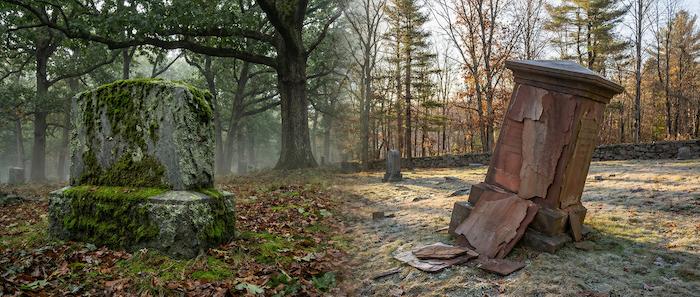
Connecticut's shoreline has taken direct hits from major storms before, the 1938 hurricane chief among them, and East Haven's low-lying ground near the marsh floods more readily than the higher inland sections of town. A flood event saturates cemetery soil completely, and once that water recedes, the ground beneath a monument settles unevenly as it dries. A footing that was level before a major storm can end up leaning afterward with no other visible cause. The fix means lifting the affected stone clear of the ground, packing fresh gravel underneath for real drainage, and setting the monument level once more — work our headstone restoration services team handles start to finish. Our guide to resetting and leveling headstones walks through that process for anyone curious how it runs.

Marsh-Adjacent Humidity on Bronze Markers
Marsh air carries more sustained dampness through the summer than drier inland ground. Near East Lawn and Green Lawn Cemetery, that humidity often lingers straight through a sunny afternoon. Marble and limestone under any tree cover pick up algae fast under those conditions, and a biocide treatment is what clears it without touching the stone's own finish. Bronze plaques near the marsh corrode at a similar accelerated pace, developing a mottled patina years ahead of markers set on higher, drier ground, so bronze grave marker cleaning strips that buildup and reseals the surface.
Sandy Coastal Soil Erosion Around Footings
Much of the ground near East Haven's shoreline is sandy and loosely packed compared to the denser soils farther inland, and ordinary rain runoff gradually washes fine particles away from around an exposed footing, a little at a time over years. As that support erodes, a monument that once sat solidly can develop a wobble long before it tips over outright. Tending addresses it by excavating the loosened area, packing in fresh compacted fill, and re-anchoring the base, so the same slow erosion doesn't undo the work again within a season or two.
Service Costs in East Haven
Our online calculator takes a monument type and a care plan and turns them into a single fixed number, well before any visit is scheduled. Plots closest to the marsh and shoreline get the most value from a standing plan, given how much faster salt efflorescence and erosion return there than on higher, drier ground.
"Very tricky to navigate the link but they did a fantastic job! I’m very pleased with the work they did it looks brand new"
— Lisa Stine, Groton, Connecticut

- Salt crust removal: chelating treatment for chloride efflorescence and lettering restoration.
- Monument resetting: footing rebuild on compacted gravel for storm-related soil settling.
- Biological growth and bronze cleaning: biocide treatment plus tarnish removal for marsh-adjacent plots.
- Footing stabilization: excavation and re-anchoring for sandy soil erosion.