
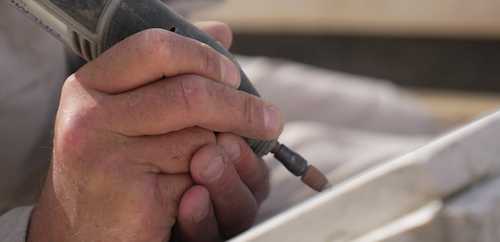
A carved name holds its color only as long as the enamel inside the groove stays bonded to the stone, and in Georgia that bond gives out for a handful of specific reasons — spring pollen, summer ozone, insect nests, or mineral-heavy irrigation water. Headstone lettering repair addresses whichever one of those actually caused the fading, not a generic touch-up. Tending clears the failed enamel and repaints to the letter's original depth statewide, carrying $2,000,000 in liability coverage and ICCFA membership.
Spring Pollen Baked Into the Groove
Georgia's pine pollen season blankets cemetery ground in a fine yellow layer every spring, thick enough that it's a recognizable seasonal event across the state rather than a minor nuisance. Once that pollen settles into a carved letter and gets wet from morning dew, direct sun bakes it into a dense crust that pulls at the enamel underneath as it hardens and contracts. A letter that looked intact in March can show bare patches by early summer once that crust finally works loose and takes flecks of paint with it. Clearing the hardened pollen residue before repainting matters more here than the paint itself, since fresh enamel applied over leftover crust fails again within a season.
Ground-Level Ozone Breaking Down the Binder
Metro Atlanta and the surrounding corridor logged decades of elevated summer ozone before federal regulators redesignated the region to attainment status in 2022, and that history left plenty of older lettering with binder damage that's still visible today. Ozone breaks down the polymer chains holding pigment together in standard outdoor paint, a documented degradation process in materials science that leaves the enamel chalky and brittle rather than smooth. Once that binder has broken down, the pigment sheds as fine dust with the next hard rain, and what's left in the groove is usually too far gone to simply repaint over. Where the same monument carries a leaning base or cracked joint, that structural movement is a separate problem addressed under headstone repair and monument restoration rather than this service.
Mud Dauber Nests in the Carved Lines
Mud dauber wasps build nests by packing wet clay into any sheltered gap they can find, and a carved letter with worn paint offers exactly that kind of cavity. The mud dries hard in the Georgia sun, and prying it back out without lifting sound enamel around it takes more patience than force. Left in place through another season, the drying and re-wetting cycle as rain gets behind the mud plug works the same way pollen crust does, pulling paint loose at the edges even where the letter itself never lost color to fading. Older sections of a cemetery tend to collect the most nests simply because the wasps favor the same sheltered letters year after year, returning to a groove that already worked once.
Mineral Buildup From Reclaimed Irrigation Water
Some Georgia cemeteries irrigate with reclaimed water rather than a plain municipal supply, and that water carries a heavier mineral load that leaves a scale-like film behind faster than ordinary rainfall would. Once that film settles into an already-thinning coat of enamel, it can obscure a date or name well before the paint itself has actually failed underneath. A degreasing pass ahead of any repaint clears that mineral residue so the fresh enamel bonds to clean stone rather than sealing the buildup in. Markers close to a sprinkler head tend to show this pattern first, while stones just a few rows away, outside the spray radius, can go years without the same film forming.
Headstone Lettering Repair Costs in Georgia
Two numbers set the price: how many characters are in the inscription, and how deep the original grooves were cut. Neither the stone's location in Georgia nor which of the four causes above is behind the fading changes that calculation. Photos of the existing lettering, entered into the calculator, are almost always enough to generate a fixed number without anyone walking the cemetery first. Once the repaint is finished, a close-up photo report goes into the Tending app so the family can see the result without visiting in person.
How Our Headstone Lettering Repair Process Works
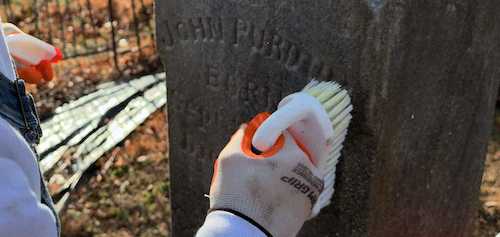
- Groove Clearing Hardened pollen crust, mud dauber residue, or mineral film gets cleared from the carved lines by hand, one letter at a time, without disturbing enamel that's still sound.
- Chemical Extraction A solvent pass dissolves whatever's left behind in the groove, leaving bare stone the new enamel can actually bond to instead of sitting over old residue.
- Moisture Removal The channel is force-dried rather than left to air-dry, since Georgia humidity keeps a damp groove wet longer than the schedule allows and painting over trapped moisture is the most common reason a repaint fails early.
- Repainting the Groove Industrial monument enamel goes into the dry channel, matched to the letter's original depth and style rather than a generic thickness.
- Surface Cleanup and Photo Log A final pass buffs any overflow off the stone around each letter, and the crew photographs the finished inscription and uploads it to Tending's app before moving on.
