
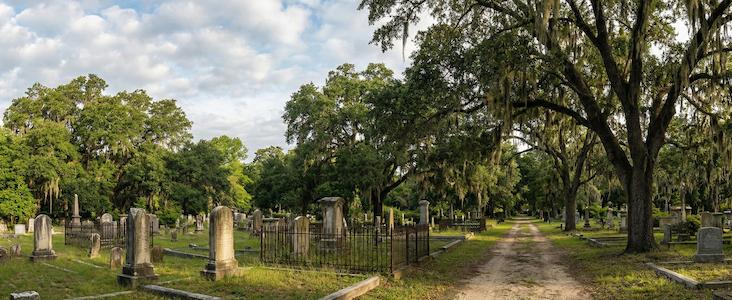
Pine sap hardens across headstones in south Georgia's pine flatwoods, and salt-laden coastal air leaves a different residue on markers out on St. Simons Island. Across all 15,536 of Georgia's cemeteries, a Tending headstone cleaning appointment comes with the same $2,000,000 liability policy and ICCFA membership attached. What actually gets a marker clean in one part of the state can do real damage to a marker somewhere else.
How Georgia's Climate and Landscape Shape Headstone Care
Humidity sits heavy over Georgia's southern lowlands for most of the year, and pine forests further north drop sap and grit onto flat markers below. Georgia's coast carries its own historical layer: cemetery walls and vault enclosures built from a shell-and-lime material that has already spent three centuries absorbing salt air.
South Georgia Humidity and Headstone Lettering Repair
South Georgia's low, humid lowlands, including the country around the Okefenokee, hold enough moisture through most of the year that algae and lichen colonize bare stone within a single season. Fine threadlike growth works into the surface as the colony spreads, and the acids it releases wear at the factory polish from underneath. A family usually doesn't spot the discoloration until the organism has already been established for months, long after a quick wipe would have made any difference. High-pressure washing clears the growth fast. It also chips paint loose from carved letters in the process, so crews rely on a biocide soak near any inscription instead. Cemeteries near tidal marshland see the fastest regrowth, since the ground rarely fully dries out even between storms, and a single annual treatment often isn't enough there. The biocide soaks into the pores the organism occupies and breaks the growth down at the root, so a surface wipe alone can't bring it back within the same season. A gentle rinse a few days later clears the dead material away without disturbing the stone underneath. Painted letters exposed to the same humid air blister and lift in a similar pattern, and headstone lettering repair resets the enamel once the growth around it is gone.
Piney Woods Sap and Bronze Marker Restoration
Pine trees dominate Georgia's forest cover, and the resin they shed lands directly on flat markers positioned underneath them. Direct sun bakes the resin into a hard, dark glaze within days, and airborne grit sticks to the surface while it's still tacky. Loblolly and slash pine, the two species planted most heavily across Georgia's timberland, both drop resin at roughly the same rate, so a marker's exposure depends mainly on which species happens to shade a given plot. A metal scraper cuts through granite polish trying to remove the hardened lump, leaving a scratch that collects dirt for years afterward. Bronze plaques nearby face identical buildup. A metal blade marks the softer alloy immediately, on the very first pass. A solvent made for hardened tree resin breaks the sap down chemically; technicians wipe the loosened residue away once it turns liquid again. The same solvent works on bronze plaques too, since a scraper mark in bare copper alloy stays visible long after the surface gets refinished. Bronze marker restoration skips the blade and goes straight to solvent.
Golden Isles Salt Spalling and Headstone Restoration
Georgia's Golden Isles and the rest of the coast take a steady load of wind-driven saltwater, and the porous stone and masonry common in the region's oldest cemeteries soak up the spray every time a storm rolls through. Some of the coast's oldest cemetery walls and vault enclosures were built from tabby. Builders mixed lime, sand, and crushed oyster shell into a wet paste and poured it directly into wooden molds. The technique spread up and down the Georgia coast from the colonial period into the 1800s. Surviving tabby structures from that era still stand at Wormsloe Plantation near Savannah and on Sapelo Island further south, proof of how long the material holds up once it's kept away from direct salt spray. The shell-and-lime matrix is naturally porous, and storm-driven saltwater works into it and crystallizes as the surface dries. Repeated cycles of wetting and drying force salt crystals to grow inside the pores, and the pressure eventually pops flakes of surface material away. Masonry conservators call this failure pattern spalling. Each new layer underneath a wall or vault opens up just as porous as the one before it, once spalling starts. Cleaning a spalling surface with anything abrasive speeds up the damage. A mild desalination poultice draws the trapped salt out through the pores, leaving the fragile surface undisturbed. Headstone restoration uses a similar salt-aware method to stabilize granite and masonry foundations along the coast, since a standard mortar repair packed with ordinary cement traps moisture behind it and starts the wetting-and-drying cycle over again.