
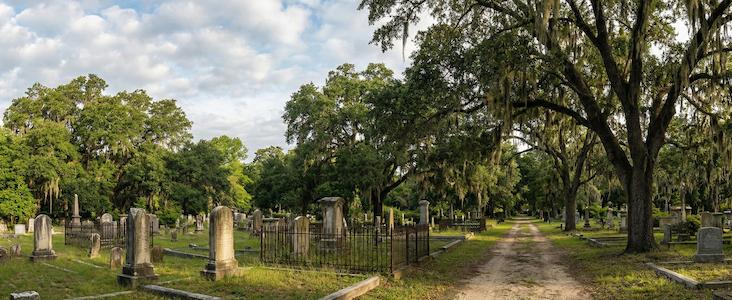
Piedmont Soil Depth Tilts Headstones
Gwinnett County's upland terrain follows a pattern typical of the Georgia Piedmont: topsoil runs thin over hills and steep slopes, sometimes just a few feet before hitting bedrock, while the same soil layer runs far deeper in low ground near Suwanee Creek and its tributaries. A single cemetery spanning both a hilltop and a nearby low spot can have headstone foundations resting on dramatically different amounts of soil, even though the plots themselves sit only a short distance apart. This variation is easy to overlook since nothing about the surface hints at how deep the bedrock actually sits below any given plot.

A headstone base on shallow hilltop soil settles very little once it's set, since it's close to solid rock, but a base on the deeper soil near a creek bottom has much more material to compact and shift over time. That mismatch means two markers placed the same year in the same cemetery can end up leaning at completely different rates. The difference has nothing to do with the quality of the original installation and everything to do with what's underneath. Headstone cleaning services near me searches from Suwanee families sometimes come after noticing that a low-ground stone has drifted while a nearby hilltop marker has stayed perfectly level. Tending checks a plot's position on the terrain before resetting an affected base, since shallow and deep soil need very different footing depths. Anything beyond a standard reset falls under headstone repair and restoration. A $2,000,000 liability policy covers Tending's work in every Suwanee cemetery, and its ICCFA membership is the kind of credential that is easy to look up and confirm.
"Great service. Cleaned my great grandfathers memorial that was in sad shape. Couldn’t be happier with the work."
— Michael Arnold, Georgia
Graphite Bedrock Corrodes Bronze Markers
Geological surveys of the Suwanee area have documented graphite-bearing phyllonite in the local bedrock, rock containing enough natural graphite that it's created real corrosion problems for buried metal infrastructure in the region, with untreated pipes needing early replacement in areas with this same rock type. Graphite acts as an unusually effective conductor next to metal, and where bronze sits in soil influenced by this graphitic rock, it can corrode measurably faster than it would in ordinary Georgia clay. This is a documented engineering concern in the area, backed by real infrastructure records.
Bronze veterans' plaques set into ground near graphite-bearing bedrock develop a heavier, more pitted patina than comparable plaques elsewhere in the same cemetery. Tending treats graphite-accelerated corrosion with a technique suited to this specific electrochemical process, and cleans and restores bronze grave markers affected by the same bedrock chemistry on the same visit.
Piedmont Moisture Fades Monument Carvings
Piedmont soil around Suwanee holds spring rain close to the surface, and marble monuments pull that moisture in more than granite ones do. Once the dry stretch of late summer arrives, the stone gives that water back up, and the swelling-then-shrinking cycle gradually wears down engraved detail. A marble inscription from a century ago often needs a close look to read at all, while a granite piece nearby from the same era still stands out clearly.
Tending recuts and repaints marble lettering worn soft by that cycle, following headstone lettering restoration standards suited to Suwanee's mix of marble and granite monuments. Suwanee's stretch of the Piedmont sees soil depth change block by block, and older surveys of the area rarely recorded exactly where the shallow, rocky patches start.

Service Costs in Suwanee
Pricing runs through Tending's online calculator once the monument type and care plan are selected, with no in-person visit required to assess the damage first. A maintenance plan can be added for markers affected by variable soil settling, graphite-accelerated corrosion, or seasonal wet-dry wear, since each of these tends to persist across many years.
- Base resetting and stabilization: correcting settlement from variable Piedmont soil depth.
- Corrosion treatment for bronze: technique matched to graphite-bearing bedrock chemistry.
- Lettering restoration: recutting engraving worn by seasonal wet-dry cycling.