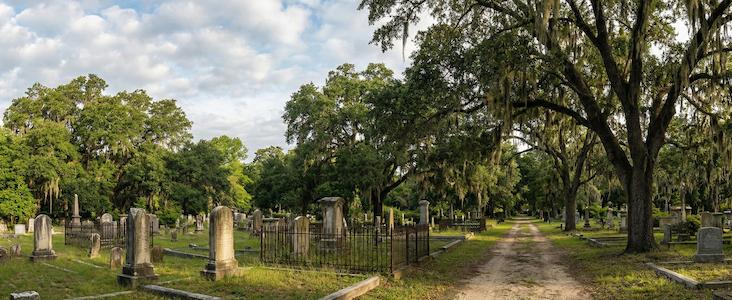
A Duluth family searching for headstone cleaning services near me usually notices one of two things: a rust-orange stain creeping up a monument's base, or a stone gone dark green despite regular rinsing. The Chattahoochee River, which runs along Duluth's western edge, takes its name from a Muscogee word meaning roughly 'red river,' a nod to the same red Piedmont clay that colors the water and the ground here. That clay shows up on local stone in more than one way, and the two problems rarely need the same fix. A stone showing one almost never shows the other at the same time, which is usually the first thing we check before recommending any treatment.
Chattahoochee Red Clay Stains Bases
Runoff carrying fine red clay particles washes toward the Chattahoochee from higher ground all over Gwinnett County, and low-lying cemetery plots along its path pick up a rust-colored film each time heavy rain moves that sediment toward lower ground and settles it firmly against exposed granite bases. Unlike a mineral stain from groundwater, this kind of discoloration sits mostly on the surface, though it deepens with every storm that isn't cleaned up afterward, especially on bases set closest to the low ground. Plots on higher terrain nearby rarely see the same buildup.
A mild acid-free cleaner lifts this surface staining without touching the granite underneath, part of the same headstone repair visit families schedule for the season. On monuments where the clay has been left to bake into the stone for years, a stronger chelating treatment handles what the gentler wash can't, without damaging the polish underneath. We test a small section first to confirm the right approach before treating the whole base.
Peachtree Ridge Humidity Grows Lichen
The Eastern Continental Divide runs close to Duluth, the ridge along Peachtree Industrial Boulevard that splits water flowing toward the Gulf of Mexico from water headed to the Atlantic. The wooded, uneven terrain along that ridge traps humidity in low pockets, and cemetery plots in those spots stay damp long after open ground nearby has dried, sometimes by several days. Moss and lichen take hold fastest in the shadiest, lowest-lying corners.
We treat this growth with a D/2 biological solution, since scrubbing it off tends to dull a granite finish faster than the lichen itself would. Bronze markers in the same shaded plots need an entirely different, gentler product built for metal — the same D/2 solution left sitting on bronze too long can dull the finish just as fast as it clears the growth from stone.

Piedmont Clay Heave Tilts Old Bases
Away from the river, the same red clay that stains stone near the water swells and shrinks underground as the seasons change, pushing on a monument's footing from below. A granite base that sat level for decades can develop a lean within a handful of unusually wet or dry years, particularly on plots set on Duluth's gentler slopes. Bases without a modern footing tend to move first.
"Great service. Cleaned my great grandfathers memorial that was in sad shape. Couldn’t be happier with the work."
— Michael Arnold, Georgia
We excavate the footing, check which side has moved, and repack with stone that drains freely, since the same soggy clay is what caused the movement, before resetting the monument level. Where the lean has gone on long enough to crack the base, that becomes a full headstone restoration and tombstone repair and restoration involving more than a simple reset.

Service Costs in Duluth
Every Tending plan in Duluth is priced through our online calculator once you choose the monument type and care plan you want. There's no technician visit before you pay and no quote to negotiate by phone. See pricing for your cemetery, then schedule the first cleaning or set up a recurring plan for the year ahead. Families near the river often start with one deep cleaning to see how much clay staining has built up before deciding on anything ongoing, since staining and base movement don't always happen together, and either one can show up entirely on its own without warning.
- Clay stain removal: acid-free surface cleaning for runoff staining, with chelating treatment for baked-in discoloration.
- Biological growth removal: D/2 treatment for ridge-humidity lichen, with bronze markers switched to a milder metal-specific product.
- Base releveling: footing inspection and drainage repacking for monuments tilted by red-clay heave.