
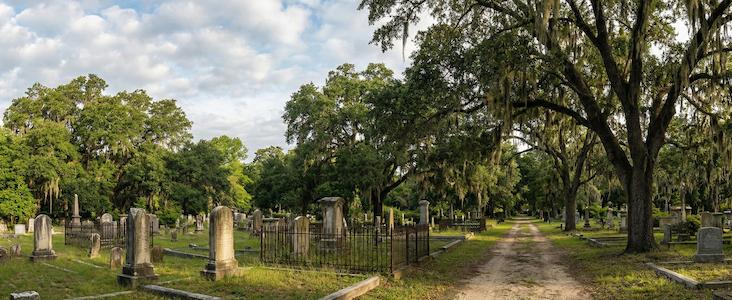
Rock Contact Zones Tilt Headstones
Carroll County's bedrock is a patchwork of schist and granitic gneiss, and where these two rock types meet underground, the contact zone tends to be heavily fractured compared to either rock on its own. Well records from the county illustrate the difference starkly: one well drilled just off the contact zone, finishing in solid schist, produced only about a gallon of water a minute, while a nearby well that hit the fractured contact itself produced a hundred times that. Those same fracture zones that make for productive wells also let groundwater move and collect in ways it doesn't in the surrounding solid rock.

A headstone foundation set across one of these contact zones doesn't get uniform support, since the fractured, water-bearing rock on one side compresses differently under load than the solid rock on the other. Since these contact zones can run in narrow bands just a few feet wide, a plot's exact position relative to one makes a real difference in how the ground beneath it behaves. Headstone cleaning services near me searches from Carrollton families sometimes come after noticing a stone that's settled unevenly, tilting toward one side for no reason visible at the surface. Tending checks for underlying rock contact zones before resetting an affected base, since a standard footing spanning both rock types won't hold the stone level for long. Bigger structural work is handled under headstone repair and restoration. A $2,000,000 liability policy protects every Carrollton family Tending works with, and the company's ICCFA membership means its methods answer to a standard set outside the business itself.

Gold Belt Quartz Crusts Headstones
Carroll County was once home to an active gold belt, with prospectors working quartz veins threaded through the local schist and gneiss throughout the 1800s. Those same silica-rich quartz veins still influence groundwater chemistry today, and where mineral-heavy water from a nearby vein reaches a headstone, it can leave behind a pale, glassy crust distinct from the reddish iron staining more common elsewhere in Georgia's clay soils. The effect tends to concentrate near old mining areas scattered through the county's rural sections. It doesn't show up uniformly everywhere.
Bronze veterans' plaques near these old quartz vein areas can develop a similar light-colored film layered over the metal's usual patina. Tending removes this silica-based crust with a treatment suited to quartz-derived mineral deposits, and cleans and restores bronze grave markers affected by the same groundwater chemistry on the same visit.
"Great service. Cleaned my great grandfathers memorial that was in sad shape. Couldn’t be happier with the work."
— Michael Arnold, Georgia
Topsoil Erosion Exposes Headstone Bases
Decades of short-sighted 19th and early 20th century farming practices stripped away much of Carroll County's original topsoil, exposing the red clay subsoil that now sits at the surface across many of the county's rural cemeteries. Without that buffering layer of organic topsoil, the exposed clay swells and dries more abruptly with each rain, and older headstones set directly into this stripped ground take the full brunt of that swing. Cemeteries on higher, more sloped ground tend to show this effect most, since erosion strips topsoil fastest wherever water runs off quickest.
Tending recuts and repaints lettering worn shallow by this exposed-clay weathering pattern, following headstone lettering restoration standards suited to the marble and granite monuments common throughout Carrollton's older rural church cemeteries. Carroll County's courthouse square dates to the 1870s, and the rural church cemeteries around it were built over the same fractured rock that shaped the town's early quarrying and farming history.
Service Costs in Carrollton
Pricing runs through Tending's online calculator once the monument type and care plan are selected, with no in-person visit required to assess the damage first. A maintenance plan can be added for markers affected by rock contact settling, quartz vein mineral crust, or exposed-clay weathering, since each of these conditions tends to develop gradually and persist over many years.
- Base resetting and stabilization: correcting settlement from fractured rock contact zones.
- Mineral crust removal and bronze treatment: silica-specific cleaning for quartz vein groundwater.
- Lettering restoration: recutting engraving worn by exposed subsoil weathering.