Sangamon Floodplain Moisture and Soft Footings in Decatur
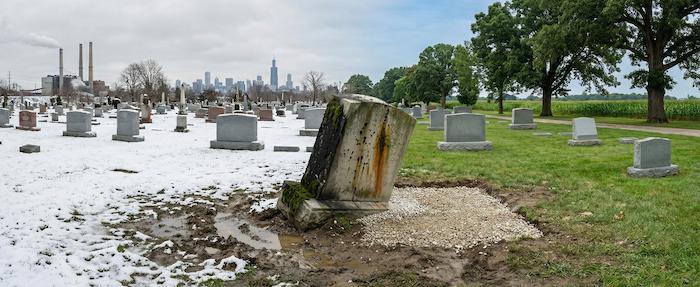
Lake Decatur backs right up against the Sangamon River at the edge of town, and the black prairie soil down there holds onto water way longer than the till on the higher lots do. Pour a footing into ground that saturated and it never really gets a firm bearing. The stone just rocks a little, dips a little, every time the water table climbs after spring rain. Nobody notices a quarter-inch dip the first year. Give it a few wet springs, though, and a flat marker's sitting in a puddle every time it rains, an upright one's leaning toward the soft side. Most people calling about headstone cleaning services near me in Decatur with a stone like that are dealing with drainage. The surface dirt is almost an afterthought at that point.
Pull the stone, dig below the saturated layer, rebuild on gravel that actually drains, so water moves through it, not against the footing — that's the fix, more or less. Not glamorous work, but it holds. We log the depth on file so we're not guessing next time we're out there. Most of what we do under headstone repair and restoration across Macon County comes down to exactly this.
Grain Dust and Tarnished Bronze Near the Plants
Decatur runs on corn and soybeans, more or less, and ADM's milling operations put a haze of grain dust and fermentation vapor into the air on the north side of town. It settles onto stone as a dull gray film — thicker near the plants, thinner the farther out you get. Bronze doesn't handle this the way granite does. Airborne dust plus a little fermentation acidity, and a smooth patina turns rough and blotchy way faster than plain Illinois humidity would manage on its own.
"I am thrilled! I had never heard of such a company and was very excited when I found them. I had tried cleaning the stones myself, and that was sort of fruitless. They came in and took stones that hadn’t been cleaned in 30 years and made them look like new. They cleaned up the plot pulled the weeds and made the grass look great. I cannot recommend them highly enough. I have them on several of my relatives now who sadly have been neglected over the years. More than thrilled."
— Laverne S, Westchester, Illinois
A standard degreaser won't lift grain dust film. Doesn't even come close, honestly — it needs something built specifically for organic residue. Bronze is worse. That grime has to come off completely, down to bare metal, before a coating built for industrial air goes back on through bronze marker restoration. A plaque near the mill district rarely makes it more than a few years without needing this. One on the quiet south side of town can go a lot longer.
Reservoir Efflorescence on Engraved Names
Lake Decatur's a dammed reservoir, built in 1922 to lock down the city's water supply, and the same mineral-heavy water that makes it useful for drinking leaves a chalky residue on anything porous nearby. Masons call it efflorescence — groundwater evaporates out of the stone, the dissolved minerals stay behind, and they concentrate wherever the stone's most porous. Usually that's right inside an engraved letter. Give it enough seasons and a name that used to read sharp and dark fades to an outline. Some of the older markers near the reservoir have all but vanished under a white crust.
Getting that crust off takes an acid wash calibrated to Macon County's water chemistry specifically. A generic cleaner just smears it around. It doesn't lift the residue clear, and that usually makes the letter harder to read than before anyone touched it. Once a letter's open again, we rebuild it with a lithochrome enamel rated for outdoor stone, and that's usually paired with headstone lettering repair on the same visit for anyone whose family name has started disappearing.

Service Costs in Decatur
We don't need to see the plot to give you a number. Our online calculator handles that — pick the monument type, pick a plan, done. Works the same for a floodplain marker or something up on higher ground, anywhere in Macon County.

- Foundation Repair: Rebuilding footings undermined by floodplain moisture.
- Bronze Restoration: Stripping and resealing grain-dust tarnish.
- lettering repair: Removing mineral crust and repainting names.
- Biological Cleaning: Removing dull film from stone near the mills.