
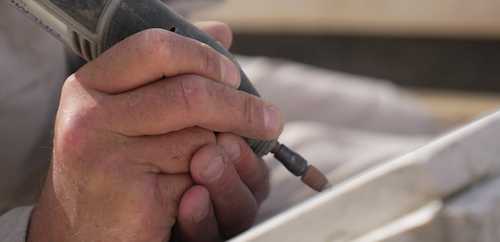
Four separate things wear paint out of an Indiana headstone's carved letters, and each one needs a different fix. Industrial grime from the northwest clogs a groove with an oily film. Hard water off the limestone belt leaves a mineral crust behind. Harvest dust packs into the channel every fall. Sustained humidity near the Ohio River lifts paint from underneath without any of the above. Every one of these repairs falls under the same $2,000,000 liability policy and ICCFA membership that covers Tending's other Indiana services.
Industrial Grime Clogging the Groove
Northwestern Indiana's steel and coking operations have put fine particulate into the air around Gary, Hammond, and East Chicago for generations, and some of it settles as an oily, dark film wherever it lands. That film settles into any weak spot along worn lettering paint and mixes with rainwater into a sticky residue that coats the channel walls. Letters facing the prevailing wind off the lake tend to show this buildup first. A degreasing solvent has to fully clear that oily residue before any new enamel goes in, since paint applied over even a thin film of it peels away again within a season. Tending's crews treat lakefront lettering jobs as a distinct category for exactly this reason.
Mineral Crust From the Limestone Belt
Groundwater used to rinse or irrigate cemetery ground in south-central Indiana often passes through the same Mississippian limestone quarried around Bedford and Bloomington, picking up dissolved calcium on the way. That mineral load settles into carved letters and hardens into a pale crust that can bury the inscription within a single season. The crust also traps whatever paint is still holding on underneath it, so a technician can't tell how much original color survives until the buildup is cleared away. A monument in this region often carries a bronze plaque as well, and that metal collects the same mineral load differently, covered under bronze marker restoration. An acidic rinse dissolves the crust without touching the surrounding stone.
Harvest Dust Packed Into the Channel
Central Indiana's fall grain harvest sends fine soil dust across open farmland every year, and cemeteries near active fields collect a steady layer of it in every carved groove. Cemeteries near grain elevators and rail loading points tend to collect the heaviest layer, since dust concentrates wherever grain actually gets handled. Rain turns that dust into a compacted paste that dries rock-hard inside the channel. Left in place through a wet winter, the packed dust holds moisture directly against any paint still in the groove and speeds up its failure. Clearing it out completely before repainting is what keeps a fresh coat from lifting again by the following harvest season.
Humidity Lifting Paint Near the Ohio River
Indiana's stretch of the Ohio River runs through some of the dampest air anywhere in the state, and that moisture works into any worn spot in carved lettering paint even without any dust or mineral contamination involved. Trapped humidity swells and lifts the paint from underneath, and shaded, low-lying plots along the river can also grow moss right up to the edge of the inscription. This same stretch of river put ninety percent of Jeffersonville underwater during the flood of January 1937, and cemetery ground along that corridor rarely gets a fully dry season even now. Force-drying the channel completely before repainting keeps trapped moisture from starting the same lifting cycle over the next humid season.
Headstone Lettering Repair Costs in Indiana
The calculator prices the job from two numbers alone: how many characters need repainting and how deep the original carving runs. Photos of the current lettering are typically all a technician needs to generate that figure, with no site visit required before the work gets scheduled. Once the repaint is finished, close-up images go into the Tending app, giving a family a way to check the result without a drive to the cemetery.
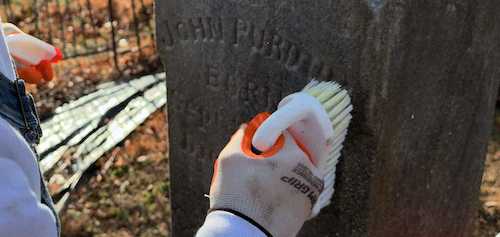
How Our Headstone Lettering Repair Process Works
- Scraping Out the Old Paint A technician works a fine pick through each carved letter, removing failed paint, dust crust, or industrial grime by hand. Enamel still bonded well to the stone is left as-is.
- Flushing Grit From the Groove A solvent flush clears whatever residue remains in the channel, whether that's oily grime, mineral scale, or packed dust, so the groove is fully clean before drying starts.
- Running the Channel Completely Dry Forced-air heat dries the channel completely. Any trace of leftover moisture under fresh enamel is one of the more common reasons a repaint fails within a season.
- Laying Down Fresh Enamel Industrial-grade enamel goes into the dry channel in thin layers, built up to match the depth of the original carving.
- Buffing Clean and Uploading Photos A pumice block clears overspray from the surrounding stone, and the technician photographs the finished letters through Tending's app before leaving.
