
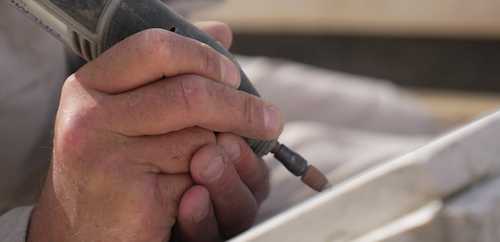
Kansas headstone lettering fades or lifts for four regionally distinct reasons, and treating them all the same way rarely holds up. Wheat harvest dust packs directly into the channel each summer. Ash from the Flint Hills' spring prairie burns bonds into the groove in the eastern half of the state. Gypsum-rich well water buries letters under a mineral crust in the Red Hills region. Windblown grit from the state's most erosion-prone soils scours paint away in the west. Tending's lettering crews carry ICCFA membership and $2,000,000 in liability coverage on every one of these jobs, statewide.
Wheat Harvest Dust Packed Into the Channel
Kansas is the nation's top wheat producer, and the harvest itself moves north across the state for roughly two months starting in late May. Every combine working an adjacent field throws a cloud of loose soil and dried chaff into the air, and a share of it ends up packed straight into whatever carved letters happen to be nearby. Once a rain shower hits that debris, it sets into a hardened paste that won't come out with a simple rinse, only real scraping. A cemetery near several fields on a harvest circuit picks up a new layer practically every time one of them gets cut.
Flint Hills Burn Ash Bonding Into the Groove
Kansas ranchers set an estimated two million acres of Flint Hills prairie ablaze each year, almost all of it packed into a few weeks around early-to-mid April, to knock back woody growth before the grazing season starts. Plumes from that many simultaneous burns show up clearly on weather satellite feeds, and eastern Kansas cemeteries downwind collect the fallout directly in every open carved letter nearby. A light rain during or just after burn season welds that ash to whatever enamel is already sitting in the groove. Once bonded there, it holds dampness against the coat long enough to lift it loose well ahead of schedule.
Gypsum-Rich Well Water Crusting Letters
Groundwater in and around the Red Hills of Barber, Comanche, and Clark counties passes through thick Permian-age gypsum beds, and irrigation drawn from those wells carries a heavy dissolved-mineral load. Watering or rinsing a headstone with that water deposits a trace of it into the carved letters each time, and over repeated cycles it hardens into a crust distinct from ordinary hard-water scale, thick enough to bury an inscription within a season or two. A bronze plaque on the same monument reacts to that mineral load on its own separate timeline, and that condition is handled specifically under bronze marker restoration. Clearing the crust off the lettering calls for a rinse formulated to that specific mineral, applied carefully enough to leave any surviving paint in place.
Windblown Grit From Dust-Bowl-Legacy Soils
Western Kansas still carries some of the most wind-erodible soil in the state, ground the Kansas Department of Agriculture continues to flag on its erosion-risk maps today, a legacy that traces back to the Dust Bowl years when a single 1935 storm dropped visibility to nearly zero across Dodge City, Liberal, and Garden City in the span of an afternoon. That same fine, sandy soil still lifts easily on a dry, windy day, and it works into carved lettering the way any airborne grit would, wearing at the paint's surface with every pass. Letters on the windward side of a monument in this region tend to show that wear first, since the grit hits that face head-on with every gust.
Headstone Lettering Repair Costs in Kansas
Character count and carving depth are the only two inputs the calculator needs to return a firm number, and clear photos of the existing lettering are all that's required to supply them. Nobody has to walk the cemetery before that price is set. Once the crew finishes repainting, they photograph the letters and post them to the Tending app, and that upload is how most families end up checking the outcome.
How Our Headstone Lettering Repair Process Works
- Reading the Damage Before Touching the Stone Dust packing, ash bonding, or a mineral crust each call for a different opening move, and a technician settles on the right one from photos before a single tool touches the letter.
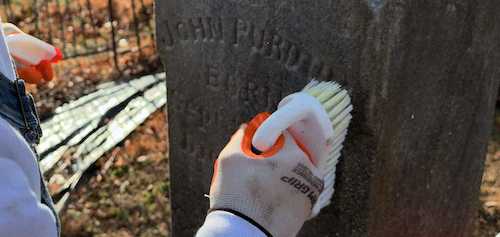
- Working Old Paint Free of the Groove A hand tool works through each carved letter individually, freeing failed paint along with whatever's clogged in around it. Paint that's still holding on gets left alone.
- Clearing the Channel With a Matched Rinse Whatever's left behind, chaff paste, ash residue, or gypsum scale, determines the rinse that flushes the groove back down to bare granite.
- Driving Out Every Trace of Moisture Forced air runs through the channel until no moisture remains anywhere inside it. A groove that's still damp underneath is the single most common reason a fresh coat doesn't hold.
- Setting the New Enamel and Finishing Up Enamel goes in layer by layer until the groove matches its original depth, then a pumice block clears any overspray before the crew photographs the result through Tending's app.
