
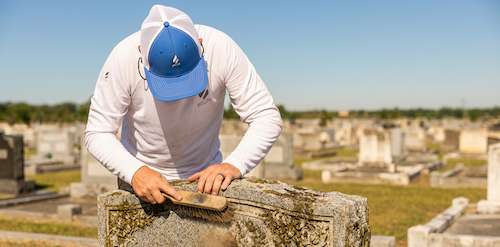
South Louisiana ground rarely holds still under a cemetery monument. Around New Orleans, the earth itself keeps sinking by measurable inches each year. Along the bayous, a permanently high water table leaves cemetery soil soft and saturated most months. Gulf hurricanes have pushed storm surge across whole parishes and displaced vaults more than once this century. Statewide, the region's heavy clay swells and shrinks with every wet season, working at any foundation not built to move with it. Tending repairs monuments anywhere in Louisiana, backed by $2,000,000 in liability coverage and ICCFA membership.
Measurable Ground Subsidence Around New Orleans
NASA satellite radar mapping of the New Orleans area, based on data collected between 2009 and 2012, measured subsidence reaching two inches per year around Norco and Michoud, and up to 1.6 inches per year near the Bonnet Carré Spillway. Groundwater withdrawal is the leading cause identified in that research, layered on top of ordinary settling that comes with building on river sediment. A cemetery foundation poured decades ago on that same ground can end up several inches out of level without a single storm ever touching it, since the ground itself simply kept dropping underneath it year after year. Tending's crews check how far a monument has actually settled before deciding whether the fix is a simple releveling or a full footing rebuild.
Saturated Ground Along the Bayous
Cemetery plots near Louisiana's bayous often sit within a few feet of the water table year-round, and the soil underneath rarely gets a real chance to dry out between rain events. Crawfish chimneys, the small mud towers the animals push up while tunneling through saturated ground, are one of the more visible signs of how wet that soil stays even in a dry week, though LSU AgCenter's own research describes the burrows themselves as a cosmetic nuisance, not a structural threat. What actually moves a monument here is the ground's bearing capacity: soil that stays chronically waterlogged compacts unevenly under a granite base, and a stone set on it can drift out of level gradually, with no single event to point to. A footing rebuilt on ground like this goes in noticeably wide, specifically to spread the monument's weight across soil that may never firm up completely.
Hurricane Storm Surge in the Lower Parishes
Hurricane Katrina's floodwater and storm surge disturbed roughly 1,500 graves across the region in 2005, and in Plaquemines Parish alone, recovery crews worked through more than 600 displaced graves spread across a dozen-plus sites, mostly outside New Orleans's own famous above-ground tombs, which largely survived the storm intact. Hurricane Ida, which made landfall near Port Fourchon in August 2021 as a Category 4 storm, pushed a measured surge of 10.3 feet at Grand Isle and 8.3 feet at Port Fourchon, and displaced vaults turned up afterward in Ironton and Lafitte, both south of New Orleans. Louisiana's cemetery response task force estimated roughly two years for a full recovery from damage on that scale. Vaults and monuments in these low-lying parishes get reset with anchoring sized for the next surge, going well beyond how the original burial was ever anchored.
Shrink-Swell Clay Statewide
The heavy, high-plasticity clay found across much of south Louisiana, sometimes called gumbo clay locally, can expand by more than 10 percent in volume when saturated and then contract sharply as it dries back out. A monument foundation poured directly onto that clay rides the same cycle every year, rising slightly through a wet season and settling back through a dry one, and a base that isn't isolated from that movement eventually cracks or tilts under the repeated stress. This shrink-swell behavior isn't limited to any single parish; it's a Gulf Coast-wide clay characteristic, present well beyond the Mississippi Delta itself. Tending isolates a new footing from that seasonal movement with a compacted aggregate base, keeping the concrete itself clear of the native clay entirely.
Headstone Repair Costs in Louisiana
Whatever caused a monument to move here, subsidence, saturated ground, storm surge, or shrink-swell clay, pricing is set the same way: from photos submitted through the calculator, with no site visit needed to lock in a number. That figure holds from the day it's quoted through the day the work happens. Once the footing is rebuilt and the stone reset, the crew documents the result through the Tending app so the family can confirm it from wherever they are.
How Our Headstone Repair Process Works
- Matching Photos to a Regional Cause A technician starts with what the photos show and narrows it against Louisiana's typical patterns, sinking ground, chronic saturation, storm damage, or clay movement, before anyone drives out.
- Testing the Ground on Site Once on site, the crew probes the actual soil, checks how close the water table sits to the surface, and looks for the specific cracking pattern tied to whichever cause is suspected.
- Lifting the Monument Clear Rigging raises the stone off its failed footing. Pieces that separate during the lift are numbered and set aside until the base is ready to rebuild.
- Pouring a Footing Sized to the Ground The replacement footing is built to match what the soil actually needs, wider over soft ground, isolated from clay movement, or reinforced against the next storm surge.
- Setting the Stone and Recording the Fix The monument is reset on the new footing, and before the crew leaves, they log the finished repair with photos through Tending's app.
