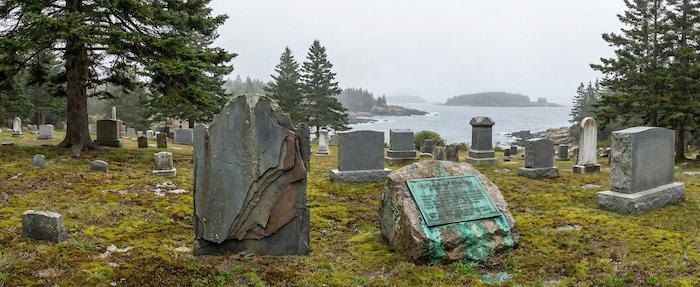
A search for headstone cleaning services near me from Old Town almost always comes down to one of two things: a stone carrying a dull industrial film, or a monument gone green from river damp. Old Town's paper mill has stood on the Penobscot since 1860, close enough to one of the city's own cemeteries that the two share a fence line. A century and a half of pulp processing next door shapes how a lot of local headstones actually age, in ways that have little to do with the river humidity that affects the rest of the city. Two separate problems, one paper town, and two very different fixes.
Mill-Adjacent Ground Grimes Granite
The paper mill's four hundred thousand square feet of buildings sit directly beside one of Old Town's older cemeteries, and decades of pulp and paper production sent fine particulate drifting over the fence line before modern air quality standards existed. Stones in that immediate neighborhood carry a grayish film worked deep into the granite's pores, distinct from ordinary surface dirt. It's the same kind of legacy grime seen at old mill towns throughout Maine, just concentrated closer to the source here than almost anywhere else.
"My Angela's headstone had not been cleaned in fifty years. I moved to Florida many years ago and I do visit San Diego, but never was able to get her headstone cleaned. My Angela is in the children's mausoleum chapel. I miss her every day. She was 5 years old when she passed. Well, im telling you after you guys cleaned up her headstone I didn't even remember what it had originally looked like. What a fabulous job! Everyone should use your company. It is truly beautiful. I can't wait for the rest of my family to see it. Thank you so much. Margaret "
— Roberta Silfen, Bangor, Maine
A degreasing soft wash breaks the film down without stripping the stone's polish. On monuments closest to the mill fence, we sometimes need a second pass to fully clear decades of buildup — one visit rarely undoes a hundred years of drift in a single treatment. We tell families that upfront, since a one-visit promise on stone this old rarely holds up. Setting that expectation early saves a family the disappointment of a second look a few weeks later.
Penobscot Humidity Feeds Algae Fast
The Penobscot and Stillwater Rivers split around Marsh Island right at Old Town, which means the air stays damp here on dry days as well as wet ones. That humidity settles onto stone overnight, and shaded plots near either river develop algae and lichen faster than cemeteries a few miles inland. Flat markers set low to the ground tend to hold the moisture longest of all, sometimes for days after a storm has otherwise cleared.
We treat this growth with a D/2 biological solution. Abrasive scrubbing wears down granite faster than the algae itself does. Bronze veterans' markers near the riverbank need a separate, gentler product — river humidity affects metal differently than it does stone, and using the wrong product on either surface tends to shorten how long the cleaning lasts.

Northern Maine Frost Cracks Old Bases
Old Town's winters run colder and longer than towns just an hour south, and the ground here holds a hard frost for a good stretch of the year. Any moisture sitting in a hairline crack has nowhere to go once the ground locks up, and the repeated freeze-thaw cycle pries the gap open wider each time. A flaw that starts small in November can be a real structural problem by the spring thaw, especially on stones set before modern footings became standard practice.

A flexible sealant fills these cracks and keeps moving with the granite as it expands and contracts through the winter, unlike a rigid filler that would just crack again on its own. On older bases that have already shifted from years of this cycle, resetting the monument on packed drainage stone is part of the same headstone restoration and monument restoration services visit, matched to how far the ground has actually shifted and not simply to how the stone looks from a few feet away.
Service Costs in Old Town
Every Tending plan in Old Town is priced through our online calculator once you choose the monument type and care plan you want. There's no technician visit before you pay and no quote to negotiate by phone. See pricing for your cemetery, then schedule the first cleaning or set up a recurring plan for the season. Families near the mill fence often start with two cleanings spaced a season apart to work through the deeper buildup, which tends to give a cleaner, longer-lasting result than trying to force it all into one visit.
- Mill-adjacent grime removal: a degreasing wash sized to a century and a half of pulp-particulate buildup, with a second pass for the heaviest sections.
- Biological growth removal: D/2 treatment for river-humidity algae and lichen, plus a separate cleaning process for bronze markers.
- Frost-crack sealing and releveling: flexible mortar for winter cracking, with full base resetting for shifted monuments.