
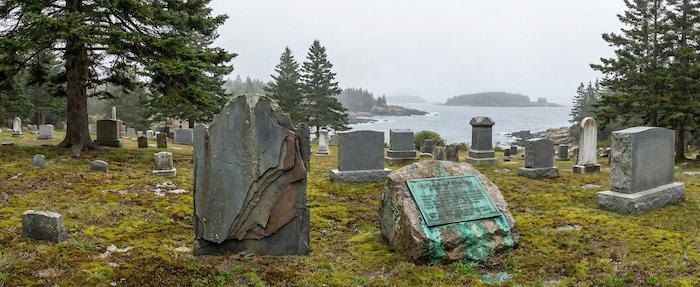
A monument in an inland Maine cemetery can tip or sink during spring "mud season," when the top foot of ground turns to slurry over rock-hard frozen subsoil; a granite marker on the coast near Bar Harbor corrodes and pits from salt spray instead, with no mud season involved. Coastal or inland, a Tending headstone cleaning visit anywhere among Maine's 5,489 cemeteries comes with the same $2,000,000 liability policy and ICCFA membership. Which fix actually helps a Maine headstone depends on what's really behind the damage.
How Maine's Mud Season and Rocky Coast Shape Headstone Care
Maine's spring mud season leaves the ground unstable enough to tip or sink a heavy monument, and the same freeze-thaw cycle splits apart the layered slate markers common in the state's oldest cemeteries. Coastal salt spray reaches granite and bronze alike near the water, and de-icing salt from winter road plowing reaches cemeteries further inland on its own.
Maine Mud Season and Headstone Repair
Maine's spring "mud season" gets its name honestly: the ground's deep subsoil stays frozen solid well into spring even as the top foot or so thaws into standing slurry, and a heavy monument sitting across that boundary gets pushed and pulled in two directions at once. A granite base can tip or sink several inches in a single bad mud season, and once it's out of level, the same freeze-thaw cycle keeps working on it every year after. Maine's oldest cemeteries hold slate markers going back two centuries or more, and slate's natural layered structure gives water an easy path to work into over that much time. Rain seeps between the layers at the stone's top edge, and when that water freezes each winter, the pressure eventually splits a whole face off the block, taking hand-carved lettering down with it. Colonial-era slate markers carved by hand carry inscriptions and folk-art carvings that simply can't be replaced once a face is lost this way. Resetting a tipped or sunken monument means digging out the unstable soil and packing a deep footer of coarse, angular gravel that drains water before mud season can heave it again. A split slate face gets cleaned out between the layers and rejoined with a specialized adhesive, clamped tight while it cures, and the top edge sealed afterward to keep the next season's rain from finding its way back in. Headstone repair in Maine handles both jobs with the same principle: keep water out of wherever it's doing the damage.
Maine Coastal Salt Spray and Bronze Marker Restoration
Fog rolling in off the Atlantic carries heavy salt across Maine's coastal cemeteries, from Bar Harbor down to Kittery, and the salt settles onto every exposed surface within reach. Old burying grounds set directly above the tideline take the heaviest exposure, since wind off the water reaches them with almost nothing to break its path. Salt drawn into granite eats into the polish directly, leaving a dull, gritty texture where a smooth finish used to be. Bronze plaques face their own damage: salt reacts with the copper in the alloy, turning bare metal a chalky green and forming a corrosive paste that keeps working as long as it stays wet. The paste eats through whatever protective coating was on the plaque originally, and once bare metal is exposed, the reaction only accelerates. A neutralizing wash breaks down the salt deposits on granite without abrasive scrubbing, and bronze marker restoration strips corrosion down to bare metal before sealing it with a hot wax coating that keeps sea air off the surface for years at a stretch.
Maine Roadside De-Icing Salt and Headstone Lettering Repair
Plow trucks push heavy loads of salted slush right up against cemetery fences along Maine's rural roads every winter, and the brine left behind soaks straight into the porous base of any nearby stone. As the water evaporates through spring and summer, salt crystals grow inside the stone's pores, and the pressure of that growth blows apart the surface from the inside, taking painted lettering with it wherever a crystal breaks through right under a letter. A marker close to a plowed road can lose paint in patches within just a few winters of heavy salt exposure. Cemeteries along Maine's older state highways, salted and plowed for decades, tend to show the deepest buildup in the ground closest to the pavement. A fresh-water flush combined with a salt neutralizer pulls the winter chemical buildup back out of the stone's pores before it can do further damage, and headstone lettering repair repaints whatever letter the salt crystals popped loose once the surface is fully rinsed clean.