
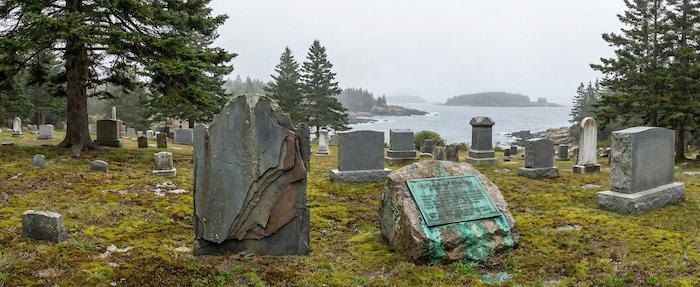
Feldspar Quarry Particulate and Tidal Silt Liquefaction
Topsham burial sites flank the Androscoggin River and the Merrymeeting Bay estuary. Historic operations at the Bowdoin Mill and local feldspar quarries subjected these masonry grids to severe industrial bleaching agents and microcline particulate. Families requiring headstone cleaning services near me encounter cemetery blocks destabilized by tidal silt liquefaction or stained entirely red by iron-oxidizing bacteria. Operating exclusively as a commercial headstone restoration company, our technicians stabilize estuarine footprints using deep friction piles and execute chemical extraction of industrial silicates.
Feldspar Quarry Microcline Adhesion
Local topography includes historic feldspar mining operations. High-velocity winds drove microcline silicate dust into the cemetery grids. Atmospheric moisture fused this particulate onto the granite polish. The resulting abrasive crust obscures the original masonry finish and traps airborne dirt.
Technicians deploy potassium bifluoride gels. The chemical targets the microcline matrix exclusively. The fused dust degrades into a removable liquid phase. Field crews flush the residual slurry using low-PSI water equipment. The underlying quartz structure remains unscarred.
Merrymeeting Bay Tidal Silt and Friction Piling
Topsham topography slopes toward the Merrymeeting Bay estuary. The sub-grade features highly unstable tidal silt. Heavy precipitation events saturate this fine dirt. The soil loses all load-bearing capacity. Monument foundations weighing thousands of pounds sink asymmetrically into the liquefied soil. Standard gravel underpinning fails immediately.
Foundation stabilization and leaning headstone repair necessitate deep friction piling. Crews extract the sunken granite. We drive threaded steel friction piles deep into the estuarine silt using hydraulic rotary heads. The shafts advance until hitting dense hardpan. A heavy steel plate bolts to the pile heads. The granite base mounts directly to this engineered platform. The unstable mud layer is bypassed entirely. Future subsidence is eliminated.
Bowdoin Mill Chlorine Fallout
Industrial paper manufacturing at the historic Bowdoin Mill utilized heavy bleaching agents. Industrial chlorine emissions enveloped the adjacent burial grids. The resulting hypochlorous acid physically attacks the calcium carbonate matrix. This chemical reaction strips the structural binders completely. The outer marble face deteriorates into loose chalk.
"My Angela's headstone had not been cleaned in fifty years. I moved to Florida many years ago and I do visit San Diego, but never was able to get her headstone cleaned. My Angela is in the children's mausoleum chapel. I miss her every day. She was 5 years old when she passed. Well, im telling you after you guys cleaned up her headstone I didn't even remember what it had originally looked like. What a fabulous job! Everyone should use your company. It is truly beautiful. I can't wait for the rest of my family to see it. Thank you so much. Margaret "
— Roberta Silfen, Bangor, Maine
We execute structural consolidation. Technicians brush liquid barium carbonate into the failing rock via multiple wet-on-wet applications. The chemical initiates an internal precipitation reaction. The solution hardens and binds the remaining calcium crystals together. This hardened barrier completely terminates the active chemical erosion. The historic engraving stabilizes permanently.
Gallionella Bacterial Hard-Fouling
The Merrymeeting Bay watershed carries massive dissolved iron payloads. Ambient mist transports this moisture to the cemetery grids, feeding aggressive Gallionella bacterial colonies. These iron-oxidizing organisms process the ambient iron and excrete dense, reddish-orange ferric oxide bio-crusts. The biological rust stains penetrate porous granite bases deeply.
We apply sodium thioglycolate extractors. The reducing agent instantly solubilizes the ferric iron. The chemical concurrently ruptures the bacterial cell walls. The heavy red stains bleed out of the rock matrix entirely. Technicians flush the eradicated biological hazard using low-pressure nozzles. The raw stone emerges free of bio-rust.
Cathance River Mist and Lithichrome Failure
Acidic river mist actively attacks the factory lithichrome binders inside the engraved text. The pigment shrinks, loses internal adhesion, and shatters into loose debris. The text channels empty completely. Legibility vanishes. Field teams execute technical headstone lettering repair.
Workers excavate the failing paint remnants utilizing angled steel picks. We eliminate residual moisture from the channels utilizing high-velocity hot air. Crews inject dense polyaspartic masonry resins directly into the dry engravings. A rubber squeegee levels the exterior surface. The high-build resin cures rapidly, returning sharp visual contrast to the stone.
Estuarine Moisture and Bronze Corrosion
High saline content in the estuarine mist compromises factory urethane sealants on flat bronze plaques. The bare copper alloy oxidizes aggressively. A heavy green sulfate scale forms over the veteran markers. The metal pits physically.

We implement onsite bronze marker restoration. Field technicians mill the oxidation bare utilizing brass rotary instruments. We apply a buffering wash to neutralize the metal surface. Crews spray a heavy, ultraviolet-cured acrylic barrier over the plaque. The chemical hardens instantly. The bronze is sealed against future estuarine moisture.

Digital Commissioning Framework
We bypass outdated on-site inspection protocols and variable pricing grids. Monument restoration costs map exactly to the stone's physical dimensions and material profile. Clients generate their guaranteed flat-rate price through our online configurator. Digital commissioning dispatches our mobile masonry units directly to the Topsham coordinates. Technicians supply time-stamped photographic evidence to your digital project dashboard immediately following task completion.
- Silicate Extraction: Deploying potassium bifluoride gels to dissolve fused feldspar quarry dust.
- Friction Piling: Driving threaded steel piles into tidal silt to stabilize severe monument subsidence.
- Marble Consolidation: Injecting barium carbonate to halt chlorine-induced degradation on historic tablets.
- Bio-Rust Removal: Utilizing sodium thioglycolate to extract iron-oxidizing Gallionella bacteria stains.