
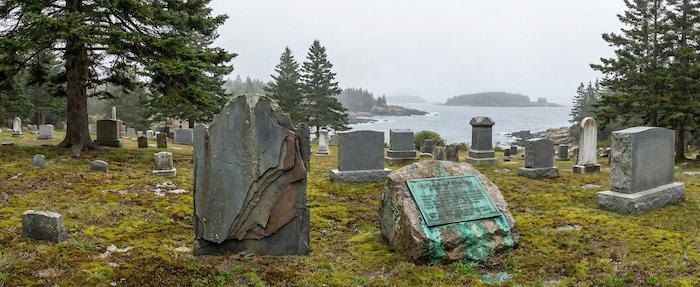
Pegmatite Bedrock Displacement and Hemlock Terpene Resins
Freeport cemetery properties occupy shallow pegmatite bedrock intersecting the Harraseeket River estuary. Intense retail traffic corridors and dense Eastern hemlock canopies subject the masonry to hydrocarbon fallout and highly acidic terpene exudate. Digital analytics tracking headstone cleaning services near me indicate high rates of foundation sliding and severe resin accumulation in this sector. Tending functions exclusively as a commercial headstone restoration company. Technicians execute titanium bedrock pinning to halt lateral subsidence and deploy glycol ether solvents to neutralize biological resins.
Eastern Hemlock Terpene Exudate
Eastern hemlock stands border multiple local burial grids. These conifers excrete viscous terpene compounds. The resin drops directly onto the granite bases. Ultraviolet radiation cross-links the molecular structure. The resulting amber crust traps airborne particulate and completely obscures the factory polish. Manual scraping permanently gouges the quartz inclusions.
Field crews apply targeted glycol ether solvents. The low-VOC chemical penetrates the cross-linked terpene matrix. The rigid crust solubilizes instantly. Technicians evacuate the resulting sludge utilizing low-pressure fluid extraction. The original granite finish emerges unaltered.
Pegmatite Ledge Topography and Titanium Anchoring
The local sub-grade features shallow pegmatite ledges. Impermeable bedrock prevents vertical water drainage. Subterranean pooling occurs directly beneath concrete monument footings. Subsequent freezing cycles exert extreme lateral and vertical hydraulic forces. The concrete footings slide downhill along the irregular rock plane. Surface-level gravel leveling fails continuously under these topographical parameters.

Permanent leaning headstone repair dictates direct bedrock coupling. Crews hoist the displaced masonry. We utilize pneumatic rock drills to bore vertical shafts directly into the pegmatite ledge. Workers insert threaded titanium anchors into the boreholes. The granite base mounts over the titanium pins. The engineered footprint achieves permanent structural rigidity against lateral ice expansion.
"My Angela's headstone had not been cleaned in fifty years. I moved to Florida many years ago and I do visit San Diego, but never was able to get her headstone cleaned. My Angela is in the children's mausoleum chapel. I miss her every day. She was 5 years old when she passed. Well, im telling you after you guys cleaned up her headstone I didn't even remember what it had originally looked like. What a fabulous job! Everyone should use your company. It is truly beautiful. I can't wait for the rest of my family to see it. Thank you so much. Margaret "
— Roberta Silfen, Bangor, Maine
Route 1 Hydrocarbon Deposition
The US Route 1 retail corridor sustains continuous high-volume vehicular traffic. Diesel combustion and tire friction generate aerosolized hydrocarbon particulate. Coastal wind shear drives this fallout into the cemetery grids. The particulate accumulates on the masonry, forming a dense, hydrophobic black film.
Technicians distribute cationic surfactant foams across the contaminated surfaces. The positively charged surfactant molecules disrupt the hydrophobic hydrocarbon bonds. The black film emulsifies into a suspended state. Crews rinse the deactivated particulate clear of the stone without inducing surface friction.
Harraseeket Estuary Halite Crystallization
The Harraseeket River mixing zone produces brackish aerosol drift. Saline moisture infiltrates the capillary pores of 19th-century marble tablets. Evaporation leaves concentrated sodium chloride crystals. Halite crystallization exerts severe internal mechanical stress. The mechanical force triggers granular disaggregation. The marble face sheds in continuous microscopic layers.
Field units trowel ammonium carbonate desalination poultices over the degrading stone. The chemical paste reverses capillary flow. The halite ions migrate out of the stone and into the poultice matrix. Crews remove the dried paste, eliminating the internal mechanical stress and halting the granular shedding.
Lime Mortar Thermo-Mechanical Shear
Multi-tier Victorian monuments utilize historic lime mortar joints. Coastal thermal cycling and asymmetrical wind loads exert thermo-mechanical shear stress across these horizontal planes. The mortar pulverizes into inert dust. The upper granite tiers detach and shift backward, presenting catastrophic crushing liabilities.
Workers secure the destabilized blocks using aluminum gantry systems. Crews evacuate the pulverized binder utilizing compressed air lines. Technicians drill mating boreholes into both granite surfaces. We insert fluted stainless steel blind pins. Workers pump non-shrinking hydraulic cement onto the lower block. The upper tier descends onto the pins. The components fuse into a singular, immovable mass.
Bronze Cuprite Oxidation
Flat bronze veteran markers endure severe cuprous oxidation due to the estuarine moisture. The factory clear sealants degrade. The raw copper alloy reacts with atmospheric oxygen and chlorides. A dense cuprite and brochantite scale pits the metal surface.
Field operators initiate bronze marker restoration protocols. Technicians abrade the scale utilizing low-pressure crushed glass media. We neutralize the raw alloy with sodium bicarbonate washes. Workers spray catalyzed polyurethane ceramic hybrid sealants over the plaque. The barrier cross-links immediately, shielding the alloy from the brackish environment.
Lithichrome Thermal Fracturing
Intense coastal thermal cycling breaks the adhesion of factory lithichrome pigment inside engraved text. The paint fractures into rigid chips and drops from the stone. Field teams implement headstone lettering repair.
Workers extract the failed pigment using hardened steel picks. We eliminate residual moisture via thermal induction. Crews inject high-density aliphatic urethane masonry dyes into the cuts. A leveling block clears the exterior face. The flexible urethane accommodates future thermal shifts without fracturing.
Digital Resource Allocation
We prohibit subjective field estimations. Monument maintenance parameters map strictly to physical dimensions and material categories. Patrons calculate fixed pricing independently through our online configurator. Submitting the digital directive routes our mobile masonry teams directly to the Freeport plot. Field operators upload time-stamped visual documentation to the client interface the moment the structural intervention concludes.
- Terpene Neutralization: Applying glycol ether solvents to solubilize Eastern hemlock resin.
- Bedrock Coupling: Boring threaded titanium anchors into pegmatite ledges to arrest foundation sliding.
- Desalination Poulticing: Utilizing ammonium carbonate to extract halite from degrading marble tablets.
- Hydrocarbon Emulsification: Deploying cationic surfactants to dissolve Route 1 traffic particulate.