Naval Shipyard Exhaust and Bedrock Frost Wedging
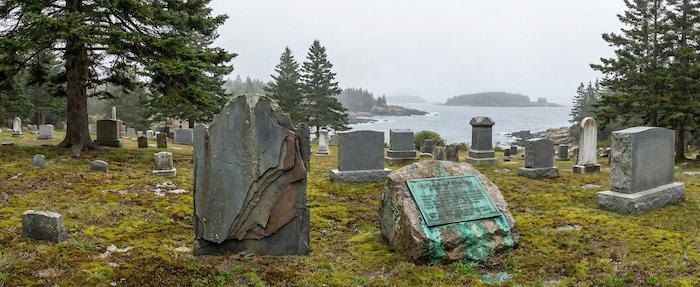
Kittery burial grids occupy shallow coastal bedrock adjacent to the Piscataqua River. Daily operations at the Portsmouth Naval Shipyard and continuous commercial shipping traffic subject the masonry to heavy bunker fuel fallout. People searching for headstone cleaning services near me locate granite monuments sealed under sticky black soot or shifted violently off shallow bedrock ledges. As a professional headstone restoration company, we extract the heavy marine hydrocarbons chemically and execute direct bedrock anchoring to stabilize failing foundations.

Bunker C Marine Fuel Soot
Naval vessels and commercial tugs operating on the Piscataqua River burn heavy marine diesel and Bunker C fuel. The exhaust stacks emit dense hydrocarbon particulate. Coastal winds drive this unburned fuel directly onto the cemetery plots. Solar heat bakes the fallout onto the granite and marble markers. The material cross-links into a waterproof black crust.
Mechanical scraping drives the petroleum deeper into the rock matrix. We deploy shipwright-grade alkaline emulsifiers. We spray the heavy-duty chemical directly over the black soot. The formula breaks the complex hydrocarbon chains. The rigid crust liquefies into a soluble sludge. We flush the bare stone clean using low-pressure nozzles. We remove the industrial marine fallout without abrasive damage.
Shallow Bedrock Frost Wedging
The Kittery coastal sub-grade contains minimal topsoil over solid granite bedrock. Surface water penetrates the thin soil and pools directly at the rock interface. Sub-zero temperatures freeze this trapped liquid. The expanding ice generates extreme vertical lift against the unyielding bedrock below. This physical force, known as frost wedging, lifts heavy monument footings and fractures concrete pads completely.
"My Angela's headstone had not been cleaned in fifty years. I moved to Florida many years ago and I do visit San Diego, but never was able to get her headstone cleaned. My Angela is in the children's mausoleum chapel. I miss her every day. She was 5 years old when she passed. Well, im telling you after you guys cleaned up her headstone I didn't even remember what it had originally looked like. What a fabulous job! Everyone should use your company. It is truly beautiful. I can't wait for the rest of my family to see it. Thank you so much. Margaret "
— Roberta Silfen, Bangor, Maine
Standard gravel trenches fail on shallow bedrock. For permanent leaning headstone repair, we execute bedrock anchor doweling. We extract the granite base and clear the soil down to the solid ledge. We core-drill directly into the coastal bedrock using heavy rotary hammers. We insert threaded stainless steel anchors into the rock and inject high-strength anchoring epoxy. We set the monument base directly over the steel anchors. The structure bolts rigidly to the earth, eliminating all frost heave movement.
Marine Salt Hydration and Marble Delamination
Historic marble markers absorb extreme levels of saltwater aerosol. The water evaporates, but heavy marine salt crystals remain inside the internal rock pores. Changing coastal humidity causes these trapped crystals to expand and contract constantly. This physical stress fractures the internal calcium carbonate matrix. The face of the marble marker shears off in flat sheets. We classify this as delamination.
We apply desalination poultices to extract the embedded salt. We clear the loose rock debris. We inject liquid ethyl silicate consolidants into the damaged stone. The chemical penetrates the porous marble and triggers a catalytic reaction. It builds a new silica matrix inside the rock, gluing the failing crystals together. This application stops the structural decay and preserves the remaining stone mass.

Halophilic Cyanobacteria Hard-Fouling
Tidal shifts in Kittery deposit high salt concentrations directly onto the cemetery granite. This hyper-saline environment supports halophilic cyanobacteria. The biological mass forms a rigid, black-green crust over the raw stone. Cellular respiration produces localized organic acids. These acids chemically etch the factory polish, leaving permanent microscopic craters.
Soap and water wash over the crust without effect. We apply industrial chlorine-dioxide biocides. The low-surface-tension liquid wicks into the micro-pores. The chemical oxidizes the biological cell walls on contact. The biological structure fails. We rinse the dead matter away completely without mechanical scrubbing.
Coastal Sleet and Lettering Abrasion
High-velocity winter sleet off the Atlantic Ocean physically strikes the open burial grounds. The sharp ice impact abrades the factory enamel inside carved lettering. The pigment deteriorates and chips away. We execute precise headstone lettering repair.
Crews scrape the dead pigment out using steel scribes. We force the text channels completely dry. We inject high-solid aliphatic urethane dye directly into the deep grooves. We drag a dense rubber block across the flat face to wipe away the excess cleanly. This restores high-contrast legibility against the granite.
Service Logistics and Pricing
We skip the on-site estimates and hidden upcharges. For all cemetery monument maintenance, we operate a flat-rate subscription model based strictly on the size and type of the marker. You check your exact cost instantly using our online configurator. You book the work, and our field crew heads to the cemetery.
- Marine Exhaust Extraction: Spraying alkaline emulsifiers to liquefy Bunker C fuel soot from shipyard traffic.
- Bedrock Anchoring: Core-drilling stainless steel anchors into solid ledge to stop shallow frost wedging.
- Ethyl Silicate Consolidation: Rebuilding the internal matrix of delaminating marble damaged by marine salt hydration.
- Halophilic Eradication: Using chlorine-dioxide biocides to destroy salt-loving cyanobacteria crusts.