
Textile Mill Carbon and Marine Chlorides
Biddeford sits at the mouth of the Saco River. The local graveyards face heavy marine salt from the Atlantic Ocean and historic industrial exhaust from the old brick textile mills. People searching for headstone cleaning services near me find monuments flaking apart from salt expansion or coated in solid black carbon. As a professional headstone restoration company, we extract the destructive chlorides and strip the industrial gypsum crusts from the masonry.
Textile Mill Coal Soot
The historic brick textile mills burned massive volumes of coal. The exhaust stacks pumped dense smoke across the city. This coal soot settled on the cemetery plots. The carbon reacted with atmospheric moisture to form a black gypsum crust directly on the granite and marble.
Mechanical scraping will destroy the original stone polish. We apply a sulfur-digesting chemical poultice. The thick paste chemically dissolves the carbon bond. The hard gypsum turns into a soft sludge. We wash the bare stone clean, exposing the natural rock color without abrasive damage.
Marine Chloride Spalling
Airborne marine chlorides blow inland from Biddeford Pool and Hills Beach. The saltwater mist penetrates the microscopic pores of older monuments. The water evaporates. The salt remains trapped inside the rock matrix. The salt crystals expand outward, physically shearing the front face off the granite. We classify this failure as spalling.
We cannot reattach the sheared flakes. We stop the active decay by flushing the stone. We trowel a thick chemical poultice over the damaged surface. The paste draws the remaining chlorides completely out of the rock pores. We strip the salt to protect the surviving inscription.
Silty Loam Subsidence
The sub-grade near the Saco River consists of loose silty loam. This dirt loses structural cohesion when saturated. Spring rain turns the soil into a soft paste. Heavy granite bases sink straight down into the dirt.
We extract the heavy stone entirely. We dig the wet silt out of the cavity. We install a deep trench and pack it with crushed angular gravel. The jagged stone locks together. It supports the granite weight and allows storm water to pass through without washing the footprint away.
"My Angela's headstone had not been cleaned in fifty years. I moved to Florida many years ago and I do visit San Diego, but never was able to get her headstone cleaned. My Angela is in the children's mausoleum chapel. I miss her every day. She was 5 years old when she passed. Well, im telling you after you guys cleaned up her headstone I didn't even remember what it had originally looked like. What a fabulous job! Everyone should use your company. It is truly beautiful. I can't wait for the rest of my family to see it. Thank you so much. Margaret "
— Roberta Silfen, Bangor, Maine
Slate Seam Failure
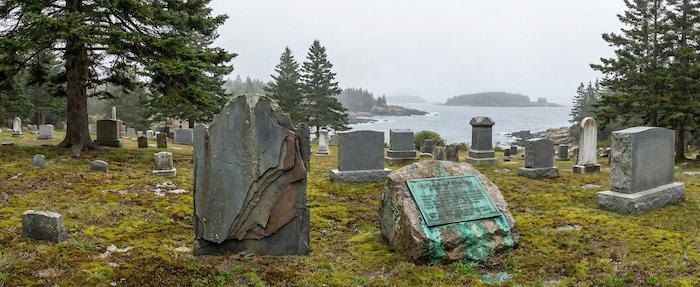
The oldest burying grounds contain sedimentary slate markers. Freezing coastal rain enters the exposed top edges of the rock. The water turns to ice. The physical expansion forces the flat slate layers apart, shearing the stone into distinct sheets.
We carefully clear the organic debris out of the open seams. We inject a specialized flowable grout deep into the cracks. The grout fills the internal voids and blocks new moisture from splitting the remaining stone layers.
Saco River Fog and Moss
The Saco River generates dense morning fog. The constant dampness breeds heavy green moss on the granite markers. The biological mat traps moisture against the rock, accelerating winter frost damage.
We spray liquid biocides over the granite. The chemical destroys the roots completely. The dead moss detaches and washes away naturally in the rain.
Accelerated Iron Pin Corrosion
Large Victorian monuments in St. Joseph's Cemetery rely on internal iron pins to connect the separate granite tiers. The marine salt air accelerates the rust process. The internal iron swells. The physical expansion snaps the granite corners completely off the base block.
We hoist the upper granite blocks using heavy steel gantries. We core the rusting iron dowels out of the rock. We install stainless steel pins. We seal the seams with structural epoxy to block coastal moisture and secure the monument.

Service Logistics and Pricing
We skip the on-site estimates and hidden upcharges. For all cemetery monument maintenance, we operate a flat-rate subscription model based strictly on the size and type of the marker. You check your exact cost instantly using our online configurator. You book the work, and our field crew heads to the cemetery.
- Carbon Extraction: Using poultice to dissolve gypsum crusts from textile mill soot.
- Salt Extraction: Applying poultice to pull sub-surface chlorides out of spalling stone.
- Base Resetting: Digging out wet silty loam and packing gravel under sinking monuments.
- Slate Repair: Injecting flowable grout to seal splitting historic slate markers.