
Pulp Mill Lignin and Alluvial Silt Frost Lensing
Waterville cemetery plots sit on fine alluvial silt deposited by the Kennebec River. Historic pulp and paper mills processed heavy timber directly across the river. People searching for headstone cleaning services near me find granite monuments sealed under black chemical tar or tilted at severe angles by expanding soil. As a professional headstone restoration company, we reconstruct the failed alluvial foundations and chemically extract the industrial pulp soot from the masonry.
Black Liquor Soot and Lignin Crusts
The local pulp mills boiled timber using harsh chemicals. The exhaust stacks emitted airborne lignin and black liquor soot. This industrial particulate settled on the cemetery plots. Solar radiation baked the wet soot onto the granite. A rigid black chemical crust forms over the polish. The tar obscures the carved lettering completely.
Mechanical scraping gauges the granite surface. We deploy heavy lignin emulsifiers. We spray the chemical foam directly onto the black crust. The formula breaks the molecular bond of the wood tar. The crust dissolves into a liquid sludge. We wash the bare stone clean using low-pressure water. We expose the factory polish without abrasive damage.
"My Angela's headstone had not been cleaned in fifty years. I moved to Florida many years ago and I do visit San Diego, but never was able to get her headstone cleaned. My Angela is in the children's mausoleum chapel. I miss her every day. She was 5 years old when she passed. Well, im telling you after you guys cleaned up her headstone I didn't even remember what it had originally looked like. What a fabulous job! Everyone should use your company. It is truly beautiful. I can't wait for the rest of my family to see it. Thank you so much. Margaret "
— Roberta Silfen, Bangor, Maine
Alluvial Silt Frost Lensing
The Kennebec River valley sub-grade consists of fine alluvial silt. This specific dirt traps high volumes of capillary water. Sub-zero winter temperatures freeze this moisture. The freezing water forms thick, horizontal ice lenses directly under the monument footings. The physical expansion generates extreme vertical uplift. This force pushes 1,000-pound granite bases completely out of level.
Pushing the monument back upright fails. The next freeze cycle will tilt the stone again. For permanent leaning headstone repair, we execute a full base extraction. We excavate the moisture-trapping silt past the local frost line. We install a deep vertical drain field using crushed angular trap rock. The jagged stone drops the localized water table. Dry ground cannot form ice lenses. The monument stays plumb.
Brownstone Exfoliation and Consolidation
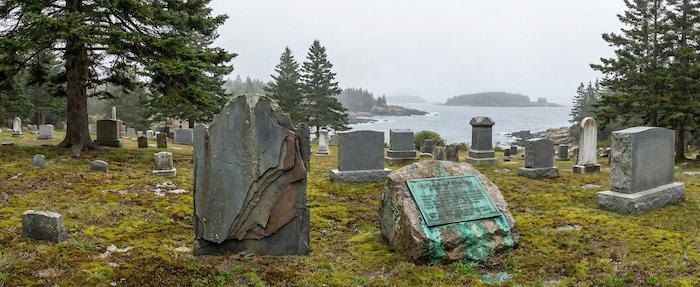
Historic 19th-century plots contain sedimentary brownstone markers. Water enters the porous bedding planes. Freezing temperatures turn the trapped liquid to ice. The physical expansion shears the front face off the marker in flat sheets. We classify this structural failure as exfoliation.

We cannot reattach the sheared sheets. We clear the loose rock debris. We apply liquid silane consolidants to the damaged stone. The chemical penetrates deep into the porous rock. It hardens and glues the internal silica crystals together. This application stops the structural decay and preserves the remaining stone mass.
River Humidity and Cyanobacteria
The Kennebec River generates dense morning humidity. The constant moisture breeds black cyanobacteria on the shaded granite panels. The organism secretes acid that physically etches the rock polish. The biological mat also traps water against the masonry, accelerating winter frost damage.
We spray commercial biocides over the granite. The chemical penetrates the rock pores and destroys the cellular structure of the bacteria. The black stains fade entirely. We wash the dead biological matter away without abrasive scrubbing.
Iron Dowel Corrosion and Granite Fracture
Large multi-tier monuments rely on internal iron dowels for structural alignment. Rainwater enters the horizontal mortar joints. The internal iron rusts and swells. The mechanical expansion exerts thousands of pounds of pressure. The force shears the granite corners completely off the base block.
We hoist the upper granite tiers using heavy steel gantries. We core the rusting iron dowels out of the rock. We install stainless steel pins. We seal the seams with structural epoxy to block new moisture and secure the heavy blocks.
Service Logistics and Pricing
We skip the on-site estimates and hidden upcharges. For all cemetery monument maintenance, we operate a flat-rate subscription model based strictly on the size and type of the marker. You check your exact cost instantly using our online configurator. You book the work, and our field crew heads to the cemetery.
- Lignin Extraction: Using chemical emulsifiers to dissolve pulp mill black liquor soot.
- Deep Leveling: Excavating alluvial silt past the frost line to stop ice lensing heave.
- Stone Hardening: Brushing liquid silane consolidants into exfoliating brownstone markers.
- Cyanobacteria Eradication: Killing dark biological growth fueled by river humidity.