
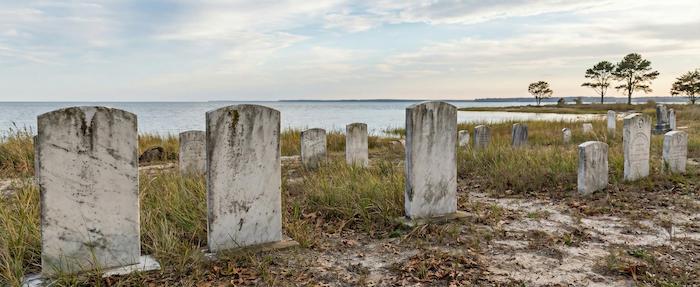
A Cockeysville marble monument in a Baltimore County cemetery can crumble to a sugary powder within a lifetime of acid rain exposure; a bronze veteran's plaque on the Chesapeake waterfront corrodes green from waterfowl droppings instead. Every headstone cleaning Tending performs, from Cockeysville marble country to the Chesapeake waterfront, covers all 2,898 of Maryland's cemeteries under one $2,000,000 liability policy and ICCFA membership. Which fix actually helps a Maryland headstone depends on what's really behind the damage.
How Maryland's Historic Marble and Chesapeake Climate Shape Headstone Care
Central Maryland's cemeteries hold historic marble quarried from the same source that built the Washington Monument, and acid rain has spent a century and a half slowly dissolving its calcite binder. Humidity off the Chesapeake Bay feeds algae that obscures inscriptions statewide, and waterfowl droppings attack bronze markers along the same shoreline.
Cockeysville Marble Sugaring and Headstone Restoration
Baltimore County's Beaver Dam quarry produced the Cockeysville marble used to build the Washington Monument in both Baltimore and Washington, D.C., along with columns at the U.S. Capitol and the exterior of Baltimore City Hall. That marble also filled headstones and family monuments across the region's historic cemeteries, and it carries the same vulnerability that affects any calcite-based stone: acid rain dissolves the binder holding its grains together, one layer at a time. Conservators call the result sugaring, since the crumbling surface takes on the texture of granulated sugar once enough of the calcite binder is gone. The Beaver Dam quarry itself flooded in 1934 and has been a swimming club ever since, so no fresh Cockeysville marble has been cut for monument work in generations, making every surviving marker that much harder to replace in kind. Water and a stiff brush alone can strip carved details off a sugaring stone within a single cleaning, since the surface grains have nothing left holding them in place. An alkaline wash first neutralizes whatever acid is still active on the surface, stopping the decay before it goes any further. A liquid silicate consolidant follows, soaking into the crumbling marble and curing into a solid mineral structure that locks the loose grains back together. Headstone restoration on Cockeysville marble always starts with this stabilization, since cleaning a stone that's still actively dissolving only wears away more of what's left.
Chesapeake Bay Algae and Headstone Lettering Repair
Maryland's cemeteries near the Chesapeake Bay sit under some of the heaviest atmospheric humidity on the East Coast, and the dampness keeps porous granite and marble monuments wet long after a storm has passed. Cyanobacteria and black algae colonize the wet surface within a single season, driving root systems down into the stone's own pores as the colony spreads. The organism releases oxalic acid as a byproduct, and the acid dissolves the polished surface chemically at the same time the growth is spreading across it. An engraved name can disappear under the black growth within a year in the wettest cemetery sections, and scraping the colony off dry only drives its embedded roots deeper into the stone. Cemetery sections under mature tree canopy stay wet longest between storms, since shade keeps the sun from ever fully drying the stone out. A biocide soak reaches those embedded roots chemically and kills the colony at depth, and a low-pressure rinse clears the dead growth away days later without disturbing the stone underneath. Headstone lettering repair repaints whatever letter the growth had obscured once the acid it released has been fully neutralized.
Chesapeake Waterfowl and Bronze Marker Restoration
Maryland's Chesapeake shoreline hosts large populations of gulls and Canada geese year-round, and their droppings land on flat monuments and bronze plaques as readily as on anything else nearby. Guano carries a heavy concentration of uric acid, and the acid attacks a bronze plaque's factory clear coat directly, breaking the protective lacquer down until it flakes away. Once the coating fails, bare copper alloy reacts with the humid coastal air, and a thick green crust forms over whatever's left of the finish. Raised cast letters lose their contrast first, since flat surfaces on a cast plaque tend to hold moisture longest between rains. Plaques mounted flat into the ground near open water see the heaviest droppings of all, since geese and gulls favor open sightlines close to the shoreline for feeding and resting. Technicians strip the dead clear coat and green oxidation down to bare metal, neutralize whatever acid residue remains, and reapply a fresh dark background paint to the recessed areas before regrinding the raised lettering back to bright bronze. Bronze marker restoration finishes with a marine-grade clear sealer over the whole plaque, giving the next round of guano something it can't easily eat through.