
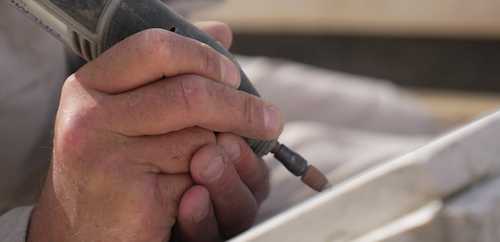
Quarries around Frederick and Hagerstown, including Vulcan Materials' Frederick operation and Martin Marietta's Pinesburg and Boonsboro sites, produce a fine limestone dust that drifts onto nearby cemetery ground and settles directly into carved lettering. Farther west, the Allegheny Plateau logs roughly 160 days a year below freezing, a stretch of hard cold few other parts of the state come close to matching, and each of those cycles works at paint sealed inside a carved channel. Along the coast, humidity and steady sun fade painted letters on their own, and once every seventeen years, Brood X cicadas emerge by the billions and leave behind organic debris that packs into grooves and traps moisture against the paint. Tending's lettering crews carry ICCFA membership and $2,000,000 in liability coverage on every job in Maryland.
Limestone Quarry Dust in the Frederick-Hagerstown Valley
The limestone valley running from Frederick through Hagerstown hosts several active quarries, Vulcan Materials' Frederick Quarry and Martin Marietta's Pinesburg and Boonsboro operations among them, and fine calcium carbonate dust from blasting and crushing drifts onto cemetery ground for miles downwind. Rain and dew bind that dust into a hard, chalky crust once it settles inside an open carved letter, and the crust keeps building with every dusty stretch of quarry activity. Enough of it accumulated behind a coat of paint is enough to lift the edges free of the stone underneath, a mechanical failure that looks nothing like ordinary sun fading. Clearing the crust first usually reveals a channel that's still structurally sound.
Freeze-Thaw Expansion in Western Maryland
Western Maryland's Allegheny Plateau logs around 160 days a year with temperatures dropping below freezing, easily the coldest stretch found anywhere in the state. Ice occupies roughly nine percent more space than the liquid water it froze from, and a carved letter holding even a small amount of trapped moisture registers that expansion directly against the paint sealing it. Each freeze cycle nudges loose whatever adhesion has already started to fail, and a groove with a weak spot from age takes the brunt of it since the expanding ice always finds that same soft point first. Garrett and Allegany County monuments can rack up freeze cycles by the dozen before a single winter is over, giving the paint little room to recover between one cold snap and the next.
Coastal Humidity and Sun on the Eastern Shore
Maryland's Eastern Shore holds humidity close to the ground for much of the year, and that sustained dampness alone works at a painted surface over time, without any salt or debris involved at all. Long stretches of open coastal sun add a second factor, delivering cumulative UV exposure to a headstone's face that a shadier inland cemetery rarely sees to the same degree. Letters faded by humidity and sun alone generally keep their shape and adhesion intact; only the pigment itself washes out, leaving a pale but still legible outline.
Brood X Cicadas and Organic Debris in the Groove
Brood X, one of the largest periodical cicada broods in the country, last emerged across Maryland in the billions in 2021 and won't surface again until 2038, on a cycle timed to exactly seventeen years. During an emergence, shed exoskeletons and dead insects collect in large numbers on any horizontal or recessed surface nearby, carved lettering included, and that organic debris traps moisture against the paint underneath it for weeks at a time. The mechanism is ordinary and mundane, damp organic matter sitting against a painted surface, but the sheer volume during an emergence year concentrates it in a way that a normal season never does.
Headstone Lettering Repair Costs in Maryland
A price comes directly out of the photos a family submits, the number of characters and how deep they're carved feed the calculator, and whichever of these four causes did the damage doesn't move that price up or down. Once the repainting wraps up, finished photos of the lettering go into the Tending app for the family to look over whenever suits them.
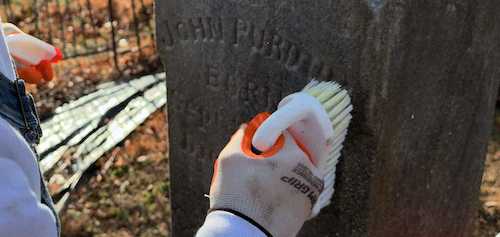
How Our Headstone Lettering Repair Process Works
- Narrowing Down the Cause From Photos Quarry-dust crusting, freeze-thaw lifting, sun fade, and cicada-debris buildup each show up differently in submitted photos, usually enough to point to a cause ahead of the visit.
- Clearing Out the Old Paint Working letter by letter, a hand tool strips away whatever paint has failed along with any crust or debris lodged in the channel, leaving sound paint untouched.
- Flushing the Channel A rinse suited to the cause, dust residue, organic debris, or ordinary grit, clears the carved letter down to bare stone.
- Getting the Groove Fully Dry Compressed air drives out whatever moisture is left in the channel, since sealing new paint over a damp groove is one of the most common reasons a repaint fails early.
- Applying Enamel and Wrapping Up Enamel builds up inside the dry channel in thin passes until it matches the stone's original carving depth, and once it's cured, the crew photographs the result and uploads it through Tending's app.
