
Painted headstone lettering fails for different reasons depending on where in Nebraska a monument stands: sun and dry air bleach it out west, wind-driven sand wears at it in the Sandhills, and hard water leaves a chalky film inside the grooves farther east. Crews on the ground regularly work on monuments carved decades apart within the same family plot, and the letter-carving depth alone can add several years to how long a fresh coat of paint holds up under any of these conditions, no matter which part of the state the family plot happens to be in. Tending repaints headstone lettering statewide on one fixed-price process, carrying $2,000,000 in liability coverage and membership in the ICCFA on every job.
Dry Air and Sun in the Panhandle
Scottsbluff sits near 3,900 feet of elevation, well above Omaha's roughly 1,090 feet, and that thinner, drier air across the Panhandle lets direct sun break down a standard paint binder within just a few summers. Once the binder turns brittle, the pigment starts flaking out of the carved groove years ahead of a letter painted somewhere with more cloud cover and moisture. Crews clear that brittle film down to bare stone before any repaint, since painting over a cracked layer just seals the same problem in underneath.
Wind-Driven Sand in the Sandhills
The Sandhills' grass-stabilized dunes hold loose sand in place most of the year, but a bare patch where the cover has thinned, from mowing or foot traffic near a family plot, can shed fine grit that a strong gust carries across a cemetery and works against a painted letter's surface. That abrasion dulls and pits the enamel in a way that looks different from simple sun-fading, and letters positioned close to grade level catch the most of that wind-carried grit since it travels low across the ground. Tending treats that wind-worn texture as its own repaint case, distinct from the fix for a UV-bleached letter farther west.
Storm Moisture and Groove Cracking Statewide
Nebraska's frost line runs to roughly 36 to 40 inches most winters, and moisture that works into a carved letter during a fall rain freezes solid by the next hard freeze, then thaws again during a later warm spell. A single freeze does little on its own; a Nebraska winter typically swings above and below freezing several times over one season, and it's that repetition that fatigues the paint film at the edge of the carving until it finally cracks. A monument with a footing that's also failing from the same freeze-thaw cycle sometimes gets flagged for both jobs on one visit, in which case the structural side is handled separately under headstone repair. That structural work addresses the base and footing only; it doesn't touch the painted lettering itself, which still needs its own separate repaint once the ground stops moving. Tending's guide to fixing faded headstone lettering walks through why the drying stage in particular matters as much as the repaint itself.
Hard Water Scale in South-Central Nebraska
Grand Island's municipal water tests at roughly 18 grains per gallon, nearly double Omaha's hardness, and the same supply used to water cemetery grounds in Hastings and Kearney leaves a mineral film that settles directly into a carved letter's grooves each time the sprinklers run. That film builds up alongside any fading paint and has to be cleared out separately, since a fresh coat of enamel won't bond over a chalky residue left behind after the water evaporates. Tending's crews dissolve that buildup with a dedicated mineral solvent before repainting the groove.
Headstone Lettering Repair Costs in Nebraska
Pricing runs on character count and groove depth, priced through the calculator from a family's photos; the size of the monument itself and which region of Nebraska the cemetery sits in don't factor into the number at all. A small rural marker near Thedford and a large municipal monument in Omaha get quoted the same way, character by character. Finished photos of the repainted lettering post through the app once the work is done.
How Our Headstone Lettering Repair Process Works
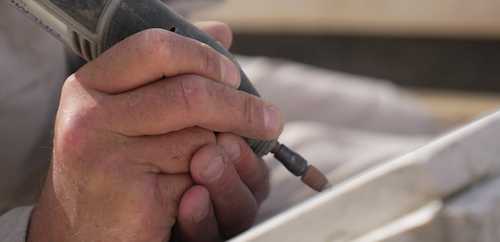
- Picking Out the Failed Paint A pick tool works the brittle or worn paint free of the groove one letter at a time, down to the bare granite or marble underneath.
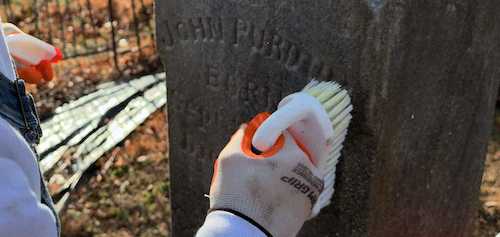
- Washing Out the Channel A solvent rinse pulls whatever scale, dust, or leftover pigment is still sitting in the carving before the crew moves on to the next stage.
- Letting the Groove Dry Out The channel sits until it's bone dry inside, since enamel applied over any residual dampness tends to bubble and lift within a season.
- Matching and Setting the Enamel The crew mixes a weather-grade enamel to match the letter's original shade and packs it into the dry groove by hand.
- Wiping Down and Logging the Job Overspray on the surrounding stone gets wiped clean, and photos of the finished lettering go up through the Tending app before the crew moves to the next site.
