
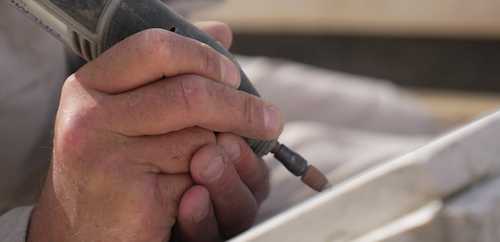
Painted headstone lettering fails for different reasons across New Jersey: heat cycling in the built-up North Jersey corridor, salt crystallizing inside the groove at the Shore, pine sap and acidic dust in the Pine Barrens, and shaded, damp stone across the Highlands. Tending's guide to fixing faded headstone lettering covers the repainting process in more depth. Every job statewide runs on the same fixed price, and every crew carries $2,000,000 in liability coverage plus membership in the ICCFA.
Heat Cycling Across the North Jersey Corridor
Dense development around Linden and South Brunswick raises local surface temperatures the EPA has measured running 1 to 7 degrees Fahrenheit above nearby open countryside during the day, an effect known as the urban heat island. Dark granite absorbs that extra daytime heat, then sheds it fast once the sun goes down. That swing puts a carved letter's paint through a wider daily range between its hottest and coldest point. The flexing gradually breaks the bond between paint and stone right at the edges of a carved letter. Chips tend to start there first, along the groove's outer rim, well before the center of the letter shows any wear at all.
Salt Crystallization at the Jersey Shore
Salt-laden air settles into the same carved grooves that hold the paint on headstones near Sayreville and the rest of the bay shore. Each time humidity rises and falls, the salt already trapped in a groove recrystallizes. The growing crystals push outward with enough force to lift a thin paint film clean off the stone underneath it. Geologists call this mechanism salt weathering, and it's documented eating into solid building stone over decades. A coat of enamel only a few thousandths of an inch thick stands little chance against that same repeated pressure.
Pine Sap and Acidic Dust in the Pine Barrens
Pitch pine forests surrounding Pine Barrens cemeteries near Sicklerville and Manchester Township drop a steady rain of sap and resin onto anything left outdoors beneath the canopy. That resin lands on painted lettering and hardens into an amber-colored film. The film discolors the enamel and traps fine grit blown up from the sandy soil underneath. The acidic sand itself works its way into hairline cracks that form in older paint, slowly widening them from the inside, well before the resin staining on the surface becomes the more obvious problem.
Shaded, Damp Stone in the Highlands
Heavy oak and hickory canopy covers many Highlands cemeteries. The same valley dampness that keeps the region's reservoirs full also keeps painted stone surfaces damp long after a rainfall has already dried up elsewhere in the state. That lingering moisture lets algae and mold take hold directly over painted letters. The organisms secrete acids as they grow, and those acids etch into the enamel and flatten the contrast between the paint and the surrounding granite.
The Repainting Process
Tending's crews clear every failed letter down to bare stone by hand first. Packing new enamel over old chips or resin residue only traps the problem underneath a fresh coat. A matched solvent flushes out whatever caused the original damage, whether that's salt, sap, or algae, and the groove sits open until it's fully dry before any new paint goes in. Fresh lithichrome enamel gets packed into the letter to the original carved depth, then a final buff evens out the surface and restores contrast between the paint and the surrounding stone. A monument with damaged lettering sometimes has a loose or cracked base underneath it, or a corroded bronze plaque mounted on the same stone. Those get scheduled as their own jobs, under headstone repair and restoration or bronze marker restoration, whichever applies.
Headstone Lettering Repair Costs in New Jersey
Pricing on the calculator runs on two numbers: how many characters need repainting and how deep the original carving actually runs, both worked out from a family's submitted photos. A heat-cracked inscription in Linden and a salt-lifted one near Sayreville get quoted through that identical math. Neither the region nor the specific cause behind the damage changes the calculation. The crew uploads a photo of the finished lettering to the app once the job is done, so a family can check the contrast for themselves.
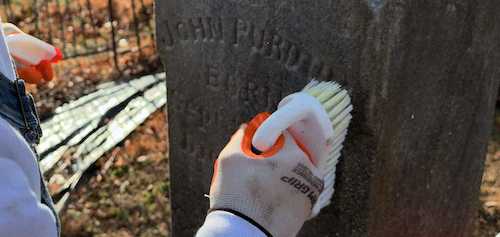
How Our Headstone Lettering Repair Process Works
- Working the Old Enamel Out of the Groove Technicians clear every failed letter down to bare stone by hand, since packing new paint over old chips or resin residue only hides the problem temporarily.
- Neutralizing Residue Inside the Channel A solvent matched to the original cause, whether that's salt, pine sap, or algae, flushes the groove clean before any new material goes in.
- Confirming the Groove Is Fully Dry The channel sits open until every trace of moisture is gone, since fresh enamel packed into a damp groove fails again within a season.
- Filling Each Letter to the Original Depth Fresh lithichrome enamel gets packed into the carved groove to match its original depth, keeping the lettering's proportions consistent with the rest of the inscription.
- Final Polish and Photo Confirmation A final buff restores contrast between the paint and the surrounding granite, and the crew uploads a finished photo to the Tending app.
