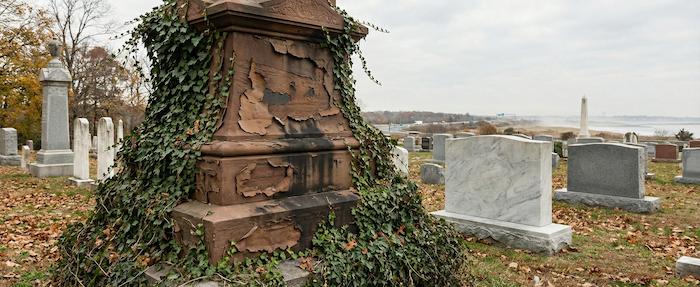
A historic brownstone marker outside Newark can lose whole flakes of its face to a single hard freeze, and a bronze plaque down at the Jersey Shore corrodes from something the winter never touches at all. Headstone cleaning across all 785 of New Jersey's cemeteries comes with the same $2,000,000 liability coverage and ICCFA membership on every Tending job, no matter which of those causes is at work. What works on soft brownstone barely touches a corroded bronze plaque, and treating them the same way just accelerates the damage.
Why New Jersey Headstones Age Differently by Region
New Jersey's own 19th-century brownstone still marks some of its oldest cemeteries, and winter moisture works on that layered stone in a way nothing else in the state quite matches. Heavy industrial traffic through the northern corridor leaves bronze and granite coated in soot, and salt air along the Shore reaches bronze through its own separate chemistry.
Newark Brownstone and Headstone Repair
Brownstone quarried from Belleville and Little Falls became one of the most heavily used building stones in the country during the 19th century, and that same stone ended up carved into monuments across New Jersey's older cemeteries. The rock itself is arkose. It's a mix of quartz and feldspar grains cemented together by iron oxide, and it formed roughly 200 million years ago in distinct horizontal beds. Quarrying could follow those beds cleanly. Masons sometimes set the stone with its natural layers running vertically anyway, for the smoother look it gave the finished face. That orientation gives water a straight path down between the layers whenever it rains, and once winter arrives, whatever moisture is trapped inside freezes and expands against the grain of the stone. Ice pressure pries a thin outer layer away from the body of the stone — stone conservators call the result exfoliation, and a single hard freeze can be enough to pop a flake loose. Cleaning an exfoliating surface without addressing the layers underneath just knocks more of them loose, so headstone repair starts by consolidating the stone itself: a specialized fluid soaks into the porous rock and hardens inside it, bonding the loosening layers back together before any cleaning even begins.
Turnpike Soot and Headstone Lettering Repair
North Jersey's cemeteries sit close to some of the busiest highway and industrial corridors in the country, and decades of diesel exhaust along the Turnpike and Parkway leave a fine carbon film on anything left outdoors nearby. The film carries enough unburned hydrocarbon residue that plain rainwater simply beads up and rolls off the surface without lifting any of it. It hardens under direct summer sun, fusing itself to the granite's polish and settling deep into every carved letter in the process. Inscriptions that were perfectly legible a decade ago start reading dim and gray soon after that. Household soap smears the residue sideways across the stone without actually lifting it off. An alkaline degreaser made to break down heavy hydrocarbon buildup dissolves that bond, and a low-pressure rinse afterward carries the loosened grime away without touching the stone's polish underneath. Bringing the inscription back to full contrast from there is what headstone lettering repair actually does, once the surface underneath has been fully degreased.
Jersey Shore Salt Air and Bronze Marker Restoration
Cemeteries along the Jersey Shore sit directly in the path of onshore wind carrying fine salt spray off the Atlantic, and that salt reaches every exposed surface within a mile or two of the coast. On granite, the sodium chloride crystallizes across the polished face as the spray dries, leaving a rough white haze that dulls the stone's finish. Bronze plaques react to the salt very differently: chloride ions penetrate the metal's surface and react with the copper to form cuprous chloride, an unstable compound that conservators call bronze disease once it takes hold. The reaction feeds itself once bronze disease sets in — moisture in the air keeps reacting with the chloride byproduct, and the corrosion spreads outward from the original pit even after the plaque is moved somewhere dry. A single untreated pit can undermine an entire plaque's finish within a few seasons of Shore exposure, spreading well past where the original salt contact happened. Standard bronze polish barely touches a chloride reaction already happening beneath the surface, so technicians strip the affected area down to bare metal first, treat it with a stabilizing rinse that neutralizes the chloride, and reseal the plaque with a wax coat rated for continued salt exposure. Bronze marker restoration stops bronze disease at the source, since polishing over the surface leaves the chloride reaction untouched beneath it.