
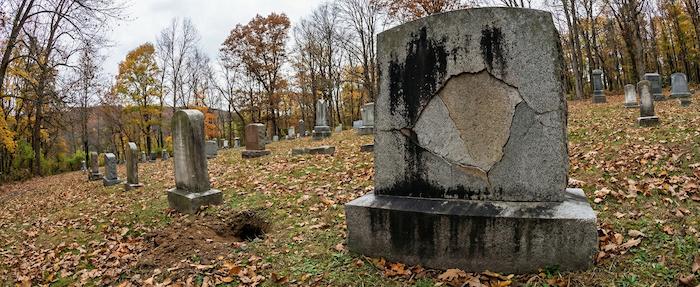
Susquehanna River Algae on Headstones
The Susquehanna River widens into a slow, humid basin through Harrisburg, and that moisture rarely leaves the cemeteries closest to the water. Fog settles into the low ground at Harrisburg Cemetery and Paxtang Cemetery on most mornings between spring and late fall. Algae takes hold first on shaded granite and marble faces, then moss follows and works down into the carved letters. A stone that was pale gray two summers ago can look almost black within three.
Families searching for headstone cleaning services near me usually describe the same thing on the phone: a marker that used to read white or gray and now looks green or gray-black, with lettering hard to make out under the growth. That's a biological growth problem, not a simple surface stain — scrubbing alone leaves the root structure intact, and the color comes back within a season. Tending carries a $2,000,000 liability policy and is a member of ICCFA, the industry's leading cemetery and funeral association.
That same river dampness is hard on more than stone. Many veterans' markers in these cemeteries are bronze, and constant humidity strips the protective lacquer and leaves green oxidation across the casting within a few years. Tending's bronze marker restoration removes that oxidation and reseals the metal with a marine-grade lacquer suited to a river-humidity climate.
Shipoke Brownstone Grave Marker Flaking
Shipoke and the older river-adjacent blocks near downtown hold a lot of 19th-century brownstone monuments, prized once for how easily the stone carved and detailed. That softness is also its weakness. Water works into the natural layering of the stone, and when it freezes each winter the outer face pops loose in thin sheets. Some markers in Prospect Hill and Harrisburg Cemetery look like they're peeling. This kind of headstone restoration takes patience, not speed.
Once a face has flaked away, the carved inscription underneath goes with it, so Tending's headstone lettering repair work here usually starts with stabilizing what layer remains before any lettering can be re-defined. Older white marble markers nearby show a related problem: acid in the rain reacts with the calcite and turns the surface into a soft, granular texture people often describe as sugar underfoot. Both materials get the same basic treatment — loose material is cleared by hand, then a stone consolidant soaks in and locks the remaining grains together so the inscription doesn't keep disappearing.
Keystone Corridor Diesel Film on Markers
Harrisburg carries a lot of through-traffic for a city its size — I-83 crosses the river right downtown, and the Keystone Corridor rail line runs freight and Amtrak trains past several older cemeteries on the east side. Diesel exhaust from both settles as a fine oily particulate that rain doesn't rinse away on its own. On granite it shows up as a gray haze that dulls the polish; on lighter stone it can look almost like a stain baked into the surface.

This film is oily, not mineral, so plain soap and water barely touch it. The crew uses a stone-safe degreasing solution paired with tampico-bristle brushing to break the bond, then rinses at low pressure so the residue lifts free and doesn't smear deeper into the surface. On a corridor like this, grave marker restoration really comes down to clearing that petroleum film on a regular cycle so it never gets the chance to bond permanently.
Riverbank Silt Settling Under Headstones
The ground closest to the river is soft alluvial silt, built up from centuries of flooding, and it doesn't hold weight well. Heavy upright monuments near the water at Harrisburg Cemetery and along the lower sections of Prospect Hill gradually lean or sink as the silt compresses unevenly underneath them. Some markers end up buried to the shoulder within a decade or two.
Resetting a stone like that isn't just lifting it back into place — if the soil underneath stays soft, it sinks again within a year or two. Tending's headstone repair and restoration crews excavate below the base, pack in compacted gravel so water drains away and doesn't pool under the stone, then reset the monument level on that new footing. It's slower than a quick reset, but it's the difference between a stone that stays upright and one that needs the same fix again in a few years.
"I needed three tombstones cleaned and restored, so I did some research and found Nationwide Grave Care & Headstone Cleaning. I emailed them to ask about their services and costs, and they quickly replied and even called to discuss the details. Two of the stones were 19 years old, and the third was at least 30 years old, all in need of cleaning and restoration. After reviewing the different options, I chose the one that best fit my budget and timeline. I was very impressed with their workmanship and how quickly the job was done. The stones looked like new, with all the stains and grime gone, and they even sent me before and after photos. I felt it was a great value for the work done and wouldn’t hesitate to use their service again."
— Douglas Fink, Chester Springs, Pennsylvania
Service Costs in Harrisburg
Pricing for this work comes from an online calculator, not a site visit. You choose the memorial type and a care plan, the calculator returns a fixed price, and you can get that number any time through our online calculator. Whether it's algae removal, brownstone consolidation, or full monument restoration services, the price is fixed before a technician is ever scheduled.
- Algae and Moss Removal: biological treatment that kills root-level growth on granite and marble, not just surface color.
- Brownstone Consolidation: clearing loose flaking layers and applying a stone consolidant to lock the surface back together.
- Exhaust Film Cleaning: stone-safe degreasing and hand brushing to lift oily diesel residue from polished granite.
- Leveling and Resetting: excavating soft silt and resetting monuments on a compacted gravel base.