
A Century of Valley Flooding Has Eroded Low Ground
Johnstown sits where the Stonycreek River meets the Little Conemaugh to form the Conemaugh River, a narrow valley confluence that has flooded catastrophically three times in the past century and a half, most famously in 1889 and again in 1936 and 1977. The 1889 flood alone killed more than 2,200 people and buried downtown Johnstown under several feet of floodwater and debris, a level of devastation that still anchors the valley's flood history today. Each of those floods, along with countless smaller high-water events between them, has scoured and reshaped the low ground along the valley floor. Cemetery plots on this lower terrain have absorbed generations of that repeated erosion, even in sections that have looked stable for years at a time.
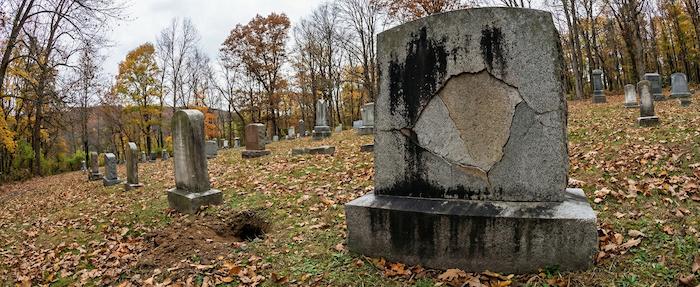
A headstone base on ground that's taken on floodwater repeatedly over the decades doesn't have the same undisturbed footing a plot on higher, valley-wall terrain would, since each flood event washes out small amounts of supporting soil even when no visible damage shows up right away. That kind of gradual, cumulative loss is easy to miss between individual flood events, since the ground can look completely normal for years at a stretch in between. Headstone cleaning services near me searches from Johnstown families sometimes come after a stone on lower ground has shifted following a wet season, tracing back to this long accumulated history. Any single storm alone wouldn't fully explain it. Tending checks a plot's flood exposure before resetting an affected base, since ground with this kind of history needs a deeper, more resilient footing than typical soil. Larger structural repairs are covered under headstone repair and restoration. Tending also carries a $2,000,000 liability policy and holds membership in ICCFA, giving Johnstown families added assurance when work happens on ground with this much settlement history.
"I had three cemeteries reviewed and memorials restored and/or cleaned. Service was fast and efficient. Memorials quickly located. I look forward to a visit shortly and quarterly update. Thanks, this has been on my mind for some time."
— Edward Drosdick, Pennsylvania

Steep Valley Walls Keep Shaded Plots Persistently Damp
Johnstown's narrow valley setting means the surrounding hillsides block direct sun from reaching parts of the valley floor for a large portion of the day, especially through the shorter days of fall and winter. Cemetery sections tucked against these steep valley walls stay damp far longer after a storm than plots with open exposure, and that persistent shade gives algae a foothold it wouldn't get on a more open hillside nearby. Two stones set the same decade can end up looking dramatically different in condition depending on which side of the valley they happen to sit on.
Bronze veterans' plaques in these same shaded, valley-wall plots develop a heavier green corrosion for the same reason. Tending clears algae from shaded valley stone with a soft-wash biocide suited to consistently damp conditions, and cleans and restores bronze grave markers affected by the same persistent shade on the same visit.
Valley Cold-Air Pooling Deepens Freeze-Thaw at Low Elevation
Cold, dense air sinks and collects at the bottom of a narrow valley like Johnstown's on clear, calm nights, a well-documented effect that leaves the valley floor noticeably colder than the surrounding hillsides even when the broader forecast shows the same temperature for the whole area. Headstones on this lower ground go through more severe overnight freezing than markers just a short climb up the valley wall, and that extra cold works into hairline cracks more aggressively with each cycle, year after year adding up to a measurable difference in wear.

Tending recuts and repaints lettering worn down by this valley-bottom freeze pattern, following headstone lettering repair standards adjusted for the deeper cold Johnstown's low-lying plots experience compared to higher ground nearby.
Service Costs in Johnstown
Pricing runs through Tending's online calculator once the monument type and care plan are selected, with no in-person visit required to assess the damage first. A maintenance plan can be added for markers affected by flood-related erosion, valley shade, or deepened cold-air freeze-thaw.
- Base resetting and stabilization: correcting settlement from historic flood erosion.
- Algae removal and bronze cleaning: soft-wash treatment for shaded valley-wall plots.
- lettering repair: recutting engraving worn by valley cold-air freeze-thaw cycles.