
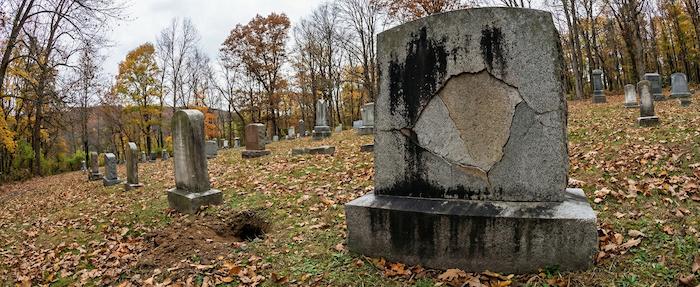
Soft Lansdale Shale Meets Hard Diabase Underground
Geologists named the Lansdale shale directly after this borough, a soft, calcium-rich red rock formation running thousands of feet thick beneath the surrounding countryside. That red shale erodes and compresses more easily than most bedrock, but it isn't uniform underground — dark bands of diabase, hard igneous rock that pushed up through cracks in the shale roughly 200 million years ago as the continents pulled apart, cut through it in dikes and sills scattered across the borough. A foundation resting on shale a few feet from one of these diabase bands ends up on dramatically different ground than a foundation set directly on the diabase itself.
That mismatch means a headstone base can settle unevenly even when nothing about the surface hints at what's happening below, since the soft shale side compresses under the monument's weight while the hard diabase side barely moves at all. The result can look like an ordinary lean at first glance, but the underlying cause has nothing to do with soil quality the way it typically would. Headstone cleaning services near me searches from Lansdale families sometimes come after a stone has developed a lean with no obvious surface cause. Tending checks which side of the underground boundary an affected base is actually sitting on before resetting it, since a standard footing spanning both rock types won't support the stone evenly. Larger structural repairs are covered under headstone repair and restoration. Tending carries a $2,000,000 liability policy on every Lansdale job and holds membership in the ICCFA, the association that sets professional standards for cemetery and memorial care.
Iron-Rich Red Shale Groundwater Leaves a Reddish Tint
The Lansdale shale gets its color from iron oxide worked through the rock, part of what regional surveys once called the "New Red" series for exactly this reason, and groundwater passing through that iron-saturated shale carries some of the color with it. Where this mineral-rich water reaches a nearby headstone, it can leave a faint reddish tint distinct from the browner rust staining more common elsewhere, building up gradually low on the stone where the water actually contacts it. The effect tends to be subtle enough that it takes several years before the tint becomes obviously noticeable.

Bronze veterans' plaques exposed to the same red-shale groundwater can pick up a similar reddish cast layered over the metal's usual patina. Tending treats this iron-oxide tinting with a solution matched to the shale's specific mineral chemistry, and the same crew cleans and restores bronze grave markers affected by the same groundwater on the same visit.
Southeastern Pennsylvania Freeze-Thaw Wears Down Older Lettering
Lansdale's winters cycle repeatedly through the freezing point. One long, unbroken cold stretch is the exception here, not the norm, and each cycle drives water a little further into cracks that have already started forming on an older stone. Marble and the softer local shale absorb that moisture readily, and the repeated pressure eventually flattens engraved lettering that was once sharp enough to read from across a row. Granite pieces standing nearby typically show far less wear over the same stretch of decades, since granite lacks the porous structure both marble and shale share. That contrast shows up most clearly in the borough's older cemetery sections, laid out well before granite became the standard choice for new markers.
When that freeze-thaw cycling has already flattened the engraving on a marble or shale monument, Tending's crew recuts the letters and repaints them, working to headstone lettering repair standards developed specifically for the porous stone common across Lansdale's oldest sections.
Service Costs in Lansdale
Pricing runs through Tending's online calculator once the monument type and care plan are selected, with no in-person visit required to assess the damage first. A maintenance plan can be added for markers affected by shale-diabase settling, red-shale groundwater tinting, or freeze-thaw wear.
"I had three cemeteries reviewed and memorials restored and/or cleaned. Service was fast and efficient. Memorials quickly located. I look forward to a visit shortly and quarterly update. Thanks, this has been on my mind for some time."
— Edward Drosdick, Pennsylvania

- Base resetting and stabilization: correcting uneven settlement between shale and diabase ground.
- Iron-oxide tint removal and bronze treatment: mineral-specific cleaning for red-shale groundwater.
- lettering repair: recutting engraving worn by regional freeze-thaw cycles.