
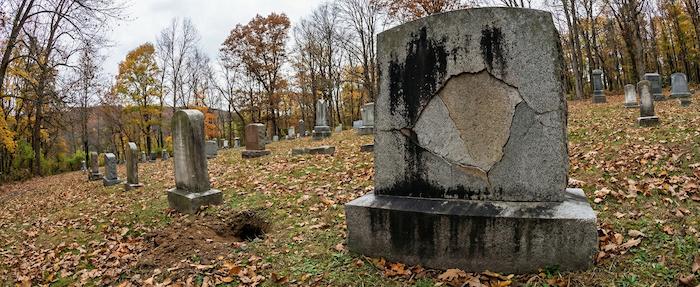
A headstone cleaning services near me search from Lebanon usually comes down to one of two things: a marble marker that's losing definition at the edges, or a stone that's gone dark and gritty despite regular rinsing. A wide belt of limestone and dolomite underlies the Lebanon dolomite, soft carbonate rock that dissolves a little every time acidic rain falls on it. Add in a long run of steel-mill history along the Quittapahilla Creek, and the ground and the air both leave their mark on local stone. Farmland pressing in on the city from nearly every direction adds a third factor that most cleaning guides never mention.
Quittapahilla Limestone Dissolves Marble
Roughly a third of Lebanon County's bedrock is carbonate rock, limestone and dolomite that supports the valley's farmland but also reacts with acid rain much the way a piece of chalk reacts with vinegar. Marble headstones, built from that same calcium carbonate, wear down at the surface with every acidic rainfall. Karst features like sinkholes show up across the valley for the same chemical reason, just on a much larger scale than a single gravestone. Older sections of cemeteries closer to the creek tend to show the wear first, since groundwater there stays closer to the surface.
We clean these markers with a pH-neutral D/2 solution. An acidic product would only speed up the very process that's already wearing the stone down. For monuments where the carved lettering has lost real depth, we treat that separately through gravestone lettering repair and headstone repair, cutting back only as far as the original inscription allows. Most family names and dates can be brought back to a legible depth without recutting the whole line.
Old Steel Mill Soot Darkens Stone
For much of the twentieth century, a steel mill operated along the Quittapahilla Creek corridor that cuts through the middle of the city, and decades of it left a mark on everything nearby, including the older cemeteries closest to downtown. Fine particulate settled into porous stone surfaces long before anyone worried about air quality, and that legacy grime is still worked into some of the older marble and limestone monuments today. Monuments placed within the past decade or two rarely carry this kind of staining, since the mill had already gone quiet by then.
A degreasing soft wash lifts this old soot without stripping the stone's surface. Bronze plaques from the same era carry a similar dark patina. A stone-strength cleaner would be too harsh for that metal, so cleaning it means a separate, gentler product made specifically for bronze surfaces.
"I needed three tombstones cleaned and restored, so I did some research and found Nationwide Grave Care & Headstone Cleaning. I emailed them to ask about their services and costs, and they quickly replied and even called to discuss the details. Two of the stones were 19 years old, and the third was at least 30 years old, all in need of cleaning and restoration. After reviewing the different options, I chose the one that best fit my budget and timeline. I was very impressed with their workmanship and how quickly the job was done. The stones looked like new, with all the stains and grime gone, and they even sent me before and after photos. I felt it was a great value for the work done and wouldn’t hesitate to use their service again."
— Douglas Fink, Chester Springs, Pennsylvania
Dairy Country Dust Fills Carved Letters
Lebanon County remains one of Pennsylvania's most productive farm counties, and dairy and poultry operations surround the city on nearly every side. Fine soil dust and airborne field debris drift into cemeteries during planting and harvest season, settling into the grooves of carved lettering more easily than across a flat polished surface. Over a few seasons, that dust builds up enough to make an inscription hard to read from a short distance. Cemeteries on the city's outer edges, closest to open fields, tend to need this kind of cleaning most often.
A soft brush and mild cleaner clear the packed dust from the lettering without widening the grooves themselves. On stones where the dust has combined with years of rain to leave a harder buildup, we use the same gravestone lettering repair and monument restoration services process used for mineral staining, matched to the letter depth that's still there.
Service Costs in Lebanon
Every Tending plan in Lebanon is priced through our online calculator once you choose the monument type and care plan you want. There's no visit from a technician before you pay and no quote to negotiate by phone. See pricing for your cemetery, then schedule the first cleaning or set up a recurring plan for the season ahead. Many Lebanon families start with a single deep cleaning before deciding whether an ongoing plan makes sense for their plot.

- Limestone and marble cleaning: pH-neutral D/2 treatment for carbonate stone affected by acid-rain dissolution.
- Soot and grime removal: degreasing soft wash for legacy steel-mill grime, with a separate bronze marker cleaning process for metal plaques.
- Lettering and dust care: gravestone lettering repair for inscriptions packed with farm dust or mineral buildup.