
Man-Made Riverbank Rubble Settles Unevenly Over Time
McKeesport grew up at the confluence of the Monongahela and Youghiogheny rivers, and a formal geological study of this exact stretch of riverbank found something surprising: roughly three-quarters of the material making up the banks here isn't natural soil at all, but rubble and fill placed during 19th-century railroad construction along the water's edge. That fill was packed in to build up rail right-of-way, not engineered the way a modern foundation site would be, and pockets of loosely placed rock and debris still sit beneath parts of the low ground near the rivers today. Cemetery ground platted near the water often shares this same disturbed history without anyone realizing it decades later.
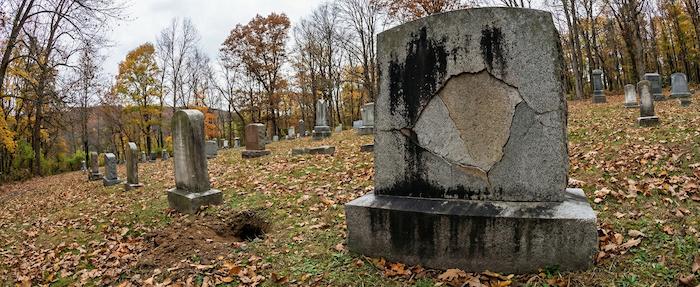
A headstone base set into this kind of rubble fill settles unevenly as gaps between the buried rock and debris slowly compact under the monument's weight, a different process than the settling seen in ordinary soil. That compaction can continue for decades after the fill was originally placed, well past anyone's memory of how the ground was actually built up. Headstone cleaning services near me searches from McKeesport families sometimes come after a stone near the river has dropped noticeably more than markers on higher, undisturbed ground nearby. Tending checks a plot's fill history before resetting an affected base, since loosely packed rubble needs a different footing approach than natural riverbank soil. Larger structural repairs are covered under headstone repair and restoration. Tending carries a $2,000,000 liability policy and holds ICCFA membership, a pairing McKeesport families can confirm before any work begins on a family plot.
Confluence Humidity Deepens Shade and Algae Growth
Where two rivers meet, the combined moisture in the air tends to run higher than it does along either waterway alone, and McKeesport's cemeteries near the Monongahela-Youghiogheny confluence sit right in that humid zone. Combined with mature tree cover common in the city's older sections, that extra humidity keeps stone surfaces damp for days after a storm passes, giving algae a foothold that drier, higher-elevation plots in the same cemetery don't deal with nearly as often. A marker set a short distance up from the river bottom often stays noticeably cleaner over the decades than a comparable stone right at the confluence.
"I needed three tombstones cleaned and restored, so I did some research and found Nationwide Grave Care & Headstone Cleaning. I emailed them to ask about their services and costs, and they quickly replied and even called to discuss the details. Two of the stones were 19 years old, and the third was at least 30 years old, all in need of cleaning and restoration. After reviewing the different options, I chose the one that best fit my budget and timeline. I was very impressed with their workmanship and how quickly the job was done. The stones looked like new, with all the stains and grime gone, and they even sent me before and after photos. I felt it was a great value for the work done and wouldn’t hesitate to use their service again."
— Douglas Fink, Chester Springs, Pennsylvania
Bronze veterans' plaques in these same humid, shaded plots develop a heavier green corrosion for the same reason. Tending clears algae from confluence-adjacent stone with a soft-wash biocide suited to persistently humid conditions, and cleans and restores bronze grave markers affected by the same dampness on the same visit. Most stone recovers its original finish within a single treatment.
Steel City Winters Wear Down Marble and Limestone Lettering
Temperatures in McKeesport cross the freezing point over and over through a typical winter, and each of those crossings pushes a bit more moisture into cracks that have already formed on an aging monument. Marble and limestone lettering bears the damage first. These stones hold surface moisture well after a nearby granite marker has already dried, and that lingering dampness is what wears engraved letters shallow. McKeesport's steel-manufacturing-era stones wear this hardest, their once-crisp names fading to a squint-and-guess read from more than a few feet away.
When engraving on these steel-era marble and limestone stones has worn past easy reading, Tending's technicians recut the letters and repaint them, working to headstone lettering repair standards calibrated for stone already softened by decades of freeze-thaw cycling.

Service Costs in McKeesport
Pricing runs through Tending's online calculator once the monument type and care plan are selected, with no in-person visit required to assess the damage first. A maintenance plan can be added for markers affected by rubble-fill settling, confluence humidity, or freeze-thaw wear, since each of these tends to persist across many seasons. None of them resolve on their own.
- Base resetting and stabilization: correcting settlement over historic riverbank rubble fill.
- Algae removal and bronze cleaning: soft-wash treatment for confluence-adjacent humidity.
- lettering repair: recutting engraving worn by regional freeze-thaw cycles.