
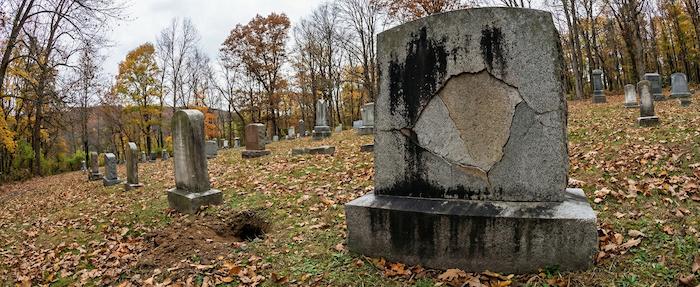
Historic Coal Mining Leaves Ground Prone to Subsidence
New Castle grew up around the confluence of the Shenango River and Neshannock Creek, and the coal deposits underlying much of Lawrence County turned this area into a mining center by the mid-1800s. Neshannock Township alone became known locally as "Coal Town" for the heavy seams worked there, and similar mining operated across the hills surrounding the city for decades. Many of those 19th-century mines were dug without the kind of detailed record-keeping a modern operation would require, and the tunnels themselves were rarely backfilled once the coal ran out.
Ground above an old, unmapped mine tunnel can hold steady for a century before the wooden supports finally give way underground, and when that happens the surface above settles or drops with little warning. A headstone base sitting above one of these forgotten workings can shift suddenly after decades of apparent stability. Neighboring markers over solid ground may show no comparable movement at all, which often makes the sudden shift look even more puzzling to the family involved. Headstone cleaning services near me searches from New Castle families sometimes come after exactly this kind of unexplained movement. Tending investigates the mining history around an affected plot, cross-checking old survey records where they still exist, before resetting the base, since ground that's still settling from below needs a different approach than ordinary soil movement. Larger structural repairs are covered under headstone repair and restoration. Tending carries a $2,000,000 liability policy on every New Castle visit, a standard tied to its membership in the ICCFA.

Historic Iron Ore Deposits Leave Rust-Tinted Groundwater
Parts of Lawrence County hold unusually rich iron ore deposits, documented in local mining records as pockets where the region's normal limestone formation gives way entirely to a thick band of iron ore instead. Groundwater moving through this kind of iron-heavy ground picks up far more dissolved iron than it would passing through ordinary soil, and that mineral-rich water leaves a stronger rust-colored stain on nearby stone than the faint tinting seen in less mineralized areas. A monument set near one of these old ore-bearing pockets can develop noticeably heavier staining within a decade than a comparable stone standing on more typical ground nearby.
Bronze veterans' plaques exposed to the same iron-rich groundwater can develop a heavier, darker corrosion than plaques elsewhere in the same cemetery. Tending treats iron-stained stone with a rust-specific solution matched to the concentration this ground produces, and cleans and restores bronze grave markers affected by the same iron-heavy groundwater on the same visit.
Western Pennsylvania Freeze-Thaw Wears Down Older Lettering
Repeated freeze-thaw cycling defines a New Castle winter, and each thaw pushes meltwater deeper into cracks an older monument has already developed, before the next freeze locks that moisture in place and widens the fracture a little more. That repeated cycle eventually flattens engraved lettering on marble and limestone markers, since both materials hold onto water in a way granite's tighter crystal structure resists. It shows up most on stones set during New Castle's industrial-era boom, where names cut sharp a century ago now take a careful eye to read from more than a few feet away, even as granite neighbors from the same decade remain perfectly legible.
Once engraving has faded past easy reading, Tending's headstone lettering repair service steps in, cutting fresh lines back into the softened marble or limestone and repainting them to match the monument's original inscription depth.
Service Costs in New Castle
Pricing runs through Tending's online calculator once the monument type and care plan are selected, with no in-person visit required to assess the damage first. A maintenance plan can be added for markers affected by mine subsidence, iron-rich groundwater, or freeze-thaw wear, since each of these tends to develop unpredictably and can resurface long after an initial repair, with dated photos from every visit tracking whether an issue is coming back.
"I needed three tombstones cleaned and restored, so I did some research and found Nationwide Grave Care & Headstone Cleaning. I emailed them to ask about their services and costs, and they quickly replied and even called to discuss the details. Two of the stones were 19 years old, and the third was at least 30 years old, all in need of cleaning and restoration. After reviewing the different options, I chose the one that best fit my budget and timeline. I was very impressed with their workmanship and how quickly the job was done. The stones looked like new, with all the stains and grime gone, and they even sent me before and after photos. I felt it was a great value for the work done and wouldn’t hesitate to use their service again."
— Douglas Fink, Chester Springs, Pennsylvania
- Base resetting and stabilization: correcting settlement from historic mine subsidence.
- Iron stain and bronze treatment: rust-specific cleaning for iron-heavy groundwater.
- lettering repair: recutting engraving worn by regional freeze-thaw cycles.