
Historic Iron Slag Fill Slowly Expands Underground
Phoenix Iron Works operated along French Creek for close to two centuries, and a plant that large generated enormous volumes of slag as a byproduct of smelting and refining iron. Slag was cheap, plentiful, and commonly used across industrial towns like Phoenixville to grade low-lying land or fill in soft spots near a plant this size, and some of that fill still sits underground in parts of the borough today. Unlike ordinary soil, certain slag types keep reacting chemically for decades after they're buried, since leftover lime compounds in the material slowly absorb moisture and expand, a process engineers call slag expansion. Blast-furnace slag in particular carries more residual lime than open-hearth byproducts, which helps explain why decades-old fill can still be actively swelling underground today.
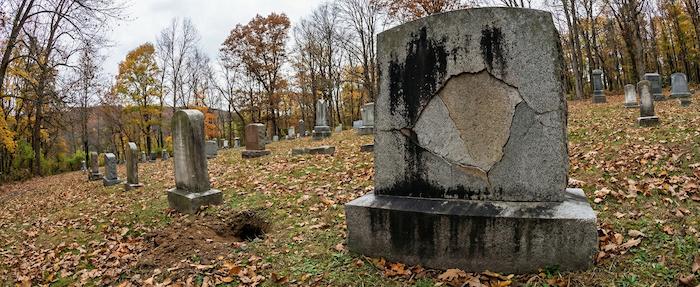
A headstone base set into ground with this kind of slag fill underneath doesn't just settle the way a base over ordinary soil might — it can actually heave upward over years as the buried material swells, pushing the stone slightly out of level in the opposite direction most settling problems move. That upward push tends to happen slowly enough that it's easy to mistake for ordinary ground shift at first glance. Headstone cleaning services near me searches from Phoenixville families sometimes come after a marker has risen, not sunk. That upward direction points toward this specific kind of fill and not typical soil movement. Tending checks for slag-related fill history before resetting an affected base, since expanding fill needs a different approach than compacting soil. Larger structural repairs are covered under headstone repair and restoration. Tending also carries a $2,000,000 liability policy and belongs to the ICCFA, credentials Phoenixville families can check before any technician works near an aging family plot.
"I needed three tombstones cleaned and restored, so I did some research and found Nationwide Grave Care & Headstone Cleaning. I emailed them to ask about their services and costs, and they quickly replied and even called to discuss the details. Two of the stones were 19 years old, and the third was at least 30 years old, all in need of cleaning and restoration. After reviewing the different options, I chose the one that best fit my budget and timeline. I was very impressed with their workmanship and how quickly the job was done. The stones looked like new, with all the stains and grime gone, and they even sent me before and after photos. I felt it was a great value for the work done and wouldn’t hesitate to use their service again."
— Douglas Fink, Chester Springs, Pennsylvania

French Creek and Schuylkill Confluence Flooding Leaves Silt
Phoenixville sits right where French Creek meets the Schuylkill River, and that confluence has flooded periodically throughout the borough's long industrial history, sometimes backing up both waterways at once during a heavy storm. Cemetery plots on lower ground near either waterway take on floodwater during these events, and the mud left behind once it recedes bonds to the stone's surface in a way plain rainwater never would, resisting a simple rinse long after the flood itself is a memory.
Bronze veterans' plaques in the same low-lying plots pick up a comparable coating and go dull underneath it. Tending scrubs out flood mud using a technique built for that dense, bonded residue. A standard cleaning pass alone won't touch it. The same visit covers bronze marker cleaning and restoration for pieces caught in the same flood zone. Most stone comes back to its original appearance once the buildup is fully worked out.
Frequent Freeze Cycles Flatten Borough Lettering Over Time
Phoenixville rarely gets one long deep freeze; instead, temperatures climb above and drop below the freezing point over and over across a typical winter, and each thaw-and-refreeze cycle pushes a little more moisture into cracks an older monument has already developed. Engraved lettering on marble and limestone fades first in this cycle. Granite's tight grain drains fast, but marble and limestone hold that same moisture right against the carved surface. The clearest cases sit among Phoenixville's industrial-boom-era stones, where names cut crisp decades ago have gone hard to make out from any real distance.
When that freeze-thaw wear has worn a name past easy reading, Tending's crews recut the letterforms and repaint them using headstone lettering repair methods matched to the softer marble and limestone found across Phoenixville's oldest sections.
Service Costs in Phoenixville
Pricing runs through Tending's online calculator once the monument type and care plan are selected, with no in-person visit required to assess the damage first. A maintenance plan can be added for markers affected by slag fill heave, flood silt, or freeze-thaw wear, since each of these tends to develop gradually and recur across multiple seasons.
- Base resetting and stabilization: correcting heave from expanding historic slag fill.
- Flood mud removal and bronze cleaning: targeted treatment for bonded silt on stone and metal.
- lettering repair: recutting engraving worn by regional freeze-thaw cycles.