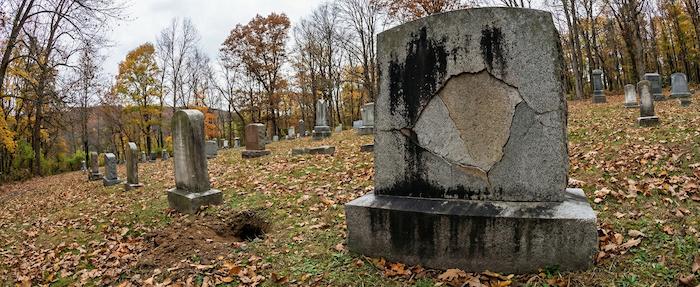
Homewood Steel-Mill Soot on Marble Headstones
Pittsburgh's mills went quiet decades ago, but their exhaust never really left. Coal smoke and blast-furnace carbon settled on cemetery marble across neighborhoods like Homewood and Allegheny for over a century, and it didn't wash off in the rain. Years of grave marker restoration work across the city show the same pattern: a hard black shell that most families mistake for the marble's natural color, built up on stone that's still solid underneath.
Underneath that crust the original white marble is usually intact — it's a surface deposit, not a stain that etched into the stone. Families searching for headstone cleaning services near me are often surprised by how much detail returns once the carbon layer is gone. Tending's technicians work under a $2,000,000 liability policy and hold membership in ICCFA, the trade group that sets standards for cemetery and funeral service professionals.
"I had three cemeteries reviewed and memorials restored and/or cleaned. Service was fast and efficient. Memorials quickly located. I look forward to a visit shortly and quarterly update. Thanks, this has been on my mind for some time."
— Edward Drosdick, Pennsylvania
South Side Slope Tilts Heavy Monuments
Some of Pittsburgh's cemeteries occupy the steepest ground in the region. South Side and Union Dale climb hillsides that were never entirely stable, and after a wet spring the clay subsoil turns soft. Monuments set into that slope drift downhill a fraction of an inch at a time until a base cracks or a marker leans hard enough to fall.

A tilted monument on a hillside is rarely a simple reset — the ground under it has usually eroded away on the downhill side, leaving the base unsupported. Tending's crew excavates a level shelf into the slope, compacts angular gravel that interlocks and resists movement, then anchors the stone before restoring the surface grade around it. That kind of headstone repair and restoration work is routine on Pittsburgh's hillside sections, where flat-ground resets elsewhere in the state need far less foundation work.
Panther Hollow Shade Moss on Markers
Panther Hollow and other wooded ravines shelter several of the city's older cemetery sections from direct sun for most of the day. That shade keeps the ground damp long after a storm has passed anywhere else, and damp stone is exactly what algae and moss need to establish themselves. Left alone, a thin green film thickens into a spongy moss mat that holds moisture against the surface around the clock.
Scraping moss off by hand tears at the stone's surface and pushes spores into hairline cracks. Tending treats it with a biocide solution that kills the root structure, not just the visible film. Once the biocide takes hold, the moss dies back and lifts off during the next rinse — no poultice, no wire brush, nothing abrasive touching the stone. Routine tombstone maintenance in these shaded sections keeps the growth from re-establishing once it's been cleared. The same damp shade that grows moss on stone also corrodes metal grave markers, which is why bronze marker restoration comes up often in these hollow sections — constant moisture accelerates the same greenish oxidation that discolors bronze.
Mon Valley Acid Rain Erases Lettering
Limestone markers throughout the Monongahela Valley took decades of acid rain during Pittsburgh's industrial peak, and softer stone lost ground fastest — it's one of the most common reasons families here look into gravestone restoration in the first place. Sulfur compounds in the rainfall reacted with the calcium carbonate in limestone, dissolving the surface a microscopic layer at a time. On many of these markers the carved inscription is now the thinnest part of the stone, since it sat closest to the weathering surface to begin with.
Once the lettering has thinned this much, an aggressive cleaning method can finish what acid rain started. Tending relies on gentle poultice and consolidant treatments that stabilize the remaining stone before any surface work begins. For names and dates that have gone shallow or faint, headstone lettering repair restores legibility without cutting new grooves into stone that's already thin from a century of weathering.

Service Costs in Pittsburgh
Pricing for monument restoration services here doesn't depend on how steep the hill is or how thick the soot has built up. The price is fixed through our online calculator, based on the memorial type and the care plan you select — the same price whether the stone rests on a level plot or halfway up a hillside in Union Dale. There's no site visit required to get that number; you choose the details online and see the total before booking anything.
- Soot Removal: Chemical dissolution of bonded industrial carbon crust from marble and granite.
- Slope Resetting: Excavation and gravel-shelf foundation work for tilted hillside monuments.
- Biological Growth Removal: Biocide treatment that kills moss and algae growth, not just the visible surface.
- Limestone Consolidation: Poultice and consolidant application that stabilizes thinning, acid-worn stone.