
Reading Railroad Iron Stains on Headstones
Brake dust and iron filings drifted off freight cars for decades along Reading's rail corridors, settling into cemetery grounds near the old lines. The metal dust worked into the surface of marble and granite alike. Rain reacts with that iron and turns it into a bright orange stain within days. At Charles Evans and Trinity Lutheran, some of those stains have bled a half-inch deep into the stone.
Families searching for headstone cleaning services near me in Reading are usually dealing with exactly this problem: an orange bloom that plain soap and water won't touch. Tending's crew uses a chelating solution built to bind iron ions and pull them out of the stone's pores, often over two or three treatments on older markers. The color lifts gradually, treatment by treatment, and the surface underneath stays sound. Tending carries a $2,000,000 liability policy and holds membership with ICCFA, the trade association for cemetery and funeral professionals.
Anthracite Coal Soot on Monument Faces
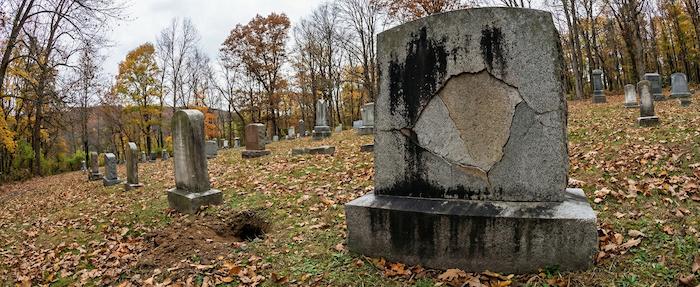
Anthracite moved through Reading's rail yards by the trainload for generations, and coal dust settled over the cemeteries nearby. That soot is oily, and the oil is what makes it stick so hard. It bonds to marble and limestone and hardens into a black crust. Water beads up on that crust and rolls off. It won't wash away on its own.
Our technicians break down that crust with a poultice made for heavy organic buildup. A stiff brush would scratch the stone long before the soot let go. We spread the paste over the black areas, leave it for a day, and lift it away once the bond releases — the soot comes off with the paste, leaving the stone clean underneath. This approach fits well within ongoing monument restoration services for markers that haven't been touched in decades. Aggressive water pressure would strip the polish right along with the soot, so that step never happens here.

Berks County Sandstone Spalling on Markers
Older markers in Berks County cemeteries are often carved from local brown sandstone, quarried nearby generations ago. Sandstone is porous, and it holds water. Freeze and thaw cycles each winter pry at that trapped moisture, and the face of the stone pops loose in flat layers. Some markers at Hoch-High and Deppen have already lost an inch or more of their carved surface this way.

Once a layer spalls off, the lost material doesn't come back. The carving on that face usually goes with it. That's why names and dates on older sandstone often fade years before the rest of the marker shows wear. We clear the loose flakes with a tampico brush, then stabilize what's left with a penetrating consolidant that binds the sand grains before another freeze pulls them apart. Where lettering has faded past reading, our headstone lettering repair recuts or repaints the inscription to match its original depth. For markers that have lost structural integrity along with the surface, our headstone repair restoration team can reset a leaning stone or rebuild a cracked base at the same visit.
Schuylkill River Dampness on Grave Markers
Fog off the Schuylkill keeps low-lying cemetery ground damp for days after a normal rain, and shade from the old growth trees at Charles Evans holds that moisture even longer. Green algae spreads fast on the north side of granite and marble alike. Left alone, it holds water against the stone and works into hairline cracks. In the same soft, wet ground, heavier markers gradually settle out of level, and a few flat stones at Fairview and Gethsemane are close to buried under grass and silt. Leveling work like this is handled as grave marker restoration, a separate step from routine cleaning.
We treat the algae with a biocide made to kill the growth completely. A plain scrape leaves the roots behind, and the green returns within a season. The same damp air that feeds algae also dulls and streaks bronze plaques and markers. Our bronze marker restoration service cleans and reseals those surfaces so the patina stops migrating. For markers that have sunk or tilted in the same soft ground, Tending's crew excavates around the base and resets the stone on a bed of gravel that carries water away from the footing.
Service Costs in Reading
Tending's online calculator sets the price for rust extraction, soot removal, sandstone consolidation, and biological growth removal before any technician steps into a cemetery. Pick the memorial type and a care plan, and the calculator returns a fixed price for the job, whether it's routine headstone restoration or a multi-step treatment for iron and soot. Visit our online calculator to see current pricing for a specific marker in Reading.
"I had three cemeteries reviewed and memorials restored and/or cleaned. Service was fast and efficient. Memorials quickly located. I look forward to a visit shortly and quarterly update. Thanks, this has been on my mind for some time."
— Edward Drosdick, Pennsylvania
- Rust Extraction: Chelating treatment that binds and lifts iron staining from marble and granite pores.
- Soot Removal: Poultice treatment that breaks down oily anthracite crust without abrasive scrubbing.
- Sandstone Consolidation: Penetrating consolidant that binds loose sand grains and slows further spalling.
- Biological Growth Removal: Biocide treatment that kills algae and moss, roots included, in one visit.