The Virginia-Tennessee Railroad reached the Cambria section of town in 1854, turning Christiansburg into a classic Appalachian depot town. The limestone bedrock underneath the whole area has its own separate story to tell on local granite, one that rarely overlaps with the railroad's. Tending's crew sees a chalky white deposit on one hand, and a dark film left behind by more than a century of rail traffic on the other, each visit backed by a $2,000,000 liability policy and ICCFA membership.

Limestone Bedrock Leaves Mineral Deposits
Montgomery County sits in Virginia's limestone-rich Ridge and Valley region, and that bedrock dissolves slowly wherever slightly acidic rainwater reaches it, a process that predates the town itself by millions of years. Groundwater carrying dissolved limestone surfaces near some of the older cemetery plots and leaves a chalky white deposit that builds up gradually, layer after layer, over years, until the buildup becomes hard to miss. Sunset Cemetery and Shaffer Memorial Cemetery both sit on ground where this mineral buildup shows up first, often on markers that have gone decades without a proper cleaning.
Clearing limestone deposits calls for a mild acid wash calibrated specifically for this kind of mineral buildup, since a standard degreaser barely touches it. One small patch gets treated first, which shows how the mineral deposit actually responds before the rest of the surface follows. Bronze fixtures near the depot need a completely different product — anything strong enough for limestone buildup leaves bronze visibly dulled.
Crab Creek Humidity Grows Algae Fast
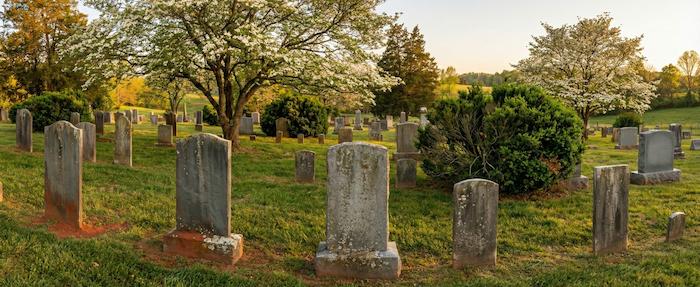
Crab Creek's headwaters sit near the heart of Christiansburg, and that creek keeps humidity elevated across a good stretch of the surrounding cemetery ground. Shaded plots near the water hold onto dampness after open ground has already dried out, and algae and lichen move in fast under those conditions, in the older rows shaded by mature trees most of all, sometimes covering a shaded panel completely within one wet season.
Tending applies D/2 to break down the algae chemically, with no scrubbing involved anywhere on the polished surface. Carved lettering softened by the same moisture gets handled through our headstone lettering repair service, working only as deep as the original inscription allows.

Railroad-Era Soot Still Darkens Stone
Coal-fired locomotives rolled through the Cambria depot on a daily basis for generations after the Virginia-Tennessee line arrived in 1854, and exhaust from that traffic settled steadily over nearby burial ground for most of that time. Nobody connected the residue to the granite itself until much later. Monuments sitting closest to the depot itself often show a uniform dark cast that plain water simply won't lift, however many times someone scrubs at it.
Our degreasing approach targets this kind of legacy grime specifically, pulling it out of the stone's surface layer without touching the polish underneath. The depth of staining varies quite a bit from stone to stone, so a check always comes first before a full treatment gets applied. Bronze fixtures from that same era call for an entirely separate product, gentler than anything used on the surrounding granite.
Service Costs in Christiansburg
Christiansburg pricing for headstone cleaning services near me comes entirely from Tending's online calculator — select the monument type, select the care plan, and that figure is final without a technician ever stopping by first. Book a single cleaning from there, or turn it into a recurring maintenance plan that renews each year on its own schedule. Each of these three problems moves at its own pace, so whichever one a family actually notices first is usually where the crew begins. Full rates are on our pricing page.
"Judging from the photos received, it looks much better. I plan to go to the cemetery in the next few days. I anticipate the actual work accomplished will be as good as, if not better than the photos. Mom"
— Dee Roach Perazzo, Tending Client
- Limestone-deposit removal and grave marker restoration: mild acid wash for karst mineral buildup, with a separate cleaning process for bronze markers.
- Biological growth removal: D/2 treatment for Crab Creek humidity algae, with gravestone lettering repair for softened inscriptions.
- Legacy soot removal: degreasing wash for railroad-era grime near the historic Cambria depot district.