
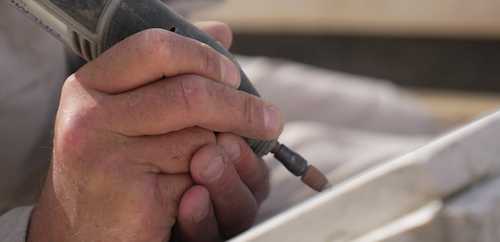
What's actually fading a headstone's painted lettering in Virginia depends heavily on the region. Grit blown in from an old soapstone quarry causes one kind of failure near Schuyler. Drifting terminal dust near the Hampton Roads waterfront causes an entirely different one. A shaded rural plot under old hardwoods adds a staining problem neither of those regions deals with. Our guide to how lettering repair actually works goes into more depth on the process itself. This service covers headstone lettering repair statewide. Every job includes $2,000,000 in liability insurance, and Tending is a member of the ICCFA.
Albemarle Soapstone Dust
Central Virginia's Nelson and Albemarle counties sit on top of one of the state's most historically significant soapstone deposits. Commercial quarrying ran there for generations around Schuyler and the old Alberene works. Fine soapstone dust from that ground still finds its way into carved letter grooves nearby, especially on windy, dry days. Once that dust gets wet, it packs tightly into the recessed lettering and holds moisture there longer than the surrounding stone face would. That sets up ideal conditions for freeze-thaw damage to the paint bond during winter. A groove packed with damp dust also just doesn't hold fresh paint as well as one that's genuinely clean and dry. Plots closest to old quarry ground tend to show this more than cemeteries further away. Getting the dust out completely, down to bare stone, is what Tending's crews do before any repaint goes in.
Hampton Roads Coal Dust Film
The same coal terminal dust that dulls bronze markers around Norfolk settles into carved lettering just as readily. Fine coal particles drift from the export terminals and work their way into letter grooves. Contact with rain or dew then turns the buildup mildly acidic against the paint. That acidic film breaks down a painted surface faster than ordinary grime, leaving lettering that looks worn and faded well before it should. Cemeteries a mile or two downwind of an active terminal show this pattern more consistently than plots further from the waterfront. The residue has to come out of the groove entirely before repainting holds, which is the first thing the crew checks on site.
Rural Oak Tannin Staining
Wooded cemetery sections across rural Virginia sit under decades-old oak canopy, and fallen leaves collect in carved letter grooves every autumn almost without fail. As that leaf litter breaks down over a wet winter, it releases tannins, and those tannins stain whatever surface they're sitting against, painted lettering included. A groove left full of decomposing leaves through an entire season can end up noticeably discolored underneath. That dulls the contrast of a repaint before it's even had a chance to wear naturally. Lichen growth on older, untended stones compounds the same problem. Lichen produces its own mild acid that etches at both stone and paint over years of contact. The crew clears out the decomposed litter and lichen growth first, then works the tannin stain itself out of the stone ahead of repainting.
Tidewater Humidity and Biological Growth
Coastal Virginia's humid climate does more than just corrode metal. It also creates conditions where mold, mildew, and algae take hold on a headstone's painted surface. That growth sets in far more readily than it would in a drier part of the state. That biological growth doesn't just sit on top of paint. It actually works into the microscopic texture of the surface and weakens the bond underneath it over time. A repaint applied over stone that's still hosting active growth tends to fail within a season or two instead of holding for years. Tidewater cemeteries close to open water or standing wetlands see this more often than cemeteries on higher, drier ground inland. The growth has to be scrubbed off and the stone given time to dry all the way through before the crew repaints.
Headstone Lettering Repair Costs in Virginia
Pricing for lettering repair in Virginia comes from two things a technician can read directly off a photo. One is how many characters need repainting; the other is how deep the original carving was cut. The pricing tool turns those two into a number before anyone visits the cemetery. A job near Charlottesville costs the same as one near Norfolk whenever the scope matches. That holds whether the groove needs a light cleaning or a full stain-and-residue treatment first. Finished photos land in the Tending app once the work is complete, letting a family check the result on their own schedule.
- Soapstone dust treatment: packed grooves cleared, dried, and repainted.
- Coal film treatment: acidic residue stripped and the groove repainted.
- Tannin stain treatment: leaf litter and lichen cleared, stain lifted, groove repainted.
- Biological growth treatment: mold and mildew removed before a fresh repaint.
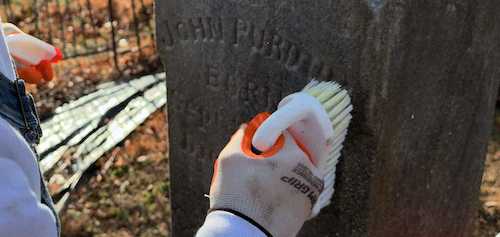
How Our Headstone Lettering Repair Process Works
- Clearing the Groove Whatever's occupying the carving, whether it's old paint, packed dust, coal film, or tannin staining, gets worked out by hand until only bare stone is left.
- Removing Residual Film A solvent pass takes care of any leftover biological growth or acidic residue on the groove walls; fresh paint needs a genuinely clean surface to bond to.
- Confirming a Dry Groove The carving has to test fully dry before anything goes back in. Moisture trapped under new paint is the single most common reason a repaint fails ahead of schedule.
- Setting the New Lettering A weather-rated enamel goes into the now-dry groove, shaped and layered to match the original letter carving exactly.
- Final Inspection and Handoff The surrounding stone gets a last pass to clear off any stray paint, and photos of the finished lettering are uploaded to the Tending app for the family's records.
