
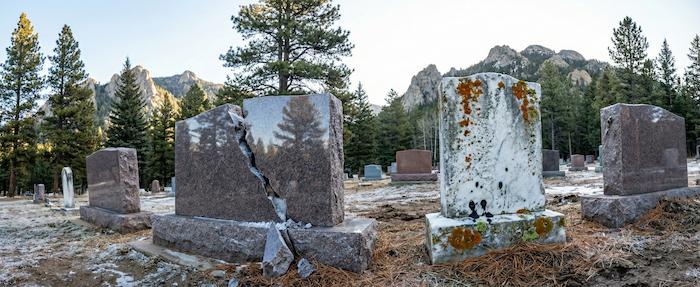
A headstone in a high mountain cemetery near Leadville can split open from one hard overnight freeze; a granite marker on the plains around Denver simply fades under decades of the same intense high-altitude sun. Every one of Tending's visits to Colorado's 1,175 cemeteries opens with the same headstone cleaning standard, and closes under the same $2,000,000 liability policy and ICCFA membership. Which fix actually works comes down to exactly what's damaging the stone in the first place.
How Colorado's Altitude and Temperature Swings Wear Down a Headstone
Colorado's daily swing from a sunny afternoon to a hard overnight freeze drives most of the physical cracking a headstone takes here, working meltwater into stone one freeze cycle at a time. The state's hard well water and its thin, intense mountain sunlight work on a headstone through slower chemical and UV processes.
Rocky Mountain Freeze-Thaw and Headstone Repair
Rocky Mountain cemeteries swing from a warm, sunny afternoon to a hard freeze after dark on most winter nights. Meltwater seeps into a hairline crack during the warm hours and expands the moment it refreezes after sunset, prying the crack open a little wider with each cycle. A crack that starts as a hairline in October can run the full width of a headstone by the following spring, after just one winter's worth of freeze-thaw cycles. A polished granite face can shear off after one especially hard winter, taking a section of carved lettering or a corner of the die along with it. Spring thaw turns frozen ground to soft mud underneath a monument too, and a heavy granite base sinks or leans the moment it loses solid footing. Cemetery sections near a stream or drainage ditch turn to mud first each spring, since runoff collects there before the rest of the ground has even started to thaw. Piling fresh dirt on top of a settling base only gets pushed down again by the next thaw, since real support has to come from below. Headstone repair in Colorado addresses both problems the same way: sealing whatever cracks the ice already opened, then excavating a sunken base and resetting it on a gravel bed deep enough to drain meltwater before it can freeze and heave the stone again.
Front Range Hard Water and Headstone Lettering Repair
Front Range cemeteries mostly pump irrigation water from deep wells, and Colorado's groundwater carries a heavy load of dissolved calcium and lime picked up from limestone and gypsum underground. Denver's own municipal supply is treated and relatively soft. Plenty of older cemetery sections outside the metro area still rely on well water pumped straight from limestone aquifers. Automatic sprinklers soak a headstone's base every summer morning, and each time the water evaporates off in the afternoon sun, it leaves behind a thin mineral residue. The residue builds into a hard white scale after enough summers, thick enough in places to bridge across an engraved letter and hide it from view. The scale shows up thickest on markers set closest to a sprinkler head, where the water lands directly and evaporates in place every morning. Wire brushes and other abrasive tools strip the scale. They also scratch straight through granite's polished finish at the same time, leaving permanent dull streaks behind. A chelating cleaner made for calcium deposits dissolves the scale chemically, without the scratching a wire brush would cause, and headstone lettering repair repaints whatever lettering the scale had been hiding once the stone underneath is legible again.
High Rockies UV and Bronze Marker Restoration
Cemeteries above 9,000 feet around towns like Leadville and Breckenridge sit under some of the most intense UV exposure in the country, since the thin mountain air here filters out very little of the sun's ultraviolet radiation before it reaches the ground. Ultraviolet exposure at this elevation breaks down the clear-coat sealant on a bronze marker within just a few years, well short of what a factory coating is rated for. Bronze plaques mounted flat into the ground take the sun straight-on all day, with none of the shade a nearby headstone or tree might otherwise provide. Once the seal fails, the bare patina underneath is exposed to windblown grit and ordinary moisture with nothing left to slow either one down. Green and brown corrosion spots spread fastest across the flattest part of a plaque, wherever rain and snowmelt sit longest before running off. Bronze marker restoration up here strips the failed coating down to clean metal and reseals it with a finish rated for sustained high-altitude UV, typically good for another five to seven years before it needs redoing.