
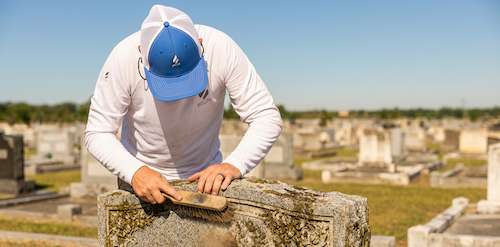
Colorado ground rarely stays still under a monument for long. Clay under a Front Range foundation can push upward hard enough to crack a base on its own, and further up in elevation, meltwater seeps into a joint and turns to ice overnight for the better part of six months. Add in a temperature swing that can drop 40 degrees between lunch and dinner, and a granite monument here is absorbing more physical stress than the same stone would see in most other states. Tending handles headstone repair and headstone restoration statewide as an ICCFA member carrying $2,000,000 in liability insurance, so a family in a Denver suburb and a family in a mountain town get the same insured crew and the same process.
Bentonite Clay Along the Front Range
The Colorado Geological Survey has documented expansive clay across the Front Range Urban Corridor, including the Denver metro area and Colorado Springs, tied to bentonite and montmorillonite weathered out of the Pierre Shale. This soil can expand as much as 20 percent by volume when it takes on water, and the survey has measured the resulting pressure at up to 30,000 pounds per square foot. A concrete footing poured on that ground doesn't stay level under that kind of force. One section of the base lifts while the rest stays put, and a headstone that started out plumb ends up leaning or cracked at the base. Tending's crews see this pattern most often on older monuments set before builders in the area routinely accounted for expansive soil. Grave marker repair on Front Range clay means excavating past the layer that's actively swelling and resetting the base on material that won't push back the same way; patching a surface crack without addressing what's underneath just buys a season or two before the same lean comes back.
High-Country Snowpack and Freeze-Thaw
Elevation changes how a monument ages. Above 8,000 feet, a freeze window can run from October into May, and meltwater that gets into a hairline gap around a base or a joint refreezes most nights through that entire stretch. Water expands by roughly 9 percent as it turns to ice, and a gap that starts too small to notice widens a little more with every cycle. Heavy snow load adds a second problem for flat markers and low bases: months of compacted snow press down on stone that's already sitting unevenly, and by the time it melts off in spring, a marker that was level in the fall can have shifted underneath the turf. Tending's technicians rebuild the footing below the frost line where the ground allows it, since a base reset only at the surface just gives the next winter's ice the same gap to work with.
The San Luis Valley's Extreme Daily Swings
Ringed by the Sangre de Cristo and San Juan mountains, the San Luis Valley traps cold air on its own floor overnight while warmer air rises up the surrounding slopes. Alamosa has recorded a 56-degree swing in a single day, from the mid-50s in the afternoon down to a low near zero before sunrise, and November lows there have reached 15 below. A granite monument in that valley isn't cycling through one freeze a night the way flatter parts of the state do. It's absorbing a much wider daily range, and the stress that puts on a joint or an existing hairline crack adds up faster than the temperature record alone suggests. Foundation work in the valley uses the same rebuilt-footing approach as the high country, just accounting for a wider and more frequent swing.
Headstone Repair Costs in Colorado
A monument's price runs through the same online calculator everywhere in Colorado, driven by what the submitted photos show about the damage rather than which region the cemetery is in. Enter the details, and the number that comes back covers a clay-heaved base near Denver the same way it covers a frost-lifted joint outside a mountain town. Nobody needs to wait for a technician to walk the cemetery first. Photos usually tell the crew what they need; on the rare job where something's genuinely unclear, that gets sorted out with a quick follow-up before work begins, not by tacking on a separate visit and a new number. When the leveling and foundation work wraps up, the crew documents the result and drops the photos into the Tending app, so the family sees the finished repair without making a trip out to the cemetery themselves.
How Our Headstone Repair Process Works
- Photo-Based Damage Review A technician reviews the submitted photos to judge how the monument shifted, whether the movement points to soil heave, frost, or a loose joint, and what the repair actually needs before any equipment gets scheduled.
- Foundation and Soil Assessment Once on site, the crew checks the base for cracking, checks how the surrounding soil is behaving, and confirms the plan from the photo review still fits what they find in the ground.
- Lifting and Base Rebuild Equipment raises the monument clear of the failing footing. With the stone out of the way, the crew digs down past whatever soil or ice layer caused the movement and pours a base built to hold against it going forward.
- Crack and Joint Repair Cracked stone gets stabilized and loose joints get reset with materials sized for the load, so the damage stops spreading instead of just looking fixed on the surface.
- Final Seal and Photo Delivery A breathable sealant protects the stone without locking moisture underneath it. Before the crew leaves, they photograph the leveled monument and upload it to the Tending app, which is how most families end up checking the finished work.
