
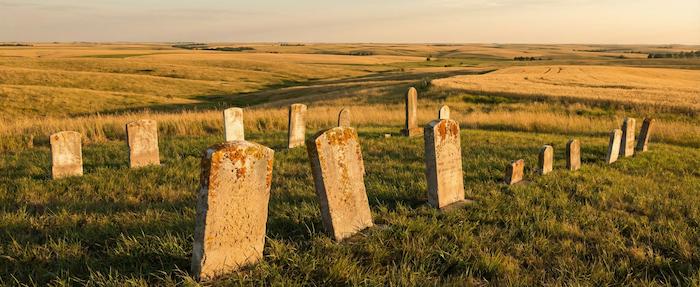
Fort Riley Limestone Weathering on Headstones
Crews once quarried Fort Riley limestone right here in Geary County, cutting blocks solid enough that one shipment built the east wing of the Kansas state capitol. That same stone, set upright as a grave marker for a century or more, weathers slower than most limestone but not forever. Rain works into its natural bedding planes and pries thin layers loose from the surface, a process locals call spalling once enough of it has happened to notice. Anyone searching for headstone cleaning services near me around Junction City eventually asks about that flaking, thinking it's dirt until a mason points out it's the stone itself coming apart in sheets. That work is backed by a $2,000,000 liability policy, and Tending's membership with ICCFA, the industry's leading cemetery and funeral association, comes with the same standard.
Groundwater moving through that same limestone carries dissolved calcium to the surface, where it evaporates into a hard white crust at the base of a stone. Given enough seasons the crust climbs into carved letters and flattens them out. We pull the deposit free with a chelating agent that leaves the surrounding stone untouched. Where the paint fill inside a name has worn thin from that same mineral wear, gravestone lettering repair restores the readable depth.

Kansas River Confluence Flood Settling
Junction City sits right where the Republican and Smoky Hill rivers come together to form the Kansas River, and that confluence has flooded the town more than a dozen times on record — 1935, 1951, and 1993 among the worst. Each flood saturates the alluvial soil under low-lying ground, and saturated soil compresses unevenly once it drains. A monument footing set in that ground settles at one corner faster than the other, and the lean shows up gradually over the following years. Tending lifts the stone, rebuilds the base on compacted gravel, and levels it back into place. Our headstone restoration services cover that reset work, and the process itself is laid out step by step in our guide to resetting and leveling headstones.
Continental Freeze Cycling on Rural Plots
Geary County winters swing from a 50-degree afternoon to a hard overnight freeze often enough that the pattern repeats several times most winters. A crack no wider than a pencil line fills with meltwater during the thaw, then locks solid by morning and pushes itself a fraction wider. Rural cemeteries like Wetzel and Salchow, set in creek-bottom ground that holds moisture longer than the uplands, tend to show this damage before anywhere closer to town does. We fill those cracks with a stone-matched epoxy compound built for repeated freeze cycling. The fill is sized precisely to the gap, not smoothed over as a general patch.
Creek-Bottom Shade and Bronze Tarnish
Several of the county's older cemeteries sit tucked along creek drainages — Humboldt Creek, Clarks Creek, Davis Creek — where tree cover keeps the ground damp well past a normal drying window. Marble stones under that canopy pick up dark biological staining that spreads across the face over a season or two. A biocide treatment kills the growth on contact. Nothing happens to the polish underneath. The same trapped humidity dulls bronze plaques at these sites faster than it does markers out in open sun, so bronze grave marker cleaning clears the tarnish and reseals the surface against the next wet season.

Service Costs in Junction City
Pricing here goes through our online calculator, where a monument type and care plan set the price with no inspection visit needed first. A standing plan pays off fastest on the low-lying and creek-bottom plots, where settling and mineral crust both return on their own schedule after every wet season.
"Tending did a wonderful job preserving headstones in a small family cemetery. Highly recommend!"
— Beatle, Tending Client
- Spalling and mineral crust removal: chelating agent treatment for limestone weathering and calcium buildup.
- Monument resetting: footing rebuild on compacted gravel for flood-related soil settling.
- Freeze-crack repair: stone-matched epoxy fill sized to the exact gap, built for repeated freeze cycling.
- Biological growth treatment: biocide application for shaded marble and bronze markers along creek drainages.