
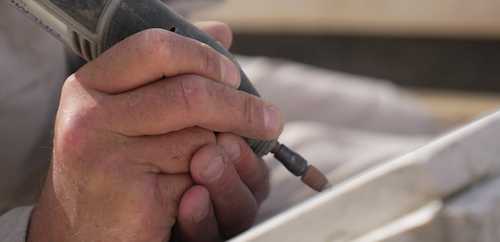
What actually strips the paint out of a Kentucky headstone's carved letters depends on which part of the state the stone is standing in. Coal dust works its way into the groove throughout the eastern coalfields, and in that same region, iron-rich mine drainage leaves a rust-colored stain behind. Head west and it's persistent river fog lifting paint loose from underneath. In bourbon country, limestone-filtered water builds its own crust over the lettering. Whichever of those is responsible, the same Tending crew, ICCFA-insured and backed by $2,000,000 in coverage, handles the repair anywhere in the state.
Coal Dust Packed Into the Groove
Fine coal dust drifts across cemetery ground throughout Kentucky's eastern coalfields, and it settles directly into any open carved letter nearby. A passing rain turns that dust into a dark paste that hardens once the groove dries out again, and clearing it back out takes real scraping, not a simple rinse. Left in place through a full season, the packed dust holds moisture against whatever paint is still bonded underneath, and that trapped dampness is what actually works the coat loose. Cemeteries closest to active or legacy mining ground tend to collect the thickest layer of all, since dust settles out of the air fastest near wherever it originates.
Acid Mine Drainage Staining Carved Letters
Kentucky's coalfield streams and groundwater have carried documented acid drainage for decades, close to 2,100 miles of affected streams by 1990, and the rust-orange mineral precipitate this runoff produces is common enough in the region to have its own name among engineers, "yellow boy." Where that same acidic, iron-rich water reaches cemetery ground, it can stain carved letters a deep rust color that's chemically distinct from ordinary weathering or dirt. A monument nearby often carries a bronze plaque as well, and that metal reacts to the same runoff differently, a condition addressed separately under bronze marker restoration. Clearing this particular stain calls for a rinse formulated to the specific iron compound involved, since an ordinary cleaning solvent tends to spread the rust color around without actually lifting it out of the stone.
Ohio River Fog Lifting Paint in Western Kentucky
Kentucky's stretch of the Ohio River holds dense fog for extended stretches, especially through the cooler months, and moisture from it works into any worn spot in carved lettering paint. Trapped dampness swells the coat from underneath and lifts it loose well before the paint would otherwise have failed. This same river corridor flooded Paducah under more than 60 feet of water in 1937, and cemetery ground along it still rarely gets a fully dry season even now. Letters facing the river itself tend to show the worst of this particular damage, since the fog sits heaviest closest to the water and thins out gradually moving inland.
Limestone Hard-Water Crust in Bourbon Country
Central Kentucky's groundwater filters through limestone on its way into the aquifer, the same geology that gives the region's bourbon industry its water in the first place, and that filtering process loads the water with calcium and magnesium as it strips iron out. None of that matters until the water gets used for cemetery irrigation. Each rinse leaves a faint mineral residue in the carved letters, and after a season or two of repeated watering, the residue hardens into a crust thick enough to swallow the inscription whole. A technician clears it with a descaling rinse matched specifically to the calcium buildup, working carefully enough that any paint still holding on underneath survives the process. Markers set flat or low to the ground fill in fastest, since a horizontal face lets hard water pool and evaporate slowly, leaving a fresh trace of mineral scale behind with every cycle.
Headstone Lettering Repair Costs in Kentucky
Two numbers set the price: how many characters need paint, and how deep they're cut into the stone. Photos of the existing lettering give the calculator everything it needs to return a fixed figure, with nobody required to set foot in the cemetery first. When the repainting is finished, the crew photographs the result and uploads it through the Tending app, and that's usually how a family sees the finished work.
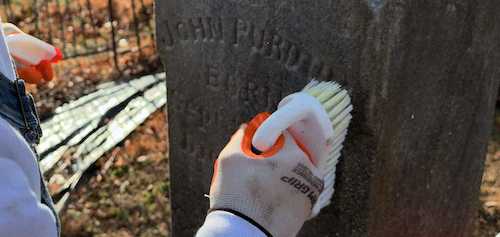
How Our Headstone Lettering Repair Process Works
- Matching the Damage to Its Cause Coal dust, iron staining, fog, or mineral crust each need their own opening approach, and photos are usually enough to tell a technician which one applies before the visit starts.
- Removing the Old Paint Letter by Letter A hand tool clears failed enamel and whatever debris is packed in with it, working through each carved letter individually. Paint still holding firm stays in place.
- Flushing the Channel Clean A rinse suited to the specific contaminant, coal dust, iron stain, or mineral buildup, clears the groove down to bare granite.
- Removing Every Trace of Moisture Forced air dries the channel completely, since any dampness left behind under fresh paint is one of the most common reasons a repaint fails early.
- Applying New Enamel and Logging the Result Enamel builds up in the dry groove until it reaches the original carving depth, and the crew photographs the finished letters through Tending's app before leaving.
