
City soot dulls headstone lettering across the five boroughs. Mountain frost two hundred miles north cracks it a completely different way. One fixed-price process covers headstone lettering repair everywhere in between. Cemetery staff coordination happens on Tending's end, and a $2,000,000 liability policy and ICCFA membership back every visit statewide. Our technical guide has the full five-step process and more on why home repaints don't last.
New York City Soot and Dulled Lettering
Airborne soot and acidic grime settle on headstone lettering throughout the city, day after day, rain or no rain. That particulate works into the texture of matte enamel finishes. Even lettering that hasn't chemically failed yet starts to look permanently gray under a film of city dirt. Given enough time, those acidic particles also break down the paint binder underneath the surface grime. Letters in older sections of Green-Wood and similar Brooklyn cemeteries often show both problems layered on top of each other. Historic markers that have never been repainted tend to look worst of all. A degreasing wash lifts the embedded soot before any repainting starts. Tending's city crews handle that step on every repaint in the boroughs.
Adirondack Frost and Acid-Splashed Lettering
Winters at elevation in the Adirondacks and Catskills freeze moisture trapped behind old paint on headstone lettering. That ice pries small flakes loose from the granite each spring. Acidic soil in these mountain counties adds a separate problem at ground level. Rain splashes that acidic soil onto the lowest letters on a flat marker. Century-old markers near Lake Placid and Saranac Lake show this kind of layered damage more than newer plots do. Elevation alone adds a few extra weeks of hard freeze most winters compared to towns in the valleys below. Fresh enamel goes on only after the frost damage and the acid staining have both been addressed. Tending's upstate crews handle both in a single visit whenever possible.
Western New York Road Salt and Faded Paint
Snow cover near Buffalo and Rochester can last for months. Whatever salt washed off the roads during that stretch sits concentrated at the base of nearby headstones the whole time. When that snow finally melts each spring, the meltwater carries a heavy dose of that salt directly into any exposed paint at ground level. Letters near cemetery access roads take the worst of it. Spring cleanup crews often find more paint damage here than anywhere else in the state at that time of year. Markers within a few feet of a plowed road see it worst. Tending strips salt-damaged paint back to bare stone as part of every spring visit in this region. Fresh enamel replaces it once the surface has dried out completely.
Long Island Water Table and Softened Paint
Long Island's water table sits close to the surface almost everywhere. Flat markers set into that damp ground stay wet at the base for most of the year. Paint at the bottom of those letters never gets a real chance to dry out between rains. Sustained dampness like that softens the paint over time. It eventually lifts away from the stone, starting right where the ground stays wettest. Suffolk and Nassau county cemeteries near the shore see this fastest, though it happens further inland too. The water table barely drops even during a dry summer stretch. A longer cure time under drier conditions helps the new paint bond better here than a same-day rush job would. Tending schedules Long Island repaints around drier stretches whenever the forecast allows it.
Paint damage on New York headstones often points to a second problem nearby. Structural settling or leaning gets handled through headstone repair and restoration. A bronze marker showing similar wear on the same plot gets its own separate treatment under bronze marker restoration.
Headstone lettering repair Costs in New York
Character count and carving depth are what set the price for headstone lettering repair in New York. Punch both numbers into the online calculator and a fixed total comes back immediately, no technician visit needed first. Deep, decades-old carving typically takes more paint than a shallow modern inscription, and the calculator adjusts for that automatically. Every quote covers both materials and labor. The app receives before-and-after photos as soon as a visit wraps up.
How Our Headstone lettering repair Process Works
- Inspection & Diagnosis A technician looks closely at the lettering to determine the cause. Soot, frost, and ground moisture each need a different fix. Any nearby stone or metal gets protected before work begins.
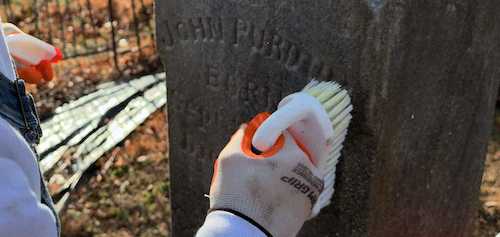
- Cleaning & Stripping Grime, old paint, and any embedded residue get removed down to bare granite. The exact method depends on what's actually causing the damage in that region.
- Enamel Application Industrial enamel is applied by hand into each cleared letter. It bonds directly with the raw stone underneath the surface layer.
- Cure & Documentation The paint is given time to cure properly before the visit wraps up. Before-and-after photos land in the app once the work is complete.
