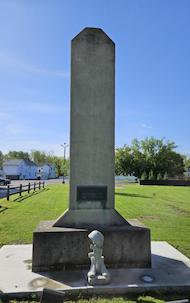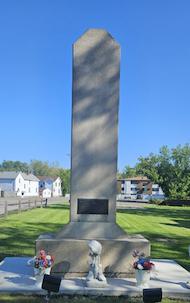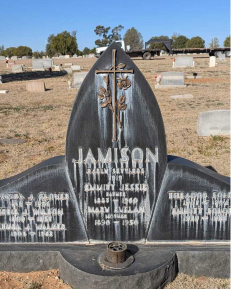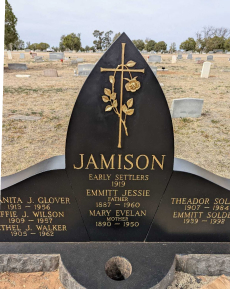
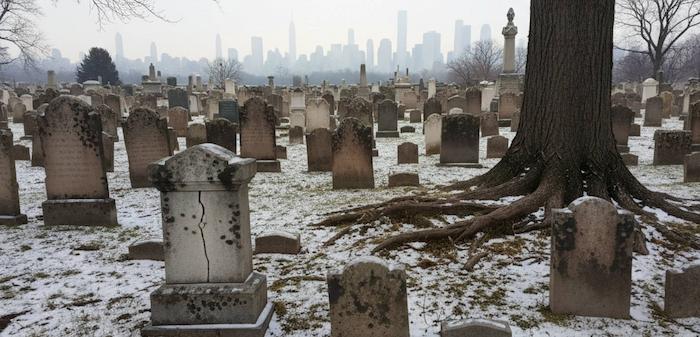
Some of New York's oldest cemetery stones have stood since before the Civil War, and the marble in them wasn't built to survive both a modern winter and a century of city pollution. New York's 4,490 cemeteries fall under one Tending service standard: headstone cleaning and restoration backed by $2,000,000 in liability coverage and ICCFA membership, whether the marker sits in a Manhattan churchyard or an upstate county plot. The app lets a family in another state manage the same in-person visit Tending's crew makes to the cemetery. Which fix actually helps a New York headstone depends on what's really behind the damage.
How New York's Winters and Industrial History Shape Headstone Care
Marble pores crack from repeated freeze-thaw cycles, and the ground underneath a monument's foundation heaves the same way each winter. Acid rain dissolves marble lettering slowly but steadily, and a century of New York Harbor industrial soot left bronze markers nearby with their own chemical residue.
New York Freeze-Thaw and Headstone Repair
Marble absorbs meltwater whenever snow on a headstone partially thaws during the day, and temperatures falling back below freezing after dark turn the trapped water to ice inside the stone. Freezing inside thousands of tiny pores at once puts enormous outward force on the surrounding stone, and a marble headstone without protection can develop new hairline cracks every winter, with existing cracks opening a little wider each time the cycle repeats. New York's ground freezes several feet deep most winters too, and ice lenses form underground as water migrates toward the cold and refreezes in layers, growing thicker through the winter and pressing everything above them upward, including a monument's base. When the deep ice finally melts each spring, the ground underneath stays loose and unstable for several weeks before it firms up again, and a heavy granite monument lifted out of level during the winter can settle unevenly once that support disappears, cracking the concrete footing in the process. Tending treats a marble stone's frost-cracked pores with a breathable consolidant that fills them from the inside, leaving future meltwater nowhere left to collect and freeze. Headstone repair addresses the ground separately, excavating down to stable soil, packing the gap with compacted fill, and resetting the monument level once the new base can support it.
New York Acid Rain and Headstone Lettering Repair
Decades of vehicle and industrial exhaust have put a steady supply of sulfur into the air over New York City. Sulfur in the air combines with rainwater to form a mild acid that reacts directly with the calcite in marble. The reaction converts the outer layer of stone into gypsum. Gypsum is softer and more porous than the marble underneath it, and ordinary weather exposure is enough to wear it away. The gypsum crust eventually flakes away in patches, and engraved lettering goes with it, since the letters were originally cut into the marble's outer surface. Headstone lettering repair in New York means recutting grooves that have lost their edges to gypsum crust, then filling them with a weather-resistant enamel built for city air.
New York Harbor Industrial Soot and Bronze Marker Restoration
New York Harbor grew into one of the busiest, most heavily industrialized ports in the country through the 1800s and early 1900s, with factories, refineries, and shipping terminals crowding the waterfront from Brooklyn's Gowanus Canal to the Hudson's western shore. Decades of soot from coal-fired industry and harbor traffic settled over cemeteries throughout the city and its surrounding boroughs, and bronze veterans' plaques absorbed a steady coating of it right along with the granite and marble around them. The soot bonds into a dark, gritty film over a plaque's original patina, and the film only grows thicker as each new decade of exposure builds on the last. A plaque with a century of harbor-era soot buildup can lose most of its contrast, leaving raised lettering and background color hidden under a uniform dark coating. Cemeteries in Brooklyn and Queens closest to the old industrial waterfront carry the heaviest accumulation, since soot settled thickest nearest its source. An industrial-strength degreaser breaks the film down chemically, and the crew regrinds the raised lettering back to bright bronze before repainting the recessed background. Bronze marker restoration finishes with a fresh clear coat, giving a plaque near New York's old industrial waterfront a clean surface again.