
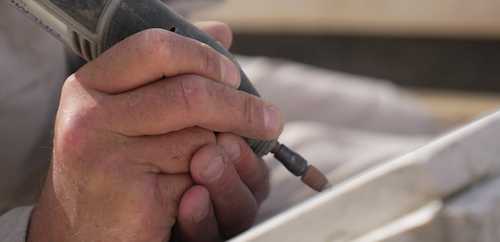
Painted lettering fades and lifts for a different reason in each part of North Carolina. Piedmont clay dust settles into the carved grooves and dulls the color years before the paint itself actually fails. Humid coastal air traps moisture inside the same kind of groove and lifts the paint from underneath. At elevation in the mountains, stronger UV bleaches the pigment out faster than it would at sea level. Our guide to restoring faded headstone lettering covers the process in more depth. Tending handles headstone lettering repair statewide, backed by a $2,000,000 liability policy and membership in the ICCFA.
Piedmont Red Clay Dust in Letter Grooves
A painted name in the Piedmont often looks dull and gray long before it looks faded. Fine red clay dust common to the region settles into the carved grooves every time the wind kicks up, and the iron in that dust stains the painted surface a rust color that plain rinsing doesn't fully clear.
Wiping the dust away while it's dry grinds the grit directly into the paint's surface. The crew flushes the grooves with water first to float the loosest dust free, then repaints any section the iron staining has already dulled past matching the surrounding letters.
Sandhills Pine Pollen and Sap in Letter Grooves
Tending's crews see more clogged, gummy letter grooves in the Sandhills than anywhere else in the state. Pine pollen drifts thick every spring around Southern Pines and Pinehurst and lands directly in the recessed carving where painted letters sit, then binds together with sap dripping from the same trees into a hardened yellow crust.
That crust holds moisture against the paint underneath it long after the surrounding stone has dried. Tending's crew dissolves the crust with a solvent built for tree resin, clears the groove completely, and repaints once the bare carving is dry.
Coastal Humidity and Lettering Mold
Painted letters near Wilmington and the Outer Banks rarely fail from sun exposure the way they do farther inland. Constant humidity off the Atlantic keeps the carved grooves damp for days after a storm passes, and that trapped moisture grows a black mold underneath the paint. The paint lifts away in flakes long before its color actually fades.
The crew clears the mold with a biocide before repainting, since sealing fresh enamel over an active mold colony only traps it under the new paint. Bronze plaques mounted nearby corrode from that same coastal humidity, an issue addressed separately through bronze marker restoration.
Blue Ridge Elevation UV and Freeze-Cracked Paint
A painted name on a granite marker near Asheville or Boone takes stronger UV exposure than one at sea level, and that added sun bleaches the pigment out within a few years of a repaint. Water that gets into the same painted groove overnight freezes solid and pops small flakes of enamel loose from the stone underneath it.
Both problems tend to show up together on older mountain markers, since bleached paint cracks more easily once winter sets in. Tending's crew clears the groove completely, checking the surrounding granite for the same freeze damage that headstone repair and restoration would need to address, before applying fresh enamel built to handle both the UV and the freeze cycles.
Headstone Lettering Repair Costs in North Carolina
Pricing for headstone lettering repair in North Carolina comes from our online calculator, based on submitted photos of the character count and groove depth. A repaint in the Sandhills costs the same as one in the mountains, since the price depends on the lettering itself and stays consistent across the state. Finished photos post to our app once the repaint is done, so families can check the result without visiting the cemetery in person.
- Red clay dust removal: groove flushing and a repaint of any iron-stained lettering.
- Pine pollen and sap removal: solvent groove clearing and a full repaint.
- Coastal mold treatment: biocide treatment and repaint of lifted lettering.
- UV and freeze damage repair: groove clearing and repaint built to handle sun and freeze cycles.
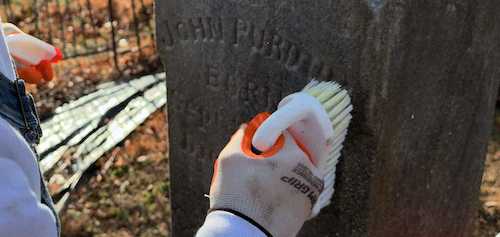
How Our Headstone Lettering Repair Process Works
- Chiseling Old Enamel Free of the Groove Old paint, dust, sap, or mold gets cleared mechanically out of each letter groove down to bare stone before anything else happens.
- Solvent-Rinsing the Channel Down to Bare Stone A solvent wash breaks down any remaining residue clinging to the sides of the groove so fresh enamel has clean stone to bond to.
- Making Sure No Moisture Is Left in the Groove Every groove is fully dried before painting, since solvent trapped under fresh enamel is a common reason repainted lettering fails early.
- Packing the Letters With Fresh Enamel A commercial-grade, weather-resistant enamel goes into the clean, dry groove, matched to the original letter depth and font.
- Polishing the Repaint and Posting the Result Excess paint gets polished off the surrounding stone, and finished photos post to our app for the family's records.
