
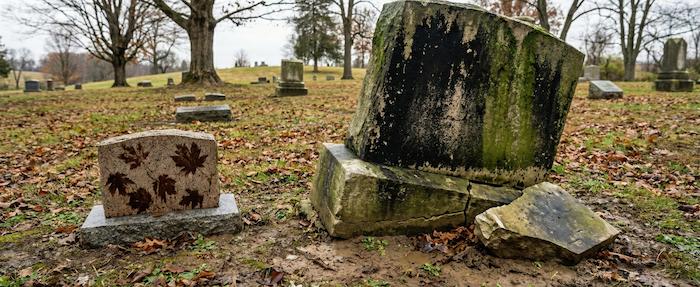
Walk through Holy Spirit Cemetery in Parma and the marble saints and carved crosses show more wear than the flat granite markers a few rows over. Parma's Byzantine Catholic and Orthodox families, many of Rusyn and Ukrainian descent, brought a tradition of ornate stone carving into these cemeteries decades ago. The folds in a robe or the lines of a carved beard hold grit and moisture that a plain granite face doesn't have to deal with. Clay soil that drains poorly combines with freeze-thaw cycling every winter, and the damage on these carved memorials looks different from what a flat marker down the road experiences. Snow that melts quickly off a smooth granite face lingers in these carved recesses, freezing and thawing against the stone dozens of times each winter. Families searching for headstone cleaning services near me in Parma are usually dealing with exactly this kind of detailed, weathered marble. Grave marker restoration here means working carefully around fine carving that most flat markers never have.

Carved Marble at St. Vladimir's and Holy Spirit Meets Big Creek Valley Clay
The ground under this part of Cuyahoga County is the same clay-heavy, slow-draining soil that feeds the Big Creek watershed toward the Cuyahoga River, and it shows up a few feet below the surface almost anywhere you check. That clay swells when saturated and pulls tight when it dries, and a heavy marble base or tall carved cross moves with it season after season. St. Vladimir's Cemetery and Holy Spirit Cemetery hold some of the densest concentrations of hand-carved marble monuments in the area, and their footings are usually the first to lean or sink. Freeze-thaw cycling through the winter compounds the movement, since saturated clay expands as it freezes and drags the footing sideways with it. A tilted monument here typically means the base pad settled unevenly under a top-heavy carved cross. Tending's crew resets the base and re-levels the stone through headstone repair and restoration, which stops the monument from working itself deeper into the clay each winter.
"Somehow I trusted that Tending would do a great job on my great great grandmother's very old and darkened headstone. They are the real deal. The work was done beautifully and it was so touching to see the headstone clean and readable again. Do not hesitate to hire Tending. They will bring your loved one's resting place shine again. "
— Louise Rosen Byer, Columbus, Ohio
Moss and Algae Take Hold in the Carved Marble Detail
The carved robes and wings on Parma's marble statuary hold moisture long after a flat granite face has dried off, and that trapped moisture feeds moss and algae in every fold, with black fungal staining showing up in the deepest recesses of the carving. A D/2 biological solution breaks down that growth without touching the calcite surface, and a soft tampico brush works the residue out of the deep carving by hand. For monuments with heavier lichen crusts, a quaternary ammonium biocide follows the D/2 treatment to keep regrowth from returning within the same season. Some of these family plots also carry bronze plaques or bronze icon markers set into the base, and the same damp conditions corrode the metal and streak green oxidation down onto the marble below. Tending handles both surfaces together through bronze marker restoration. Cleaning and resealing the metal keeps it from staining the stone next to it.
Acid Rain Erosion Wears Down Lettering at St. Theodosius and Parma Heights Cemetery
The fine incised lettering on these marble monuments erodes faster than lettering cut into granite because marble is calcite, and acid rain slowly dissolves the sharp edges of every carved letter and numeral. At St. Theodosius Cemetery and Parma Heights Cemetery, family names and dates from the early 1900s have softened into shallow, hard-to-read grooves. A chelating agent lifts the mineral crust built up in the letter grooves without widening them, and a consolidant stabilizes the granular surface before it sheds any more material. Parma's clay-heavy groundwater also leaves a faint white mineral film across lower sections of these monuments, which the same chelating treatment clears in the same visit. Tending restores that detail through headstone lettering repair, re-cutting worn edges while the original lines are still visible.
Service Costs in Parma
Pricing for monument restoration services in Parma is set before any work starts, through our online calculator. Pick the monument type (flat marker, upright headstone, carved statuary, or mausoleum) and a care plan, and the calculator returns a fixed price immediately. No on-site visit is required to get that number. Carved marble statuary is priced as its own category since these pieces take more shop time than a flat granite marker. The calculator also prices multi-piece monuments, like a marble base with a detached carved cross, as their own line item. Ongoing tombstone maintenance runs as a recurring plan billed at that same fixed rate.
- Marble statuary reset and re-leveling for clay-heave settling
- Biological growth removal and bronze marker restoration
- Acid rain erosion treatment and lettering repair