
Drive two hours from the sandstone hollows of Hocking County to the flat glacial plains around Lima, and the ground itself seems to belong to two different states. From lakeshore towns in the north to old coal country in the southeast, Tending handles headstone cleaning and restoration across all 7,747 of Ohio's cemeteries. Every visit runs under a $2,000,000 liability policy, with ICCFA membership standing behind the crew as well. None of that work looks the same from one part of the state to the next.
How Ohio's Geology and History Shape Headstone Care
Buried glacial valleys shift a monument's foundation in central and western Ohio. Lake Erie's humidity feeds algae and heavier bronze patina along the northern shore, and acid mine drainage in the southeastern hill country eats away at marble and limestone lettering.
Ohio's Buried Teays Valley and Headstone Restoration
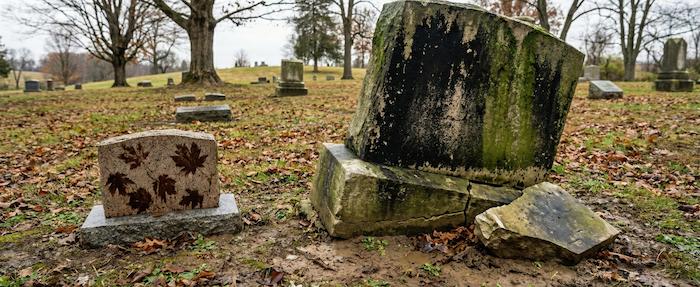
Long before the most recent ice sheet ground its way across the state, an ancient river system called the Teays cut a wide valley through what's now central and western Ohio. Glaciers buried the valley under thick, loose sediment. They never scoured it away, and the loose fill left behind never compacted into solid ground. The loose fill supplies groundwater to towns across the region today. The same structure drains water fast and shifts unevenly, season after season. A headstone base set into old valley fill settles unevenly over the decades, sometimes dropping several inches lower on one side before a family notices the lean. A cemetery can sit half on solid till and half on buried valley fill without any visible line between the two, so two rows a short walk apart can end up leaning at noticeably different angles within the same decade. Tending resets a settled base on compacted gravel, deep enough to reach ground that isn't still adjusting to old valley fill. The reset gets checked again after the next freeze cycle to confirm the new footing holds. Work at this scale falls under headstone repair and restoration, and it's usually the first call once a family notices the lean.
Lake Erie Humidity and Bronze Marker Restoration
Lake Erie is shallow enough to warm up fast every summer and give a lot of that heat back as evaporation. The moisture settles over towns along the southern shore and rarely clears out fully, even during a dry stretch. Winters add their own moisture on top: lake-effect snow piles up heavily in the eastern shoreline counties, and the slow spring melt keeps cemetery ground damp for weeks after the last snow is gone. Cemetery plots near the shoreline hold onto dampness for weeks at a time, and algae and lichen get plenty of room to spread across granite and limestone as a result. Bronze veterans' plaques sit in the same humid air, and the metal builds a heavier patina season after season. A soft-wash biocide treatment lifts algae and lichen without touching the polish underneath, and Tending's crew usually checks nearby bronze on the same visit. An older plaque near the shoreline is often left with a dull, uneven greenish cast once the surface growth is gone. Restoring a uniform finish on a plaque in that state falls under bronze marker restoration, and a properly resealed plaque can go several years before it needs attention again.
Appalachian Coalfield Acid Drainage and Headstone Lettering Repair
Southeastern Ohio's hill country was coal country for the better part of a century, and abandoned mines left more than empty tunnels behind. Groundwater moving through old mine workings in watersheds like Sunday Creek picks up sulfuric acid and dissolved iron along the way, and some of it eventually reaches the shallow water table under nearby cemeteries. The acidic runoff turns some local streambeds a visible rust-orange, and anyone who has spent time near the old mining towns of Athens and Perry counties has seen the color firsthand. Marble and limestone headstones downstream of these old mines lose their polish early. A name carved a century ago can turn nearly unreadable decades before the rest of the same stone starts to show real wear. Recutting worn lettering only works once the underlying acid exposure is addressed, since fresh grooves cut into acid-softened stone wear down again within a few seasons. Tending treats the surface first with a solution matched to the acidity already in the stone, then recuts and fills the lettering under Ohio's headstone lettering repair standards. A stone treated this way holds its depth for years before it needs attention again.