Old Farmland Drainage Tile Settles Grove City Headstones
Much of Grove City was farmland before it was anything else, flat, high-lime till plain that 19th-century farmers laced with clay drainage tile to make the naturally poorly drained ground workable. Several of the city's older cemeteries were carved straight out of those same fields, and the buried tile lines didn't go anywhere when the land changed use. Where a section of century-old clay tile has collapsed or clogged, water backs up underground with nowhere to route away. The soil above it settles unevenly as it saturates and drains in cycles no one can see from the surface.
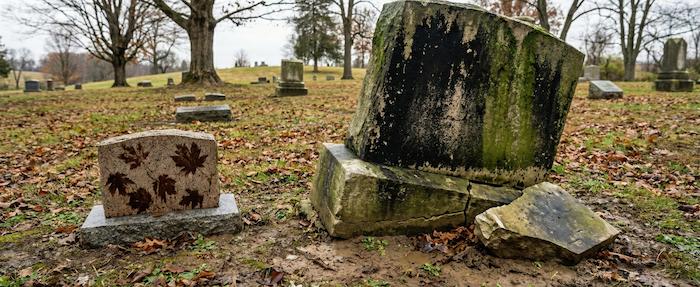
A headstone base sitting near one of these failed tile runs settles right along with the ground around it, usually with one corner dropping faster than the rest. Families running headstone cleaning services near me searches in Grove City sometimes describe a stone that's sunk on one side without any lean to explain it, which is exactly the pattern old tile failure produces. Tending checks for drainage issues before resetting an affected base, since resetting a stone without addressing standing water underneath just delays the same problem. A proper fix sometimes means rerouting a short section of drainage around the plot. Leveling the stone alone doesn't solve the underlying cause. Larger structural repairs are covered under headstone repair and restoration.

Quarry Dust from Nearby Limestone Operations Films Older Stone
Franklin County's aggregate industry runs plenty of limestone and gravel quarries within a short distance of Grove City, and fine limestone dust from crushing and hauling operations can drift onto nearby cemetery grounds over the years, especially on markers close to haul roads or pit boundaries. That dust settles into a headstone's pores as a thin, chalky gray film, different from ordinary dirt in that it doesn't rinse off with plain water the way surface grime does. The film tends to build gradually enough that families rarely notice it until a stone looks distinctly duller than its neighbors in the same row.
"Somehow I trusted that Tending would do a great job on my great great grandmother's very old and darkened headstone. They are the real deal. The work was done beautifully and it was so touching to see the headstone clean and readable again. Do not hesitate to hire Tending. They will bring your loved one's resting place shine again. "
— Louise Rosen Byer, Columbus, Ohio
Bronze veterans' plaques near the same routes pick up the same dust film, and it dulls the metal's finish in a way that looks more like tarnish than dirt at first glance. Tending removes quarry dust buildup with a cleaning approach suited to fine mineral particulate, not general grime, and cleans and restores bronze grave markers affected by the same dust on the same visit.
Level, Poorly Drained Ground Deepens Freeze-Thaw on Flat Markers
Franklin County's till plain is famously flat, and that flatness is part of the problem — water has nowhere to run off toward, so it sits directly on the ground surface for days after a storm without ever reaching a low point to drain toward. Flat, flush-mounted markers common in Grove City's newer cemetery sections sit right in that standing water, and each freeze locks moisture directly against the engraved surface. On an upright stone, that same moisture would sit lower down, against the base.
That direct contact wears lettering on flat markers faster than on upright ones nearby, since the freeze-thaw cycle reaches the inscription itself. The stone underneath takes the same exposure a level deeper. Families with flat family markers in older Grove City plots often notice the lettering going shallow well before the surrounding granite border shows any comparable wear. Tending recuts and repaints lettering worn shallow by this pattern, following headstone lettering repair standards adapted specifically for flush, ground-level markers.
Service Costs in Grove City
Pricing runs through Tending's online calculator once the monument type and care plan are selected, with no in-person visit needed to assess the damage first. A maintenance plan can be added for older sections built on former farmland that need periodic drainage checks.
- Base resetting and drainage correction: addressing settling tied to old farm-tile failure.
- Quarry dust removal: mineral-particulate cleaning for stone and bronze markers.
- Flat-marker lettering repair: recutting engraving worn by standing water and freeze-thaw.